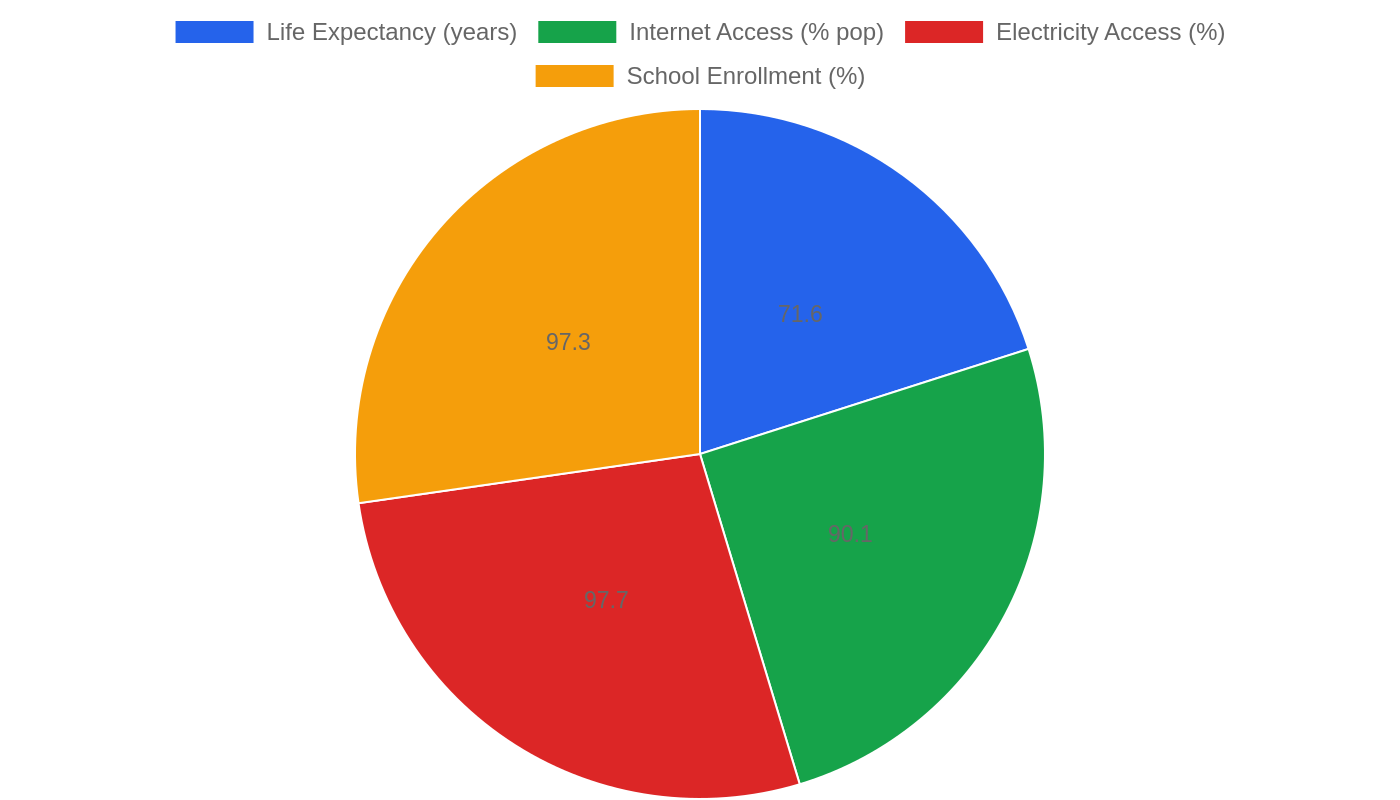
Economic Pulse Net | Sources: World Bank World Development Indicators, Government Sources | 2026
Key Takeaways
- Political Stability Amidst Monarchy: Jamaica operates as a stable parliamentary democracy and constitutional monarchy, with King Charles III serving as the head of state, represented locally by the Governor-General.
- Diversified Corporate Landscape: The nation’s business sector is anchored by major players in telecommunications, consumer goods, and financial services, including Digicel, Desnoes & Geddes, and CGM Gallagher.
- Tourism and Services as Pillars: A significant portion of the economy is driven by consumer services, with prominent entities like Beaches Resorts, Dolphin Cove, and the Bob Marley Museum highlighting the cultural and recreational strengths of the island.
- Data Constraints Limit Quantitative Analysis: Current World Bank indicators for GDP growth, inflation, and unemployment are not available in this dataset, necessitating a qualitative focus on structural and political frameworks rather than numerical economic performance.
The Structural Backbone of a Caribbean Economy
Understanding the economic pulse of Jamaica requires looking beyond immediate numerical indicators to the structural components that define its market.
While specific World Bank data points for GDP growth, inflation CPI, and unemployment rates are currently unavailable in this report, the composition of the nation’s primary industries offers a clear window into its economic character.
The economy is heavily weighted toward consumer services and tourism, a sector that leverages the island’s natural beauty and cultural heritage to generate revenue.
This reliance on the service sector means that economic health is closely tied to global travel trends, foreign exchange rates, and the stability of the hospitality infrastructure.
Furthermore, the presence of established firms in basic materials and telecommunications suggests a diversified industrial base that supports the broader consumer market.
Without current inflation or employment figures, analysts must rely on the stability of these core sectors to gauge economic resilience.
The absence of specific GDP per capita or GNI data prevents a precise comparison with regional peers, but the depth of the corporate sector implies a mature market with established supply chains.
Ultimately, the narrative of Jamaica’s economy is one of service-led growth, where the value of cultural assets and natural resources plays a pivotal role in sustaining national income.
Living Costs and Daily Expenses
While specific cost-of-living metrics such as rent indices or housing prices are not provided in the current data set, the nature of Jamaica’s top companies offers indirect insights into the consumer environment.
The prominence of consumer goods firms like Desnoes & Geddes and consumer service providers like Beaches Resorts indicates a robust domestic market for both luxury and everyday essentials.
In a service-oriented economy, daily expenses are often influenced by the availability of local produce and the cost of imported goods, which can fluctuate based on global commodity prices.
For residents, the cost of living is likely shaped by the balance between locally produced agricultural goods and imported manufactured items, a dynamic common in Caribbean island economies.
Without specific housing data, it is difficult to compare rent versus buy scenarios, but the existence of large resort chains suggests that the high-end tourism market commands premium pricing, which can ripple into general service costs.
The lack of specific inflation data means that consumers’ purchasing power is best understood through the stability of the major retail and service providers operating within the island.
The Corporate Powerhouse: Giants in Every Sector
The business climate in Jamaica is defined by a set of influential companies that dominate their respective sectors.
In telecommunications, Digicel stands as a critical infrastructure provider, ensuring connectivity that underpins both personal and commercial activities.
The financial sector is anchored by CGM Gallagher, which offers essential banking and insurance services to businesses and individuals alike.
On the consumer front, Desnoes & Geddes is a household name, particularly known for its beverage products, reflecting the strong cultural significance of local manufacturing.
The tourism sector is not just a collection of small operators but is supported by major entities like Beaches Resorts and Dolphin Cove Jamaica, which manage large-scale hospitality operations.
Additionally, the Gleaner Company represents the media and consumer services sector, providing essential information and connectivity to the populace.
These companies collectively form the economic spine of the nation, providing employment and driving local consumption.
Their stability and market presence suggest a business environment that, while facing global challenges, maintains a solid foundation of domestic corporate strength.
Governance, Safety, and the Political Framework
Jamaica’s political landscape is characterized by a stable parliamentary democracy operating under a constitutional monarchy.
The head of state is King Charles III, who is represented in the country by the Governor-General of Jamaica.
This constitutional arrangement provides a layer of continuity and institutional stability, with the Governor-General nominated by the Prime Minister and the Cabinet before formal appointment by the monarch.
All members of the Cabinet are appointed by the Governor-General on the advice of the Prime Minister, ensuring that the executive branch remains aligned with the elected government.
While specific crime and safety indices are not available in this dataset, the clarity of the political structure suggests a well-defined legal and governmental framework.
This system allows for the separation of ceremonial duties and executive power, a feature that has historically contributed to the stability of Caribbean nations.
The political environment, therefore, is one where democratic processes are maintained within a monarchical structure, offering a distinct governance model that balances tradition with modern democratic practice.
Navigating the Current Economic Landscape
In the absence of recent news headlines or live indicators detailing specific policy shifts or immediate business developments, the current economic narrative is defined by the steady operation of its core institutions.
The focus remains on the sustainability of the tourism and consumer service sectors, which continue to be the primary drivers of economic activity.
With no data on recent inflation trends or specific reform initiatives, the situation appears to be one of maintenance rather than rapid transformation.
The business environment is likely focused on adapting to global economic conditions while leveraging the strengths of its major corporations.
The political stability provided by the constitutional monarchy offers a predictable backdrop for long-term planning, even as short-term economic indicators remain opaque.
This period is characterized by the resilience of established firms like Digicel and Alpart, which continue to operate within the existing regulatory and market frameworks.
The current affair is less about dramatic change and more about the consistent delivery of services and goods by the nation’s top companies.
The Bottom Line
Jamaica presents a complex economic picture where the strength of its service sector and corporate giants offsets the lack of immediate quantitative data on growth and inflation.
Investors and observers should watch the performance of key players in telecommunications, finance, and tourism, as their stability is a proxy for broader economic health.
The political framework of a constitutional monarchy provides a stable governance environment, which is crucial for long-term business confidence.
While specific numbers on living costs and crime are unavailable, the depth of the local market suggests a mature economy capable of sustaining its population through diversified corporate activity.
Sources & Methodology
This article is authored by Economic Pulse Net for informational and research purposes.
Economic Pulse Net sources its data from multilateral institutions, national statistics bureaus, and proprietary databases.
All data is believed to be current as of the date of publication. Published: September 03, 2026 |
Category: Research — Jamaica
Use these signals in your own platform
Economic Pulse publishes its live signal feed through a documented, read-only API. Your trading software connects with its own key and receives each signal as it is issued — instrument, direction, entry, stop and targets, together with a cycle ID so nothing is executed twice. The feed is independent of this website and cannot change it.
Signals are informational only and are not financial advice.