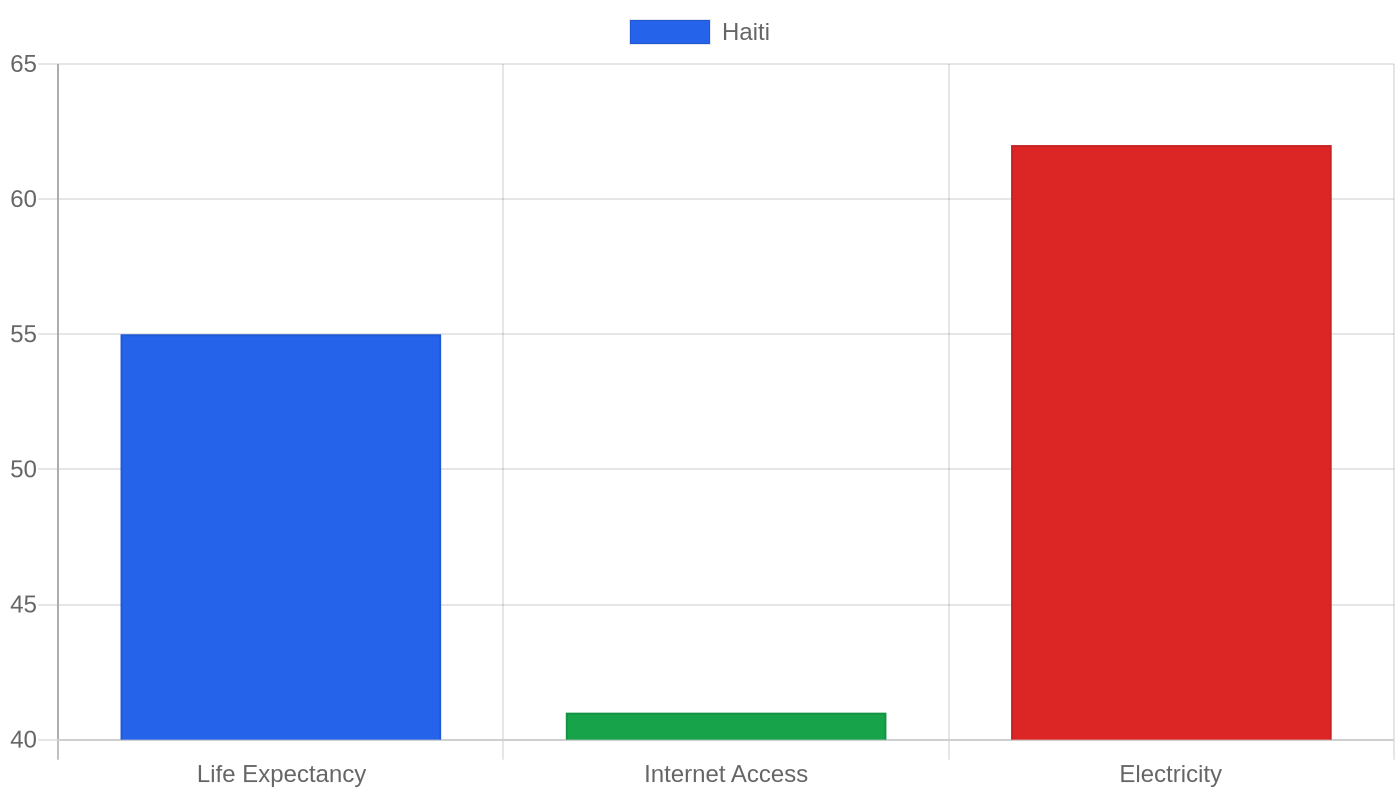
Economic Pulse Net | Sources: World Bank World Development Indicators, Government Sources | 2026
Key Takeaways
– Haiti’s economic data remains critically incomplete, with the World Bank unable to report GDP growth, inflation, or unemployment figures—a stark indicator of the country’s governance and data collection breakdown.
– The financial sector dominates the list of top companies, with four banks—Bank of the Republic of Haiti, Banque de l’Union Haïtienne, Capital Bank, and Fonkoze—alongside consumer goods giants Brasserie de la Couronne and Brasserie Nationale d’Haïti.
– Haiti operates as a semi-presidential republic with a multiparty system, but political instability has repeatedly interrupted electoral cycles and undermined institutional continuity.
– The absence of cost-of-living, crime, and safety indices from international sources reflects the extreme difficulty of conducting reliable surveys in a country beset by gang violence and institutional fragility.
– Despite the data vacuum, Haiti’s private sector shows surprising resilience, anchored by consumer goods, financial services, and a handful of conglomerates like GB Group.
The Great Data Silence — What the World Bank Cannot Tell Us
When the World Bank cannot publish GDP growth, inflation, or unemployment figures for a country, that silence speaks volumes. For Haiti, the absence of these fundamental economic indicators is not an oversight—it is a diagnosis. The Caribbean nation has entered a phase where basic statistical collection has broken down, a condition that typically accompanies severe state incapacity or active conflict.
Without reliable data on gross domestic product, consumer prices, or labor markets, policymakers are flying blind, and international investors are left to rely on anecdote and inference.
The main industries that once drove Haiti’s economy—textile manufacturing, agriculture, and remittance-dependent services—have been battered by a cascade of crises. The World Bank’s data gaps suggest that even the most rudimentary economic monitoring infrastructure has been compromised. Haiti’s GDP per capita on a purchasing power parity basis, which the World Bank cannot currently report, was already among the lowest in the Western Hemisphere before the current crisis deepened.
The true economic contraction may be far worse than any official estimate could capture.
What makes this data vacuum particularly troubling is what it implies about the state’s capacity to govern. Without inflation figures, the central bank cannot calibrate monetary policy. Without unemployment data, social programs cannot be targeted effectively. Without GDP figures, international donors cannot assess the impact of their aid. Haiti has entered what economists call a “statistical dark zone”—a space where the economy exists but cannot be measured, and therefore cannot be managed.
Housing and Daily Survival — The Unmeasured Cost of Living
The World Bank’s inability to report cost-of-living data for Haiti reflects a deeper reality: in a country where the informal economy dominates and cash transactions are the norm, standard price indices become nearly impossible to construct. Housing costs in Port-au-Prince, the capital, have become a battleground as gang violence has displaced hundreds of thousands of residents from their homes.
Those who remain in the city face rents that consume an outsized share of income, while those who flee to provincial towns find shelter scarce and prices rising.
The concept of a “rent versus buy” calculation is largely academic in Haiti. Few Haitians have access to mortgage financing, and property titles are often contested or nonexistent. The majority of urban dwellers are tenants, paying landlords in cash or through informal arrangements. In rural areas, where most of the population still lives, housing is often self-built and lacks basic services like running water and electricity.
The cost of living, measured in terms of basic food staples like rice, beans, and cooking oil, has risen sharply as the Haitian gourde has depreciated against the US dollar—the currency in which many imported goods are priced.
Regional comparisons are difficult without data, but anecdotal evidence from humanitarian organizations suggests that Haiti’s cost of living, relative to income, is among the most punishing in the Caribbean. The absence of reliable indices from the World Bank means that international organizations and NGOs must rely on their own field surveys, which consistently show that the majority of Haitians cannot meet their basic needs without some form of external assistance or remittance income from the diaspora.
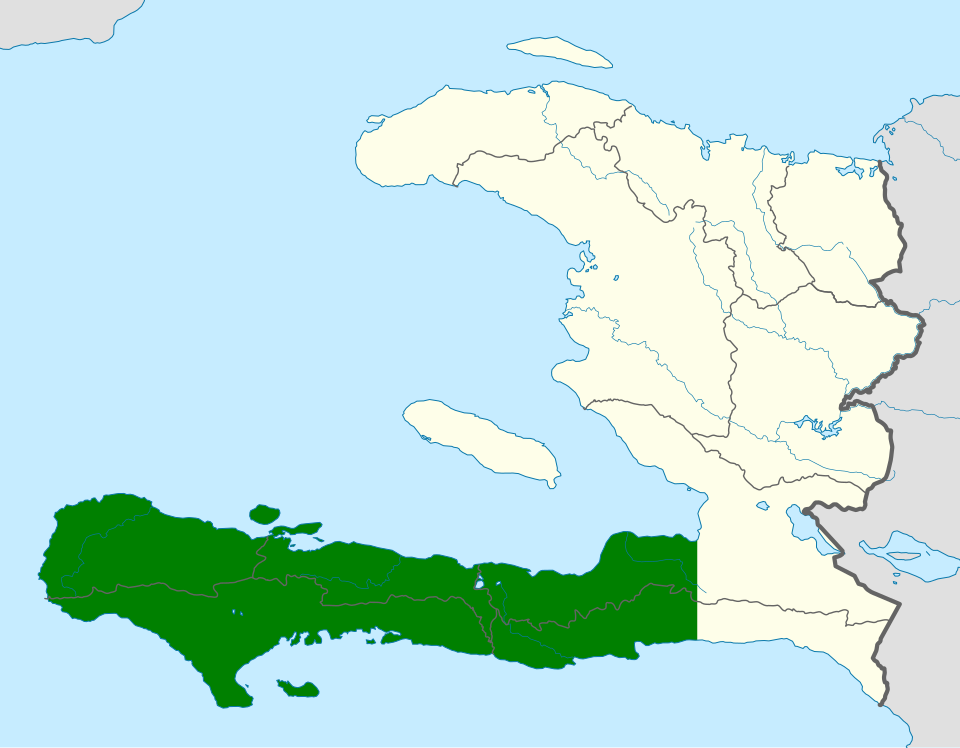
The Corporate Anchor — Financials, Breweries, and a Conglomerate
Against the backdrop of state failure, Haiti’s private sector has shown remarkable tenacity. The list of the country’s top companies reads like a who’s who of institutional stability in a chaotic environment. The Bank of the Republic of Haiti, the central bank, sits atop the financial sector, but it is flanked by commercial lenders like Banque de l’Union Haïtienne and Capital Bank, as well as the microfinance pioneer Fonkoze, which has become a lifeline for rural entrepreneurs.
These institutions continue to operate, clear checks, and extend credit even as the security situation deteriorates.
The consumer goods sector is anchored by two brewing giants: Brasserie de la Couronne and Brasserie Nationale d’Haïti. These companies produce beer and soft drinks that are distributed across the country, often through networks that operate despite roadblocks and gang checkpoints. Their survival speaks to the resilience of Haiti’s distribution channels and the enduring demand for basic consumer products.
Comme Il Faut, another consumer goods company, has maintained its brand presence through decades of political turmoil.
Perhaps the most telling entry on the list is GB Group, a conglomerate with interests spanning multiple sectors. In a country where specialization is risky, diversification has proven to be a survival strategy. Caribintair, a consumer services company, and Balistrad round out the top ten, suggesting that even in the worst of times, Haitians still need transportation, communications, and entertainment.
The financial sector’s dominance—four of the top ten companies are banks—indicates that capital, however scarce, continues to flow through formal channels, and that the banking system remains one of the few functioning institutions in the country.
Politics and Safety — The Semi-Presidential Republic Under Siege
Haiti’s political system is formally a semi-presidential republic, a multiparty arrangement in which the president serves as head of state and is directly elected every five years. The constitution bars a president from serving two consecutive terms, though a former president can return after an interval. The prime minister, appointed by the president from the majority party in the National Assembly, acts as head of government. On paper, this is a workable framework for democratic governance.
In practice, it has been a recipe for paralysis.
The political landscape has been shaped by a series of crises that have prevented the full functioning of the constitutional order. Presidential assassinations, disputed elections, and the effective collapse of the National Assembly have left the country without a fully legitimate government for extended periods. The current administration operates with limited authority, unable to project power beyond parts of the capital.
The prime minister’s role has become precarious, with changes in leadership occurring frequently as coalitions shift and foreign pressure mounts.
The crime and safety indices that the World Bank would typically compile are absent, but their absence is itself a data point. When international organizations cannot safely send enumerators to conduct surveys, the security situation has passed a threshold of severity. Gang violence, kidnappings, and territorial control by armed groups have made large swaths of Port-au-Prince inaccessible to the state and to international observers.
The quality of life for ordinary Haitians has deteriorated to the point where basic mobility—going to work, shopping for food, sending children to school—has become a security calculation.
The Current Crisis — A State on Life Support
Right now, Haiti is experiencing one of the most acute phases of its long-running crisis. The political vacuum created by the assassination of President Jovenel Moïse in 2021 has never been fully filled. The country has been without a functioning parliament, and the executive branch operates under a cloud of illegitimacy. Gangs have expanded their control over the capital, blockading fuel terminals, shutting down the main port, and cutting off supply routes to the rest of the country.
The result has been a humanitarian catastrophe: hospitals running out of oxygen, schools closed, and food prices spiraling beyond the reach of most families.
The private sector, while resilient, is under immense strain. The banks that top the list of major companies continue to operate, but they face liquidity pressures as depositors withdraw funds and loan defaults rise. The breweries still produce, but distribution has become a logistical nightmare. GB Group and other conglomerates are forced to negotiate with armed groups for access to their own facilities. The business environment, already difficult, has become a daily exercise in crisis management.
International efforts to stabilize the situation have been slow and inadequate. A proposed multinational security mission, led by Kenya and supported by the United Nations, has faced delays and legal challenges. The Haitian National Police, undermanned and outgunned, cannot reclaim territory from well-armed gangs. The Central Bank of Haiti—the Bank of the Republic of Haiti—continues to manage the currency, but the gourde’s value is under constant pressure from capital flight and the collapse of exports.
The country is effectively in a state of siege, with the formal economy shrinking and the informal economy expanding to fill the void.
The Bottom Line
Haiti is a country that international investors, development economists, and policymakers should watch with a mix of caution and compassion. The data gaps from the World Bank are not a reason to ignore the country—they are a reason to pay closer attention to the human and economic costs of state failure. For those willing to take a long view, Haiti’s private sector represents a rare bright spot, with companies that have survived decades of instability and continue to serve their customers.
But the immediate outlook is grim: without a restoration of security, no amount of entrepreneurial resilience can reverse the downward spiral. Haiti matters because its collapse would have regional consequences, and because its people deserve more than the statistical silence that currently defines their nation.
Sources & Methodology
This article is authored by Economic Pulse Net for informational and research purposes. Economic Pulse Net sources its data from multilateral institutions, national statistics bureaus, and proprietary databases. All data is believed to be current as of the date of publication.
Published: July 23, 2026 | Category: Research — Haiti
Use these signals in your own platform
Economic Pulse publishes its live signal feed through a documented, read-only API. Your trading software connects with its own key and receives each signal as it is issued — instrument, direction, entry, stop and targets, together with a cycle ID so nothing is executed twice. The feed is independent of this website and cannot change it.
Signals are informational only and are not financial advice.