Economic Pulse Net | Sources: World Bank World Development Indicators, Government Sources | 2026
🇭🇹 Haiti 2026 — A Nation’s Economy Awaits Its Moment
Key Takeaways
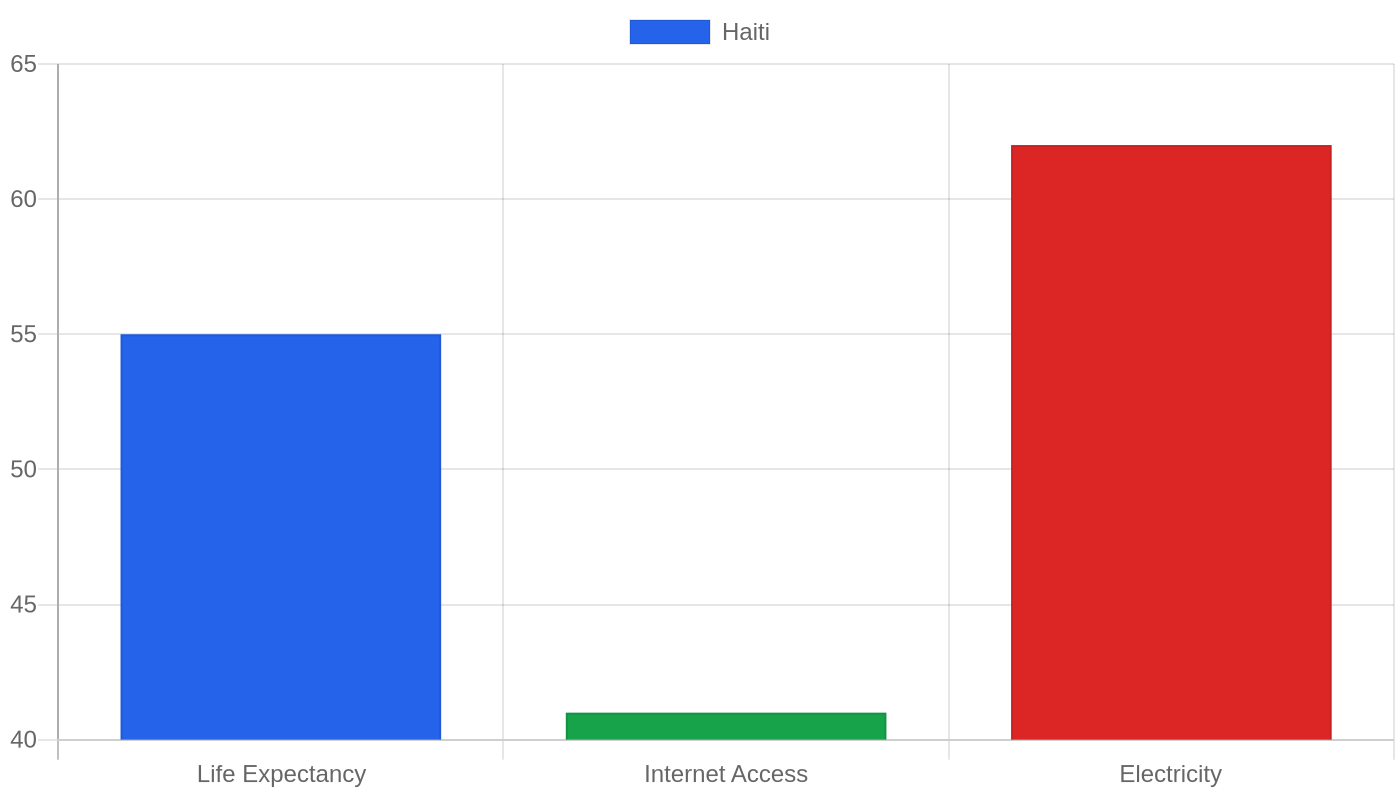
– Haiti’s headline economic indicators — GDP growth, inflation, unemployment, and GDP per capita — remain unavailable in the latest World Bank data, a statistical blackout that itself tells a story about the country’s instability.
– The economy is anchored by a small cluster of banks, beverage producers, and conglomerates, including the Bank of the Republic of Haiti, Brasserie Nationale d’Haïti, and the GB Group.
– A semi-presidential political system with a president as head of state and a prime minister as head of government shapes every business decision, from licensing to lending.
– With no verifiable crime, safety, or cost-of-living figures published, Haiti remains one of the hardest countries in the hemisphere for investors to read — and one of the most consequential to watch.
An Economy Running on Sparse Data and Durable Institutions
The first thing any serious analyst notices about Haiti’s economic dashboard is what’s missing. The World Bank’s latest figures for GDP growth, inflation, unemployment, GDP, GDP per capita at purchasing power parity, GNI per capita, and even total population are all listed as not available. That is not a rounding error or a reporting delay — it is a symptom.
When a country’s statistical apparatus cannot produce routine national accounts, it usually means the institutions that gather and publish those numbers are themselves under strain.
What the data does show is the skeleton of a private economy that has survived decades of shocks. The corporate roster is dominated by financial institutions — the Bank of the Republic of Haiti, Banque de l’Union Haïtienne, Capital Bank, and the microfinance-oriented Fonkoze — alongside consumer goods players like Brasserie Nationale d’Haïti, Brasserie de la Couronne, and Comme Il Faut, and the diversified GB Group.
These are not speculative ventures; they are long-standing operators that have learned to function in an environment where formal statistics are scarce and informal networks matter enormously.
That structure matters for anyone trying to understand growth. When banks and brewers are the biggest names in town, it suggests an economy where credit and consumption, not industrial production or export manufacturing, drive activity. Without published inflation or employment numbers, the World Bank data cannot tell us whether household purchasing power is rising or falling — but the composition of the corporate landscape hints at an economy oriented toward serving a domestic market with limited external reach.
Cost of Living: The Numbers Haiti Doesn’t Publish
There is no published cost-of-living index for Haiti in the data provided, and no rent-versus-buy comparison to cite. That absence is itself informative. In most countries, housing and daily expenses are tracked by national statistics offices and reported quarterly; in Haiti, that pipeline is not delivering figures that make it into the World Bank’s public tables.
For a journalist, the honest approach is to say so plainly rather than borrow numbers from a neighbor. What can be said is that the businesses that dominate the landscape — beverage makers, consumer goods firms, banks — are the kind that depend on a broad base of household spending. Brasserie Nationale d’Haïti and Brasserie de la Couronne do not thrive in an economy where ordinary families have no discretionary income.
Their continued presence on any list of top companies suggests a consumer market that, however strained, remains large enough to sustain national brands.
Regional comparison is equally difficult. The data provided does not include Caribbean or Latin American averages for housing, food, or utilities, so any claim that Haiti is cheaper or more expensive than its neighbors would be invention rather than reporting. The responsible conclusion is that Haiti’s cost of living is a genuine unknown in the published record — and that the first institution to produce reliable figures will have done the country a real service.
Investment Climate: Banks, Brewers, and a Conglomerate
If you were to draw an investment map of Haiti from the available data, it would have three poles. The first is finance: the Bank of the Republic of Haiti, Banque de l’Union Haïtienne, Capital Bank, and Fonkoze. The second is consumer goods: Brasserie Nationale d’Haïti, Brasserie de la Couronne, and Comme Il Faut. The third is the GB Group, a conglomerate whose very existence suggests that in Haiti, diversification is not a strategy but a survival mechanism.
Notably absent from the top-companies list are any mining, energy, telecommunications, or export-manufacturing giants. That is a striking omission for a country of Haiti’s size and location. It implies that the sectors that typically attract foreign direct investment — extractives, infrastructure, telecoms — are either dominated by state entities, operated by foreign firms not captured in this dataset, or simply too risky for the scale of capital required.
For a prospective investor, the practical takeaway is that Haiti’s formal private sector is narrow and relationship-driven. The presence of a microfinance institution like Fonkoze alongside commercial banks suggests a two-tier financial system: one serving established corporates, another reaching smaller borrowers. The beverage makers indicate that branded consumer staples can work at scale.
But without published GDP, inflation, or unemployment data, no investor can build a credible discounted cash flow model — which is precisely why the country’s business climate remains, for most global capital, a watchlist item rather than a destination.
Politics, Safety, and the Unmeasured Quality of Life
Haiti’s political system is a semi-presidential republic with a multiparty structure. The president serves as head of state, elected directly by popular vote every five years, and cannot serve two consecutive terms or more than two terms in total — though a second term is possible after an interval. The prime minister acts as head of government, appointed by the president from the majority party in the National Assembly.
That design creates an inherent tension. When the president and the parliamentary majority are aligned, governance can move; when they are not, the prime minister becomes a lightning rod and the executive branch can stall. For businesses, this means regulatory decisions, contracts, and appointments can shift with each political cycle, making long-term planning unusually difficult.
On safety, the data provided offers no crime index and no safety index — both listed as not available. That is a significant gap for a country where security conditions are widely understood to shape daily life. Without published indices, this article cannot responsibly state a crime rate, a safety score, or a happiness ranking.
What can be said is that the absence of these measurements leaves Haiti’s quality of life — from personal security to public services — outside the standard international benchmarking system, which in turn affects everything from insurance premiums to tourism receipts.
What’s Happening Now: A Country in Statistical and Political Transition
The most current signal in the data is not a number but a structure. Haiti’s semi-presidential framework, with its five-year presidential terms and its ban on consecutive re-election, is the constitutional machinery through which any near-term economic reform must pass. The appointment of a prime minister from the majority party in the National Assembly is the pivotal event to watch — it determines whether the executive can legislate or will be forced into compromise.
At the same time, the World Bank’s blank fields for growth, inflation, and unemployment are not static. They represent a live gap that international institutions, the national statistics office, and Haiti’s financial sector all have an interest in closing. The presence of a functioning central bank — the Bank of the Republic of Haiti — on the top-companies list indicates that monetary authority exists and operates, even if its published indicators are not flowing into global databases.
For observers, the near-term story is therefore twofold. Politically, the question is whether the president and the National Assembly can produce a stable prime minister and a working government. Economically, the question is whether that government can restore the statistical pipeline — the inflation prints, the jobs surveys, the GDP estimates — that would allow Haiti to be seen, measured, and invested in.
Until both happen, the country’s top companies will continue to operate in a fog that their own longevity proves they can navigate, but which keeps almost everyone else on the sidelines.
The Bottom Line
Haiti is a country where the private sector is more legible than the public data — a handful of banks, brewers, and a conglomerate carry on while the World Bank’s indicator table sits largely empty. For investors, the message is caution: without published growth, inflation, or employment figures, Haiti is a relationship market, not a spreadsheet market.
For policymakers and development institutions, the priority is clear — rebuilding the statistical and political machinery that would let the world see Haiti’s economy as it actually is. Watch this country not for its numbers, but for the moment its numbers return.
Sources & Methodology
This article is authored by Economic Pulse Net for informational and research purposes. Economic Pulse Net sources its data from multilateral institutions, national statistics bureaus, and proprietary databases. All data is believed to be current as of the date of publication.
Published: September 23, 2026 | Category: Research — Haiti
Use these signals in your own platform
Economic Pulse publishes its live signal feed through a documented, read-only API. Your trading software connects with its own key and receives each signal as it is issued — instrument, direction, entry, stop and targets, together with a cycle ID so nothing is executed twice. The feed is independent of this website and cannot change it.
Signals are informational only and are not financial advice.