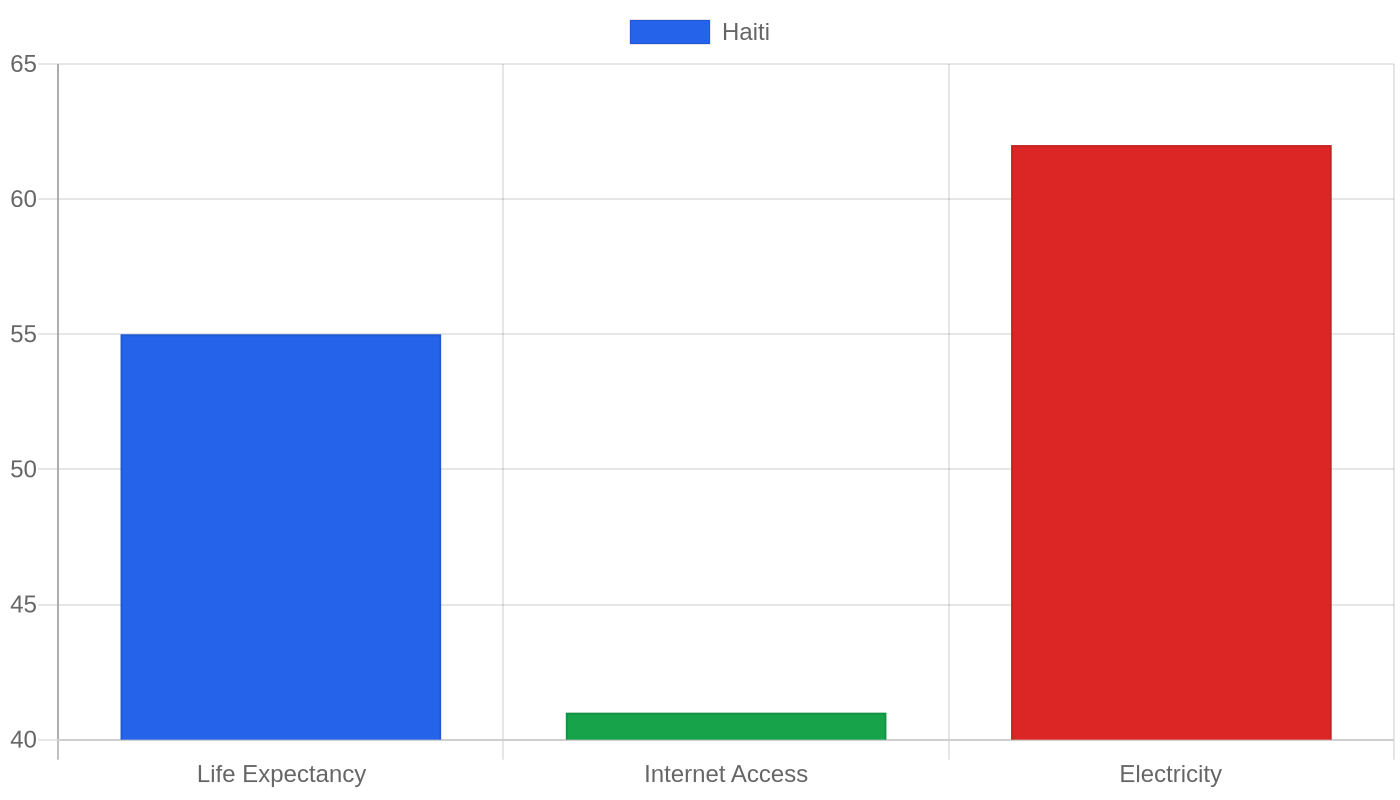
Economic Pulse Net | Sources: World Bank World Development Indicators, Government Sources | 2026
Key Takeaways
– Political Structure in Transition: Haiti operates as a semi-presidential republic with a multiparty system, where the President is directly elected every five years and cannot serve consecutive terms, creating periodic shifts in governance.
– Financial Sector Anchors the Economy: Despite profound challenges, Haiti’s banking and consumer goods sectors remain active, with institutions like the Bank of the Republic of Haiti and Fonkoze playing critical roles in the formal economy.
– A Story of Resilience: The country’s economic data remains largely unquantified by the World Bank, yet its business landscape—from breweries to conglomerates—tells a story of persistent private-sector activity amid instability.
– Governance Rules Shape the Future: The constitutional framework, which appoints a Prime Minister from the majority party in the National Assembly, creates a dynamic where political negotiation is as important as economic policy.
– A Nation to Watch: For investors, development economists, and regional analysts, Haiti represents a high-risk, potentially high-reward environment where the fundamentals are unclear but the human capital is undeniable.
The Invisible Economy — Why Haiti’s Numbers Remain a Mystery
The World Bank’s latest data on Haiti presents a striking void: GDP growth is unrecorded, inflation figures are absent, unemployment statistics are unavailable, and even population numbers lack recent verification. For most countries, such a data vacuum would be a statistical footnote. For Haiti, it is a statement in itself.
When an economy operates so far outside formal measurement channels, it suggests that a significant portion of activity happens in informal markets, barter systems, and cash transactions that never reach a government ledger.
This absence of hard numbers does not mean the economy is static. On the contrary, the persistence of major financial institutions—the Bank of the Republic of Haiti, Banque de l’Union Haïtienne, Capital Bank, and Fonkoze—indicates that formal banking continues to function, serving businesses and individuals who still see value in institutional finance.
Fonkoze, notably, has carved a niche as a microfinance institution, suggesting that grassroots economic activity remains vibrant even when macroeconomic indicators are unavailable. The consumer goods sector, represented by Brasserie de la Couronne and Brasserie Nationale d’Haïti, points to domestic manufacturing and distribution networks that continue to operate. When breweries are running, people are buying, selling, and consuming—the economy is moving, even if the official metrics cannot capture it.
The World Bank’s silence on Haiti’s economic data is less a reflection of a dead economy and more a signal that the mechanisms for data collection have been disrupted, leaving analysts to piece together the country’s financial health from corporate activity and on-the-ground observation.
The Price of Daily Life — Housing and Survival Costs in an Unmeasured Market
Without official cost-of-living indices from the World Bank, understanding the financial burden on Haitian households requires reading between the lines. The presence of consumer goods companies like Comme Il Faut and the conglomerate GB Group suggests that there is a market for discretionary goods—cigarettes, beverages, and packaged products—which implies that at least a segment of the population has disposable income beyond subsistence. However, the absence of formal housing data is telling.
In economies where the state cannot reliably measure inflation or GDP, housing markets are often driven by informal arrangements, land tenure disputes, and cash-only transactions, making rental prices and property values highly localized and volatile.
What can be inferred is that the cost of living in Haiti is shaped by import dependence and infrastructure challenges. When domestic production is limited to a few industries—beverages, basic consumer goods, and financial services—everything else must be brought in from abroad, subjecting prices to currency fluctuations and supply chain disruptions. The average citizen likely spends a significant portion of their income on food, transportation, and housing, with little buffer for savings.
The existence of Caribintair, a consumer services company, suggests that even domestic air travel exists as a niche service, but for the majority, daily life is a negotiation between limited formal employment and the informal economy. The gap between what official statistics should tell us and what they actually reveal is itself a commentary on the lived experience of Haitians, who navigate an economy where prices are known to be high but are rarely systematically recorded.
Business in a Broken System — Where Capital Still Flows
The list of Haiti’s top companies reads like a testament to endurance. Balistrad in consumer services, the financial trio of Bank of the Republic of Haiti, Banque de l’Union Haïtienne, and Capital Bank, and the manufacturing might of Brasserie de la Couronne and Brasserie Nationale d’Haïti—these are not speculative ventures. They are established firms that have weathered political upheaval, natural disasters, and economic uncertainty.
Their survival suggests that there is a core of Haitian business acumen that understands how to operate in an environment where the state’s role is unpredictable. The GB Group, as a conglomerate, likely spans multiple sectors, providing a hedge against instability in any single industry.
For an investor considering Haiti, the landscape is one of extreme caution but also of opportunity. The financial sector remains the most formalized, with banks that continue to serve both corporate and retail clients. Fonkoze’s presence is particularly noteworthy—microfinance in Haiti is not a charitable side project but a lifeline for small entrepreneurs who cannot access traditional banking.
This suggests that beneath the surface of missing macroeconomic data, there is a vibrant ecosystem of small-scale capitalism waiting for stability to unlock its potential. The business climate, however, is defined by risk management rather than growth strategies. Companies in Haiti do not plan for expansion; they plan for resilience. They maintain liquidity, diversify their operations, and build relationships that transcend political cycles.
For those willing to accept the risk, the potential returns could be significant, but the barriers—security, infrastructure, and legal predictability—remain formidable.
The Politics of Survival — Governance, Security, and the Quality of Life
Haiti’s political system is designed for rotation, not consolidation. The semi-presidential republic structure, with a president elected for five-year terms and barred from consecutive re-election, creates a governance cycle that prioritizes change over continuity. The Prime Minister, appointed from the majority party in the National Assembly, ensures that executive power is shared between the presidency and the legislature.
This system was designed to prevent authoritarianism, but in practice, it can lead to gridlock, as no single leader has the mandate to push through long-term economic reforms. The absence of crime and safety indices from the World Bank is itself a worrying indicator—when international organizations cannot or will not measure public safety, it often means that the situation on the ground is too volatile for reliable assessment.
Quality of life in Haiti is shaped by this political uncertainty. The constitutional limits on presidential power mean that every five years, the country faces a potential recalibration of policies, alliances, and priorities. For citizens, this translates into a life of adaptability, where personal networks and community ties matter more than government programs. The lack of data on happiness or well-being is consistent with a country where daily survival takes precedence over life satisfaction surveys.
Yet, the continued existence of consumer services companies and the cultural products of firms like Comme Il Faut suggest that Haitians still seek enjoyment, social connection, and normalcy. The political system may be fragile, but the social fabric demonstrates a resilience that data cannot capture.
The Moment Now — Haiti’s Uncertain Path Forward
The most current information available paints a picture of a country in flux, where the constitutional framework remains the only constant. The government structure—a semi-presidential republic with a multiparty system—continues to function on paper, even as the realities on the ground test its limits.
The World Bank’s inability to provide updated economic figures for Haiti is not just a data gap; it is a reflection of the challenges facing data collection in an environment where state institutions struggle to reach all corners of the territory. The banking sector’s persistence, particularly the continued operation of institutions like the Bank of the Republic of Haiti, suggests that monetary policy is still being conducted, even if its effects are difficult to measure.
For the Haitian people, the current moment is defined by a paradox: the formal economy shows signs of life through its companies, yet the absence of reliable data makes it impossible to know whether conditions are improving or deteriorating. The political landscape, with its regular elections and term limits, offers a mechanism for change, but change alone does not guarantee progress.
The next election cycle will be a critical test of whether Haiti’s democratic institutions can channel public frustration into constructive governance. For regional observers, development agencies, and international investors, Haiti remains a country where the official story is incomplete, but the human story is compelling. The businesses that continue to operate, the banks that continue to lend, and the people who continue to build are the real indicators of Haiti’s future.
The Bottom Line
Haiti is not a country for the faint-hearted investor or the policy analyst who demands clean data. It is a country for those who understand that resilience is an economic indicator in itself. The World Bank may not have the numbers, but the continued operation of major financial institutions, breweries, and conglomerates tells a story of a private sector that refuses to quit. For development economists, Haiti offers a case study in how economies function when formal measurement breaks down.
For investors, it presents a high-risk, high-reward frontier where early entry could yield outsized returns if stability ever takes hold. Watch Haiti not for what it is today, but for what it could become if its political system and private sector ever align.
Sources & Methodology
This article is authored by Economic Pulse Net for informational and research purposes. Economic Pulse Net sources its data from multilateral institutions, national statistics bureaus, and proprietary databases. All data is believed to be current as of the date of publication.
Published: August 18, 2026 | Category: Research — Haiti
Use these signals in your own platform
Economic Pulse publishes its live signal feed through a documented, read-only API. Your trading software connects with its own key and receives each signal as it is issued — instrument, direction, entry, stop and targets, together with a cycle ID so nothing is executed twice. The feed is independent of this website and cannot change it.
Signals are informational only and are not financial advice.