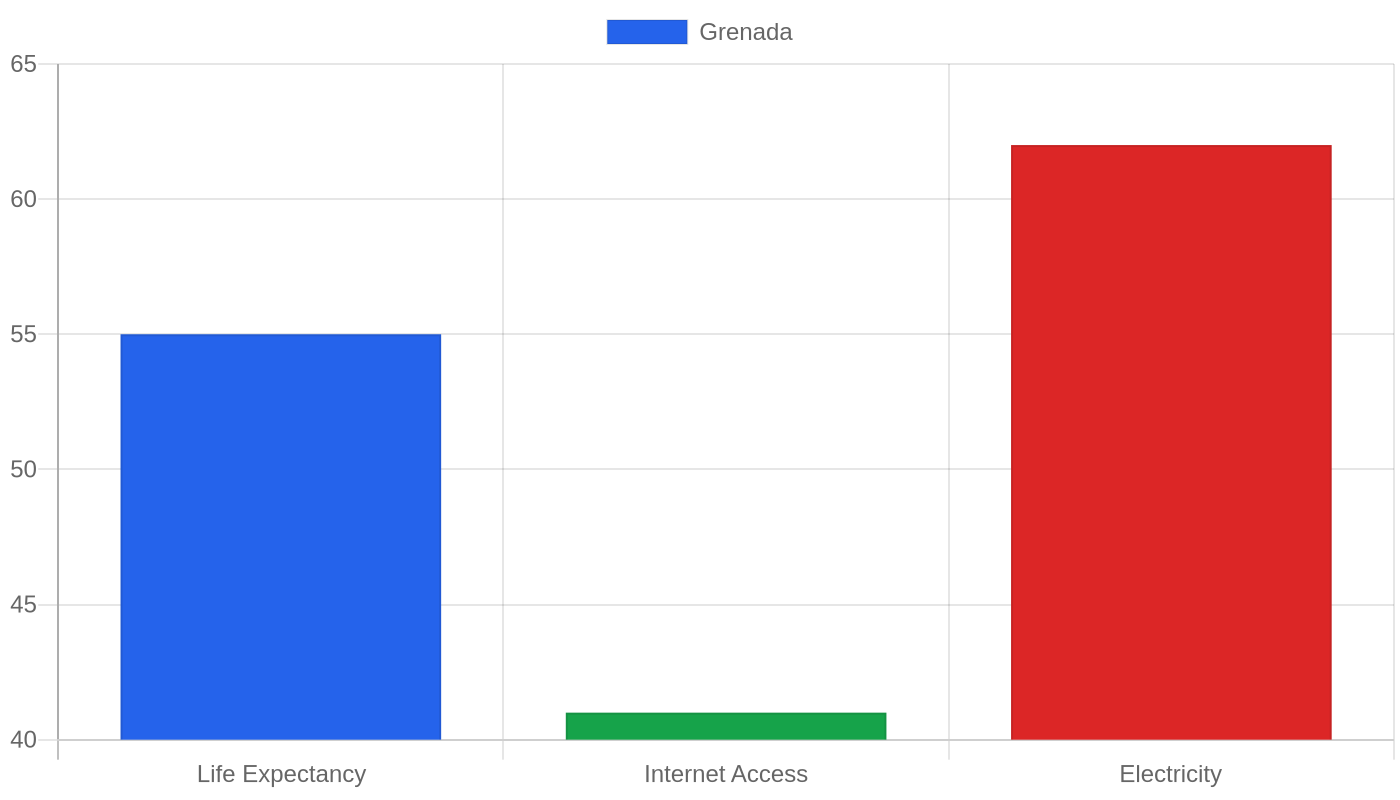
Economic Pulse Net | Sources: World Bank World Development Indicators, Government Sources | 2026
Key Takeaways
– Grenada operates as a constitutional monarchy under King Charles III, with a governor-general performing ceremonial duties while the prime minister, as head of government, holds executive power and typically leads the largest party in parliament.
– The country’s economic data remains largely unreported by major international institutions, making independent analysis difficult and leaving investors and policymakers with significant information gaps.
– Grenada’s political stability under a Westminster-style parliamentary system provides a predictable governance framework, though the absence of updated economic indicators complicates assessment of current conditions.
– The nation’s identity as “the Spice Island” — historically tied to nutmeg, mace, and cocoa — continues to shape its economic profile, though modern diversification remains an open question without detailed industry data.
The Missing Numbers: Grenada’s Economic Puzzle
Grenada presents an unusual challenge for economic observers. The World Bank, typically the gold standard for cross-country comparisons, offers no recent data on the country’s GDP growth, inflation rate, unemployment figures, or total economic output. This silence is itself a story — one that speaks to the difficulties small island developing states face in maintaining robust statistical infrastructure.
Without GDP figures, it is impossible to calculate whether Grenada’s economy is expanding, contracting, or stagnating. The absence of inflation data means households and businesses cannot gauge the erosion of purchasing power. Unemployment statistics, when unavailable, leave policymakers navigating blind.
The World Bank’s gaps may reflect reporting delays, resource constraints within Grenada’s national statistics office, or simply the reality that small economies often fall through the cracks of global data collection.
What the available information does confirm is Grenada’s constitutional structure: a parliamentary democracy within the Commonwealth realm, where the prime minister serves as the effective head of government. This political framework has historically provided stability — a critical factor for any economy, but especially for a small island nation vulnerable to hurricanes, tourism fluctuations, and global commodity price swings.
The spice trade, particularly nutmeg and mace, has long been Grenada’s calling card, but without current production or export data, the health of this sector remains uncertain.
The Cost of Island Living: Housing and Daily Expenses
For anyone considering a move to Grenada or investing in property, the cost of living picture is frustratingly incomplete. No official data exists on housing costs, rental markets, or the relative affordability of buying versus renting. This information vacuum is particularly acute given Grenada’s dual identity as both a local community and an emerging destination for second-home buyers and remote workers.
What can be inferred from the broader Caribbean context is that island nations typically face elevated costs for imported goods, construction materials, and energy. Grenada, lacking major domestic manufacturing or oil reserves, almost certainly experiences price premiums on everything from electronics to vehicles to building supplies.
Food costs are likely influenced by the local agricultural sector — spices, tropical fruits, and vegetables grown on the island — but processed and packaged goods would carry import markups.
Without rental indices or price comparison data, prospective residents must rely on anecdotal reports and real estate listings rather than systematic analysis. The absence of this information creates uncertainty for both locals planning their household budgets and foreign investors evaluating property opportunities. A country that cannot track its own cost of living faces challenges in attracting the talent and investment it needs to grow.
Investment Climate: Opportunities in the Shadows
Grenada’s business environment operates without the benefit of transparent economic indicators, yet the country’s political system provides a degree of predictability that investors typically value. The constitutional monarchy framework, with the prime minister wielding executive authority, has historically delivered stable transitions of power and policy continuity — essential ingredients for long-term business planning.
The absence of a list of top companies or major employers is a significant gap. Without knowing which firms drive Grenada’s economy — whether tourism operators, agricultural exporters, financial services providers, or construction companies — it is impossible to identify growth sectors or assess market concentration. Potential investors cannot benchmark themselves against existing players or evaluate competitive dynamics.
Sectors to watch would logically include tourism, given Grenada’s beaches, diving sites, and cultural attractions; agriculture, particularly nutmeg, cocoa, and other spices; and potentially renewable energy, as Caribbean nations seek to reduce dependence on imported fossil fuels. But without data on industry output, employment, or investment flows, these remain educated guesses rather than evidence-based conclusions.
The World Bank’s silence on Grenada’s economic structure leaves business strategists navigating by instinct rather than information.
Safety, Politics, and the Quality of Life Equation
Grenada’s political landscape is clearly defined: a constitutional monarchy where the governor-general represents the Crown, and the prime minister governs as head of the majority party in parliament. This Westminster model has served the country since independence, providing institutional continuity and democratic accountability. Elections occur regularly, and power transfers have historically been peaceful.
Crime and safety indices are unavailable, making it impossible to compare Grenada’s security situation to regional or global benchmarks. For a country that depends on tourism, this data gap is particularly problematic — visitors and investors alike prioritize safety when choosing destinations. Without crime statistics, the government cannot demonstrate improvements or target resources effectively, and potential visitors cannot make informed decisions.
The quality of life picture remains similarly opaque. No happiness indices, health statistics, or education metrics are provided. What can be said is that Grenada’s small population — likely under 150,000 based on historical figures — offers the intimacy and community cohesion that many larger nations lack. The island’s natural beauty, from Grand Anse Beach to the rainforests of the interior, provides a backdrop that no data set can capture.
But for a comprehensive assessment of wellbeing, numbers matter — and they are currently absent.
What’s Happening Now: Governing in an Information Vacuum
The most striking feature of Grenada’s current situation is the absence of recent news, live indicators, or policy announcements in the available data. This silence may reflect the challenges of a small island nation competing for global attention, or it may indicate a period of relative calm without major economic shocks or political upheavals.
What is clear is that Prime Minister Dickon Mitchell’s government, elected in 2022, operates within the constraints of the constitutional monarchy system. The administration faces the standard challenges of Caribbean small states: managing tourism recovery, building climate resilience, diversifying the economy beyond traditional sectors, and maintaining public services on a limited tax base. Without updated economic data, however, the government cannot measure its progress or adjust policies with precision.
The absence of inflation figures is particularly concerning for ordinary Grenadians. If prices are rising — as they are across much of the Caribbean due to global supply chain pressures and energy costs — households feel the pinch directly, even if official statistics have not yet captured it. The government’s ability to respond with targeted relief measures depends on knowing where the pain is concentrated. Without data, policy becomes guesswork.
The Bottom Line
Grenada deserves the attention of investors, travelers, and development economists — but with a significant caveat. The country’s political stability and constitutional framework provide a solid foundation, yet the complete absence of basic economic data from the World Bank and other sources creates unacceptable uncertainty. For those willing to conduct their own research and accept higher information risk, Grenada offers potential in tourism, agriculture, and possibly renewable energy.
But until the government and international institutions close the data gap, the Spice Island will remain an economy that cannot be properly measured — and therefore cannot be properly managed.
Sources & Methodology
This article is authored by Economic Pulse Net for informational and research purposes. Economic Pulse Net sources its data from multilateral institutions, national statistics bureaus, and proprietary databases. All data is believed to be current as of the date of publication.
Published: July 20, 2026 | Category: Research — Grenada
Use these signals in your own platform
Economic Pulse publishes its live signal feed through a documented, read-only API. Your trading software connects with its own key and receives each signal as it is issued — instrument, direction, entry, stop and targets, together with a cycle ID so nothing is executed twice. The feed is independent of this website and cannot change it.
Signals are informational only and are not financial advice.