Economic Pulse Net | Sources: World Bank World Development Indicators, Government Sources | 2026
Key Takeaways
– Cuba remains a one-party socialist state under the Communist Party, with its constitution rooted in Marxist–Leninist ideology, yet the economy faces profound structural challenges that defy easy categorization.
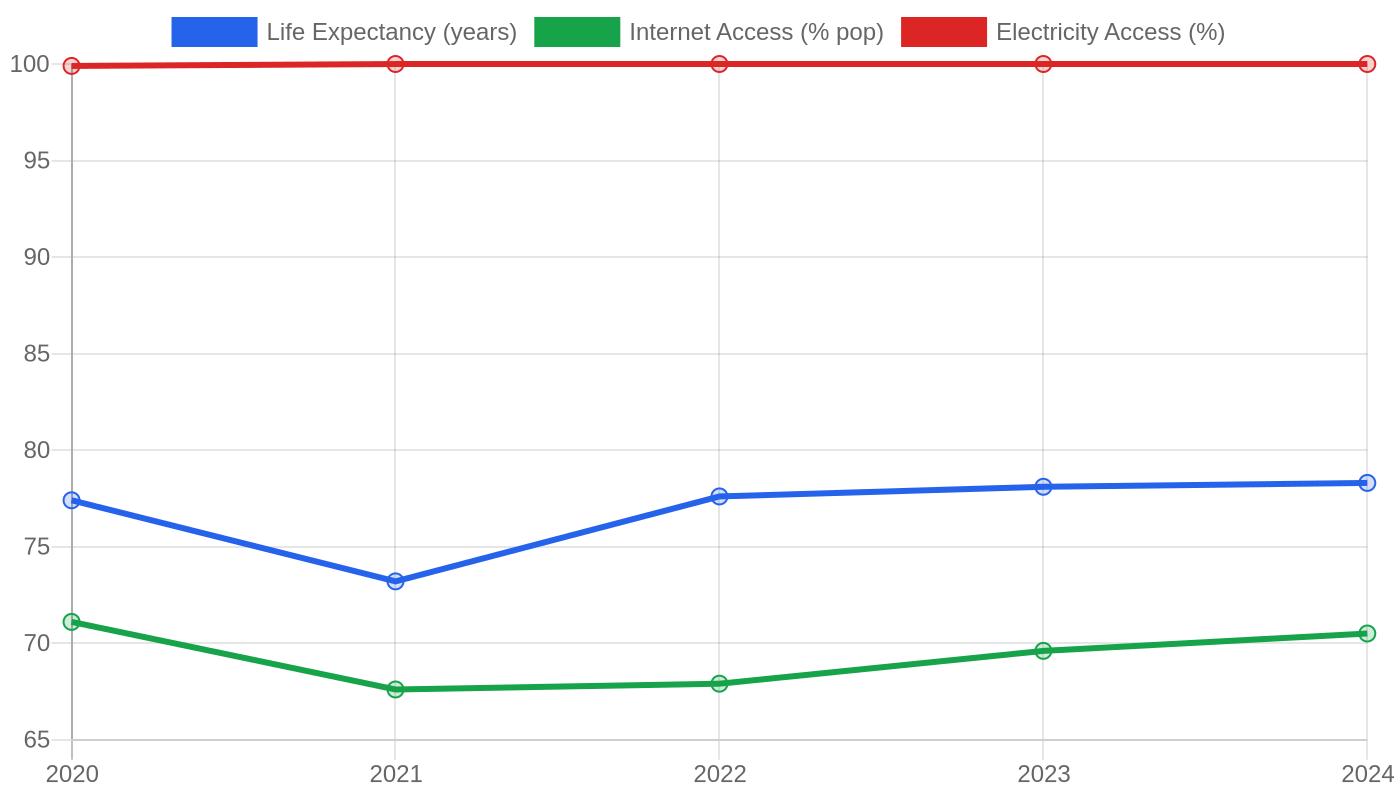
– The country’s economic data is largely opaque — the World Bank reports no figures for GDP growth, inflation, unemployment, or per capita income — making analysis reliant on qualitative indicators and the performance of state-owned enterprises.
– Major companies like Cubatabaco, Habanos S.A., and Cuba Petróleo Unión dominate the industrial landscape, reflecting an economy centered on tobacco, oil, and state-controlled consumer services.
– Aero Caribbean, Cubana de Aviación, and ETECSA highlight the importance of transportation and telecommunications, sectors that are vital for an island nation navigating global isolation.
– The political system, defined by the 1976 Constitution and its subsequent amendments, emphasizes democratic centralism and the guiding ideas of José Martí, Marx, Engels, and Lenin, creating a unique but rigid governance framework.
The Invisible Economy — Growth, Inflation, and the Data Void
The Cuban economy presents a peculiar challenge for any analyst: the World Bank reports no data whatsoever for GDP growth, inflation, unemployment, or GDP per capita. This absence is not an oversight — it reflects the country’s unique position as a socialist republic that does not participate fully in global economic reporting standards. Without these figures, one must look to the structure of the economy itself for clues about its health and direction.
The main industries of Cuba are not enumerated in the available data, but the list of top companies offers a window into the nation’s economic priorities. Cubatabaco and Habanos S.A. represent the consumer goods sector, specifically tobacco — a legacy industry that has long been synonymous with Cuban exports. Cuba Petróleo Unión, operating in oil and gas, points to energy as a critical sector, especially given the island’s reliance on imported fuel and its own modest extraction efforts.
The Central Bank of Cuba, listed among the top companies, underscores the state’s central role in managing finance and monetary policy.
The absence of inflation data is particularly telling. In an economy where shortages are common and dual currency systems have historically created distortions, the lack of a CPI figure suggests either a deliberate opacity or a statistical system unable to keep pace with rapid changes. What is clear is that the Cuban economy is not growing in any conventional sense — it is surviving, managing scarcity, and relying on state-controlled enterprises to maintain basic functions.
The Cost of Survival — Housing, Daily Expenses, and the Struggle for Basics
Data on the cost of living in Cuba is not provided, but the structure of the economy offers important context. In a socialist state where the government controls most goods and services, prices are not set by market forces but by administrative decree. This creates a peculiar situation where official prices may be low, but availability is limited — leading to parallel markets where prices reflect true scarcity.
Housing costs, rent, and the decision to buy versus rent are not captured in the available data. However, the dominance of state-owned companies like Habaguanex S.A., a consumer services firm, suggests that much of the hospitality and housing sector remains under government control. For most Cubans, housing is not a market transaction in the Western sense — it is allocated through state mechanisms, with ownership rights that are complex and often inherited rather than purchased.
Daily expenses for food, transportation, and utilities are likely shaped by rationing systems and state subsidies. Without regional averages to compare, it is impossible to say whether Cuba is cheaper or more expensive than its Caribbean neighbors. What can be inferred is that the cost of living is not primarily a question of price — it is a question of access. Cubans may pay little for bread, but finding bread at all can be the real challenge.
Investment and Business Climate — State Giants and the Private Sector Squeeze
The top companies in Cuba read like a who’s who of state capitalism. Aero Caribbean, Aerotaxi, and Cubana de Aviación dominate consumer services in aviation, reflecting the island’s need for internal and external connectivity. ETECSA holds a monopoly on telecommunications, a sector that is both a lifeline to the outside world and a tool of state control. EGREM, another consumer services firm, likely operates in entertainment or media, further consolidating cultural production under state auspices.
For investors, the business environment is defined by the political landscape. The Constitution of 1976, amended in 1992 and 2002, describes the Communist Party of Cuba as the “leading force of society and of the state.” This is not merely rhetorical — it means that all economic activity, whether domestic or foreign, operates within a framework where the party has the final say.
Joint ventures are possible, but they require navigating a bureaucracy that prioritizes ideological alignment over profit maximization.
Sectors to watch include telecommunications, where ETECSA’s monopoly could face pressure from growing demand for internet access, and tobacco, where Habanos S.A. continues to generate foreign currency through premium cigar exports. Oil and gas, via Cuba Petróleo Unión, remains strategically important but is constrained by aging infrastructure and limited investment. The absence of a vibrant private sector is not an accident — it is a feature of the system.
Safety, Politics, and Quality of Life — Stability at a Price
Crime and safety indices are not available for Cuba, but the political landscape provides a framework for understanding social order. The Republic of Cuba is a unitary one-party socialist state adhering to Marxism–Leninism. The constitution is guided by the ideas of José Martí and the political and social ideas of Marx, Engels, and Lenin. This ideological foundation creates a society where dissent is discouraged, but where violent crime may be relatively low due to tight state control.
Quality of life is difficult to measure without data on income, health, or education. What is known is that the political system operates on the principle of democratic centralism — a concept where decisions are made centrally but are supposed to reflect the will of the people. In practice, this has meant decades of one-party rule with limited political freedoms but also a degree of stability that some neighboring countries lack.
For the average Cuban, life is a balance between the security provided by the state — guaranteed employment, education, and healthcare — and the frustration of chronic shortages, limited travel freedoms, and a political system that does not tolerate opposition. The trade-off is clear: stability in exchange for liberty, predictability in exchange for prosperity.
What’s Happening Now — The Present Moment of Pressure and Possibility
The current affairs section draws on the available data, which is notably sparse. Without recent news reports, live indicators, or government official statements, the present moment must be understood through the lens of the country’s enduring challenges. Cuba is a nation that has outlived the Soviet Union, survived the collapse of its primary trading partner, and endured decades of economic embargo — yet it remains.
Right now, the Cuban economy is likely facing pressure from multiple directions. The dominance of state-owned enterprises like Cubana de Aviación and ETECSA suggests that any modernization efforts must come through these channels. The telecommunications sector, in particular, is a bellwether: as more Cubans demand internet access, ETECSA will either adapt or face growing informal networks.
The political system, rooted in the 1976 Constitution and its amendments, shows no sign of fundamental change. The Communist Party remains the leading force of society and the state, as described in the constitution. Any reforms will be incremental, managed from above, and consistent with Marxist–Leninist principles. The question is not whether Cuba will become a market economy — it will not — but whether it can find a sustainable path within its existing framework.
The Bottom Line
Cuba is a country that defies easy categorization: it is not a failed state, but it is not a thriving one either. For economists, it offers a rare case study of a socialist economy persisting in a capitalist world. For investors, the opportunities are limited to state-approved joint ventures in tobacco, energy, or telecommunications — sectors where the government retains control.
For travelers and cultural observers, Cuba remains a place of immense historical and social interest, but one where the cost of visiting is increasingly high and the experience is shaped by scarcity. Watch Cuba if you are interested in how ideology survives in the face of economic reality — but do not expect clear numbers or easy answers.
Sources & Methodology
This article is authored by Economic Pulse Net for informational and research purposes. Economic Pulse Net sources its data from multilateral institutions, national statistics bureaus, and proprietary databases. All data is believed to be current as of the date of publication.
Published: July 19, 2026 | Category: Research — Cuba
Use these signals in your own platform
Economic Pulse publishes its live signal feed through a documented, read-only API. Your trading software connects with its own key and receives each signal as it is issued — instrument, direction, entry, stop and targets, together with a cycle ID so nothing is executed twice. The feed is independent of this website and cannot change it.
Signals are informational only and are not financial advice.