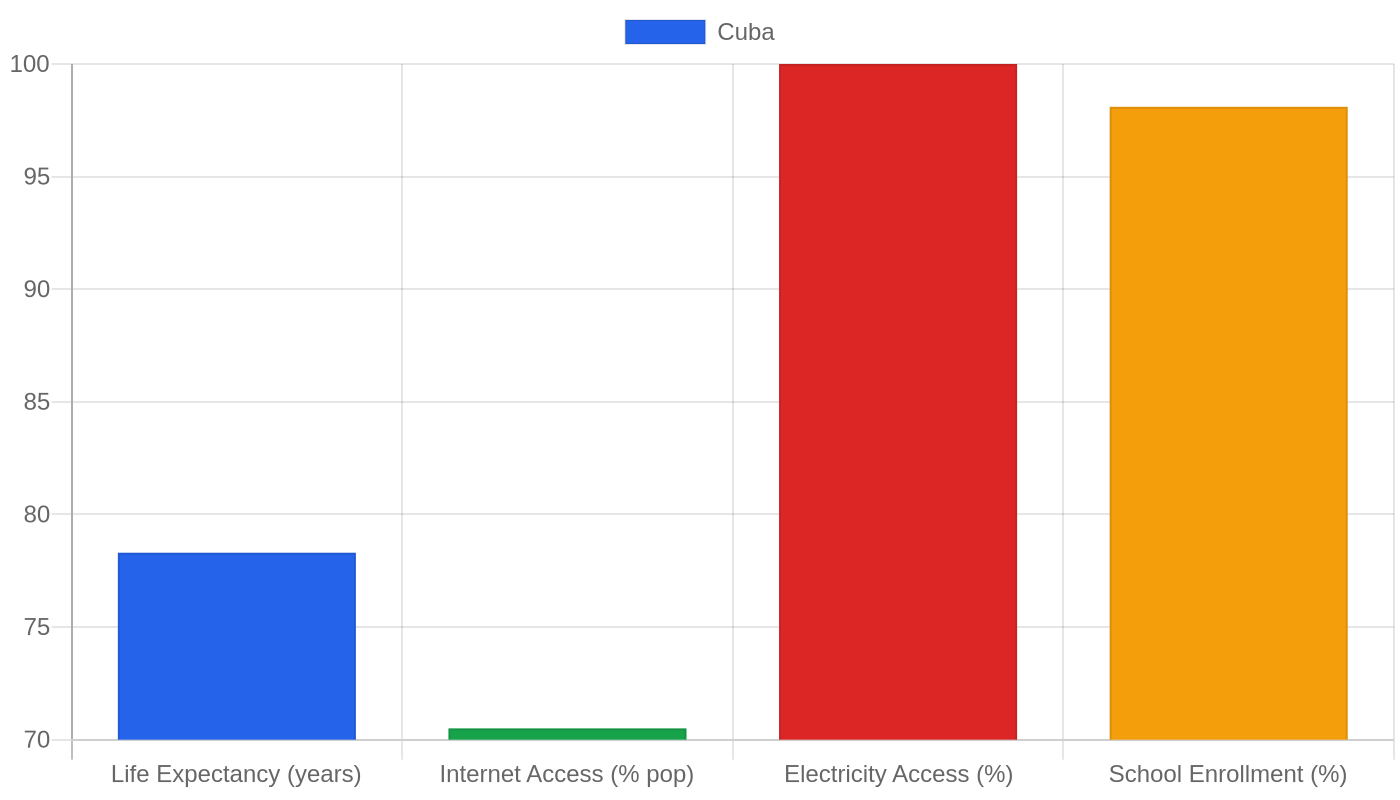
Economic Pulse Net | Sources: World Bank World Development Indicators, Government Sources | 2026
Key Takeaways
* Data Void: Comprehensive macroeconomic indicators, including GDP growth, inflation, and unemployment, are currently unavailable from the World Bank, leaving a significant blind spot for international investors.
State-Dominated Economy: The business landscape is defined by large, state-controlled entities such as Cubatabaco, ETECSA, and Cuba Petróleo Unión, which dominate key sectors like tourism, telecommunications, and energy.
Political Rigidity: As a unitary one-party socialist state guided by Marxism-Leninism, Cuba’s political system offers little room for private enterprise or market-driven reforms, maintaining strict ideological control over economic activity.
Limited Visibility: With crime indices and safety metrics marked as N/A, external observers lack the standard tools to assess risk, relying instead on structural knowledge of the state’s monopolistic industries.
The Invisible Ledger: A Macroeconomic Black Box
For global economists, Cuba presents a unique challenge: a nation whose economic heartbeat is effectively silent to standard measurement tools. According to the latest data from the World Bank, critical indicators such as GDP growth, inflation rates (CPI), and unemployment figures are listed as “N/A.” This absence of data does not imply stability; rather, it suggests a systemic opacity that complicates traditional financial analysis.
Without concrete numbers on GDP per capita (PPP) or Gross National Income (GNI), assessing the true health of the Cuban economy requires looking at structural outputs rather than aggregate statistics. The population size is also unrecorded in these specific datasets, further isolating Cuba from standard comparative models used by international financial institutions.
Consequently, any discussion of Cuba’s economic performance must rely on qualitative assessments of its industrial output and state planning mechanisms rather than quantitative growth trends. This data vacuum forces analysts to infer economic conditions through the lens of state-owned enterprises and physical production levels, acknowledging that the official statistical framework may not capture the full scope of informal markets or black-market activities that often sustain daily life.
High Walls, Low Prices? The Cost of Living Puzzle
The cost of living in Cuba remains an enigmatic variable, with no specific housing costs or rental yields provided in current datasets. Typically, in economies where official price indices are absent, residents navigate a dual-economy reality, balancing state-subsidized goods against increasingly expensive imported items.
While we cannot compare Cuban rent-to-income ratios to regional averages due to the lack of numerical data, the dominance of state-run consumer services implies that basic amenities are likely subsidized but scarce. Daily expenses are heavily influenced by the availability of foreign currency and the efficiency of state distribution networks.
For expatriates or investors, the lack of transparent cost-of-living data means that budgeting is less about mathematical precision and more about understanding the informal exchange rates and the physical availability of goods. The absence of a Safety Index and Crime Index further complicates the quality-of-life assessment, suggesting that personal security concerns may be managed through social cohesion or state control rather than recorded statistical trends.
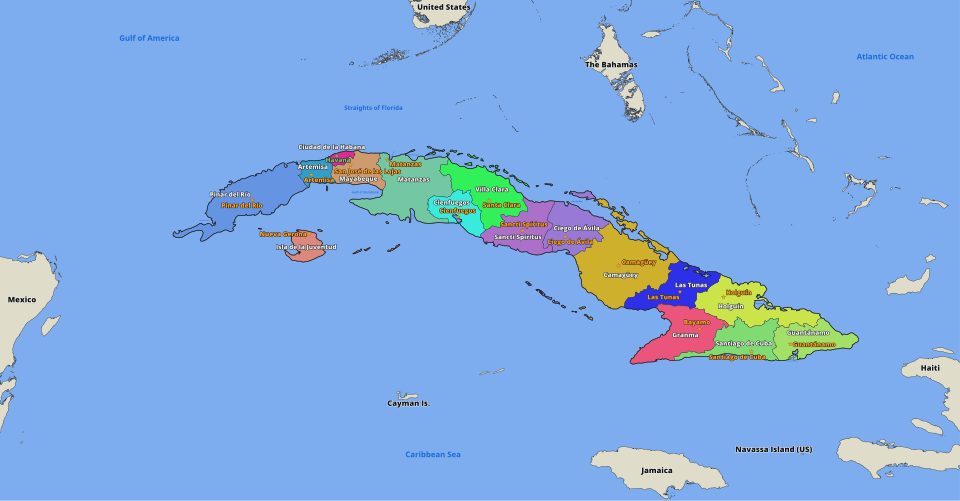
State Giants: Navigating a Monopolized Business Climate
The investment landscape in Cuba is characterized by the overwhelming presence of state-owned conglomerates that control virtually every major sector. Leading companies such as Cubatabaco and **Habanos S.A.** dominate the global premium cigar market, leveraging brand heritage under strict state supervision. In the energy sector, **Cuba Petróleo Unión** manages oil and gas resources, while **ETECSA** holds a monopoly on telecommunications, controlling the digital infrastructure of the island.
Tourism, a vital potential revenue stream, is serviced by state airlines like **Aero Caribbean**, **Aerotaxi**, and **Cubana de Aviación**, alongside hospitality giants like **Habaguanex S.A.** and **EGREM**. These entities operate within a framework that prioritizes national sovereignty and socialist ideology over profit maximization or shareholder returns. For foreign businesses, entering this market means negotiating directly with state apparatuses rather than engaging with competitive private markets.
The concentration of power in these few key players indicates that opportunities exist primarily in joint ventures or service contracts with these established giants, rather than through greenfield investments in free markets.
Ideology Over Indicators: Politics and Stability
Cuba’s political structure fundamentally shapes its economic trajectory, serving as both a stabilizer and a constraint. The Republic of Cuba is defined constitutionally as a unitary one-party socialist state, adhering strictly to Marxism-Leninism. The Communist Party of Cuba is enshrined in the Constitution as the “leading force of society and of the state,” ensuring that economic policy remains subservient to political ideology.
This system, described as reflecting the Marxist-Leninist concept of democratic centralism, prioritizes social objectives and state control over liberal market reforms. While this creates a predictable political environment with no risk of sudden democratic upheaval, it also eliminates the possibility of rapid, market-led economic diversification.
The lack of independent crime statistics makes it difficult to gauge social unrest, but the strong central authority suggests that public order is maintained through institutional control. For long-term stakeholders, the political risk is low in terms of volatility but high in terms of rigidity, as policy shifts are driven by ideological consistency rather than economic necessity.
Current Affairs: The Weight of Continuity
In the absence of recent news events or live economic indicators, the current affairs surrounding Cuba are defined by continuity and isolation. There are no reported elections, new policy reforms, or shifting inflation trends to analyze, as the data streams from major financial monitors remain closed. The business environment continues to operate under the same structural constraints seen in previous years, with state companies maintaining their dominant positions without significant disruption.
Any developments in the country are likely occurring behind closed doors, dictated by internal party decisions rather than public announcements. This static nature of current affairs means that the “news” is essentially the absence of change, reinforcing the status quo of a centrally planned economy.
Investors and observers must therefore look beyond headline news and focus on the slow-moving tectonic plates of diplomatic relations and informal economic adaptations that occur outside the formal reporting channels.
The Bottom Line
Cuba remains a fascinating but opaque case study for economists, offering deep insights into state-capitalist resilience while providing almost no actionable quantitative data. It is a market best watched by those interested in geopolitical strategy and state-monopoly dynamics rather than traditional financial returns. Investors should approach with extreme caution, recognizing that the lack of data reflects a deliberate systemic choice rather than a temporary reporting gap.
Ultimately, Cuba’s economic story is one of endurance and isolation, where success is measured in political survival rather than GDP growth.
Sources & Methodology
This article is authored by Economic Pulse Net for informational and research purposes. Economic Pulse Net sources its data from multilateral institutions, national statistics bureaus, and proprietary databases. All data is believed to be current as of the date of publication.
Published: October 25, 2026 | Category: Research — Cuba
Use these signals in your own platform
Economic Pulse publishes its live signal feed through a documented, read-only API. Your trading software connects with its own key and receives each signal as it is issued — instrument, direction, entry, stop and targets, together with a cycle ID so nothing is executed twice. The feed is independent of this website and cannot change it.
Signals are informational only and are not financial advice.