Economic Pulse Net | Sources: World Bank World Development Indicators, Government Sources | 2026
Key Takeaways
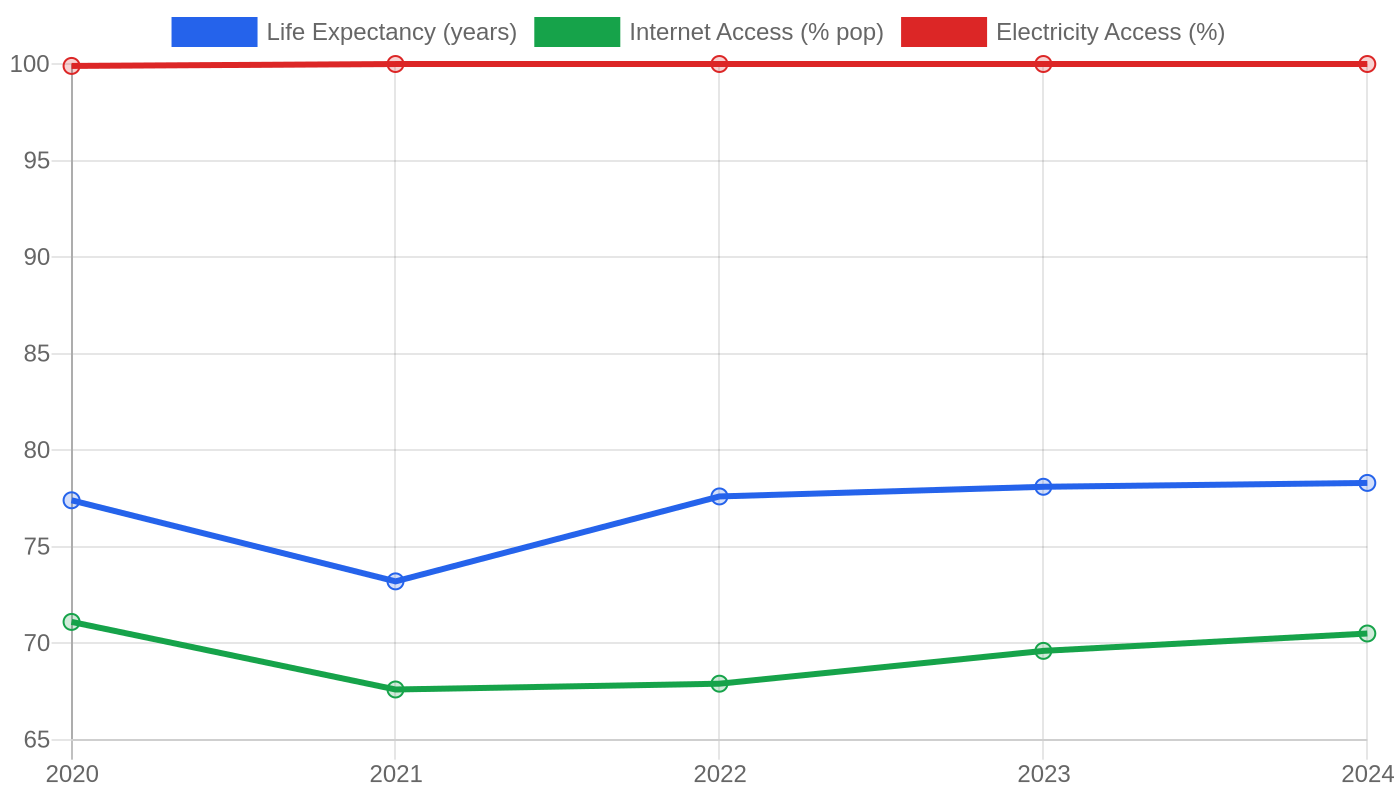
- Cuba’s economic data remains largely opaque, with the World Bank reporting no available figures for GDP growth, inflation, or unemployment — a reflection of the country’s unique position in the global financial system.
- The state remains the dominant economic actor, with key industries including tourism, tobacco, telecommunications, and energy all anchored by state-owned enterprises.
- Habanos S.A. and Cubatabaco continue to represent Cuba’s most globally recognized export brands, cementing the island’s reputation in premium consumer goods.
- The political landscape remains defined by a one-party socialist system, with the Communist Party constitutionally enshrined as the leading force of society.
- For investors and analysts, Cuba represents a market of potential rather than present data — a country where business climate assessments must be made qualitatively, not quantitatively.
The Missing Numbers: Reading Cuba’s Economic Silence
The World Bank’s latest data on Cuba presents an unusual challenge for economic journalists: there are no numbers to report.
GDP growth is listed as N/A.
Inflation is N/A.
Unemployment is N/A.
Even GDP per capita and population figures are absent from the international dataset.
This statistical silence is not an accident — it is a statement about how Cuba engages with the global economic system.
What we do know is structural.
Cuba’s main industries — though not enumerated in the available data — are widely understood to center on tourism, tobacco, rum, nickel mining, and pharmaceuticals, with the state controlling the commanding heights of the economy.
The presence of Cuba Petróleo Unión in the top companies list signals ongoing activity in the oil and gas sector, while ETECSA’s position underscores the telecommunications industry’s importance in a country that has gradually opened its internet infrastructure over recent years.
The absence of hard data matters because it limits the ability to compare Cuba with regional peers or global benchmarks.
Analysts cannot chart inflation trajectories or measure employment against Caribbean averages.
This data gap itself is a form of information — it tells us that Cuba remains outside the mainstream of international economic reporting, a reality that shapes everything from risk assessment to investment decisions.
For the Cuban people, the lack of official statistics does not diminish daily economic realities.
Scarcity, currency complexities, and the dual economy of state salaries and remittance-driven consumption continue to define everyday life, even if international databases cannot quantify them.
Housing and Daily Life: The Cost of Living in a Dual Economy
Without official cost-of-living indices, understanding Cuban daily expenses requires reading between the lines of the country’s economic structure.
The state’s provision of subsidized housing and basic goods creates a baseline of affordability that is difficult to compare with market-driven neighbors in the Caribbean or Latin America.
For those with access to state salaries, housing costs remain nominal, as the government allocates homes through a system that prioritizes need over purchasing power.
However, the emergence of a private market for goods and services — particularly in Havana’s tourist districts — has created a parallel economy where prices reflect supply and demand rather than state directives.
Renting versus buying in Cuba follows rules unfamiliar to most international observers.
Property transactions have been legal since 2011, but the market remains constrained by low salaries, limited mortgage financing, and the complexities of a currency system that features both national and convertible pesos.
For visitors and expatriates, accommodation costs in the tourist sector are comparable to other Caribbean destinations, but for residents, the calculation is entirely different.
The presence of Habaguanex S.A. in the top companies list is telling — this state-owned enterprise manages a significant portfolio of hotels, restaurants, and retail operations in Old Havana, effectively controlling much of the tourist-facing real estate market in the capital.
Business and Investment: State Giants and Global Brands
Cuba’s corporate landscape is dominated by state-owned enterprises, but the composition of the top companies list reveals strategic priorities.
Habanos S.A., the joint venture that controls the global distribution of Cuban cigars, represents perhaps the most successful Cuban brand internationally — a luxury consumer good that commands premium prices despite — or perhaps because of — the country’s political isolation.
The Central Bank of Cuba anchors the financial sector, though its role in international finance is limited by the country’s exclusion from many global banking networks.
ETECSA’s presence signals the telecommunications sector’s growth potential, particularly as mobile internet access has expanded in recent years.
Aero Caribbean, Aerotaxi, and Cubana de Aviación represent the aviation sector, crucial for an island nation dependent on tourism and international connectivity.
EGREM, the state recording company, highlights Cuba’s cultural exports — a significant soft power asset that has produced globally influential music for decades.
Cubatabaco and Cuba Petróleo Unión round out the list, underscoring the continued importance of tobacco and energy in the national economy.
For foreign investors, the business environment is defined by the 2014 Foreign Investment Act, which offers tax incentives and protections, yet the practical realities of operating in Cuba — from bureaucratic hurdles to currency controls — remain challenging.
The country’s participation in regional trade blocs and its relationships with key trading partners continue to evolve, but the fundamental structure of state dominance remains intact.
Safety, Politics, and Quality of Life: Stability in a One-Party State
Crime and safety indices for Cuba are not available in the current dataset, but the country has long maintained a reputation for low violent crime rates compared to many regional neighbors.
The political landscape, however, is unambiguous: Cuba is a unitary, one-party socialist state adhering to Marxism-Leninism, with the Communist Party constitutionally defined as the “leading force of society and of the state.” The 1976 Constitution, amended in 1992 and 2002, remains the foundational document, explicitly guided by the ideas of José Martí and the political and social theories of Marx, Engels, and Lenin.
This ideological framework shapes not only governance but also economic policy, education, and social services.
Quality of life in Cuba presents a paradox.
The country boasts impressive human development indicators in health and education — universal healthcare and literacy rates that rival developed nations.
Yet material conditions remain difficult for many citizens, with shortages of basic goods, aging infrastructure, and limited economic opportunities outside the state sector.
The concept of “democratic centralism” embedded in the political system means that decision-making flows from the top down, with limited space for civil society organizations or independent media.
For Cubans, this political stability comes at the cost of political pluralism, a trade-off that continues to shape emigration patterns and generational attitudes.
Current Affairs: An Economy at a Crossroads
Cuba in 2026 finds itself navigating a complex landscape of economic pressures and gradual reform.
The ongoing effects of decades of trade restrictions have intensified the government’s push for economic diversification, with renewed emphasis on tourism, biotechnology, and renewable energy.
The tourism sector remains the country’s economic lifeline, with efforts to attract visitors from new source markets and expand beyond traditional beach destinations into cultural and health tourism.
The presence of multiple aviation companies in the top corporate rankings suggests continued investment in connectivity, even as regional competition intensifies.
Telecommunications is another front of change, with ETECSA expanding mobile and internet services, gradually opening a sector that was once tightly controlled.
The social implications are significant — increased connectivity brings new information flows and generational expectations that may eventually reshape the political economy.
Energy security is an ongoing concern, with Cuba Petróleo Unión working to maintain domestic production capacity while exploring partnerships for offshore exploration and renewable alternatives.
The country’s dependence on imported energy remains a structural vulnerability, one that economic planners are attempting to address through solar and wind projects.
For international observers, the most significant development is Cuba’s continued integration into regional economic frameworks, even as global financial isolation persists.
The country’s participation in Caribbean and Latin American initiatives provides diplomatic space and potential economic pathways, though the pace of change remains deliberately measured.
The Bottom Line
Cuba warrants attention from anyone interested in how ideological commitment interacts with economic pragmatism.
For investors, the country offers a market where state control means fewer competitors but also greater complexity.
For analysts, the absence of data is itself a signal of Cuba’s unique position.
For travelers and cultural observers, the island’s resilience and creativity continue to produce global influence disproportionate to its economic size.
Cuba is not a country for those seeking conventional market opportunities — it is a case study in how a nation sustains its identity and economy against considerable odds.
Sources & Methodology
This article is authored by Economic Pulse Net for informational and research purposes.
Economic Pulse Net sources its data from multilateral institutions, national statistics bureaus, and proprietary databases.
All data is believed to be current as of the date of publication. Published: August 30, 2026 |
Category: Research — Cuba
Use these signals in your own platform
Economic Pulse publishes its live signal feed through a documented, read-only API. Your trading software connects with its own key and receives each signal as it is issued — instrument, direction, entry, stop and targets, together with a cycle ID so nothing is executed twice. The feed is independent of this website and cannot change it.
Signals are informational only and are not financial advice.