Economic Pulse Net | Sources: World Bank World Development Indicators, Government Sources | 2026
Key Takeaways
– Bermuda remains one of the world’s most sophisticated offshore financial centers, with a corporate roster dominated by global insurance, reinsurance, and asset management giants.
– The political landscape is defined by its status as a British Overseas Territory, with executive authority resting with the UK monarch, currently King Charles III, and exercised locally by a governor appointed by the British government.
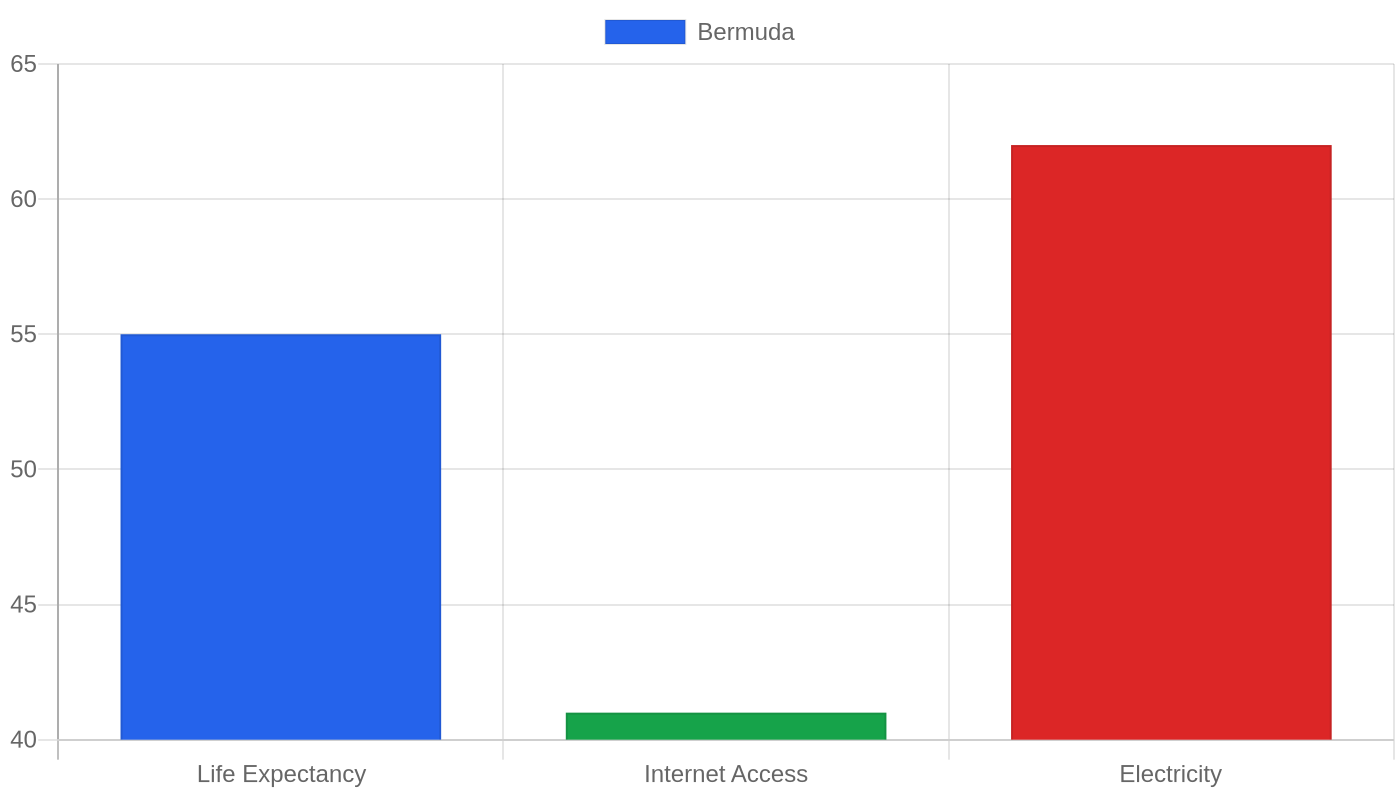
– While headline economic indicators like GDP growth, inflation, and unemployment are not currently available from the World Bank, the island’s economic character is unmistakably shaped by its financial services sector.
– Top companies including Bacardi, Butterfield Bank, and Brookfield Infrastructure Partners underscore a diverse corporate base that extends beyond banking into consumer goods and industrial services.
– The absence of a crime index or safety index in the available data leaves a gap in quantitative assessment, but the political structure provides a stable, rule-of-law framework that underpins the jurisdiction’s global reputation.
The Quiet Machinery of a Financial Powerhouse
Bermuda’s economy does not announce itself with factory smoke or sprawling industrial parks. Instead, it hums quietly through the ledgers of some of the world’s most important financial institutions.
The World Bank’s latest data set does not include GDP growth figures, inflation rates, or unemployment numbers for the island, which in itself is a telling detail — Bermuda’s economic metrics are often less publicly scrutinized than those of larger nations, yet its influence punches far above its weight.
What we do know is that the island’s main industries are anchored in financial services. The Bermuda Monetary Authority, which serves as both the central bank and the financial services regulator, sits at the heart of this ecosystem. Its presence signals a jurisdiction that takes oversight seriously, even as it offers the kind of tax-neutral environment that has made Bermuda a preferred domicile for international insurers and reinsurers. The Catlin Group and Frontline Ltd.
are among the notable names headquartered here, representing both the insurance sector and maritime shipping industries respectively.
The absence of hard numbers does not mean the economy is static. Rather, it reflects a model where the value generated is often booked internationally, with Bermuda serving as a strategic hub rather than a traditional production economy. This is an economy built on legal frameworks, regulatory sophistication, and global connectivity — not on raw materials or manufacturing output.
For the casual observer, the lack of data might seem like a void; for the seasoned economist, it is simply the nature of a jurisdiction whose economic output is measured in risk transfer and capital flows rather than tonnes of steel or barrels of oil.
The Price of Paradise: Housing and Daily Life
Living in Bermuda comes with a premium that reflects its status as both a tropical island and a global financial hub. While the available data does not include specific cost-of-living figures, the island’s character as a high-income jurisdiction with limited land area implies a housing market where supply is constrained and demand is persistent.
Rent versus buy calculations here are heavily skewed by the simple geography of the island — there is only so much land, and much of it is devoted to residential, commercial, and tourism uses.
For expatriates and locals alike, housing costs are widely understood to be among the highest in the Caribbean region. The presence of major financial institutions like Butterfield Bank and Fidelity International means there is a steady stream of well-compensated professionals competing for a finite pool of properties. This dynamic pushes prices upward and makes affordable housing a perennial topic of local political debate.
Daily expenses, from groceries to transportation, also carry an import-driven premium, as the island must bring in the vast majority of its consumer goods from abroad.
The comparison to regional averages is difficult to quantify without specific data, but the anecdotal and structural evidence is consistent: Bermuda is an expensive place to live. That cost is borne willingly by those who value the island’s safety, stability, and professional opportunities, but it also creates a two-tier society where the financial sector’s prosperity does not always translate into broad-based affordability.
For policymakers, this is the quiet tension that sits beneath the surface of an otherwise prosperous jurisdiction.
Where the World Parks Its Capital: Investment and Business Climate
If Bermuda were a company, its prospectus would highlight the Bermuda Monetary Authority as a guarantor of regulatory rigor, and its listed firms as evidence of global reach. The roster of top companies reads like a who’s who of international finance: Brookfield Infrastructure Partners, a global infrastructure giant; Genpact, a professional services firm with a presence in industrial operations; and Central European Media Enterprises, which despite its name operates in consumer services.
This diversity is a strength, insulating the island from over-reliance on any single sector.
The business environment is characterized by proximity to major markets, a legal system rooted in English common law, and a time zone that bridges the Americas and Europe. These factors make Bermuda a natural home for insurance-linked securities, captive insurance vehicles, and investment funds.
The presence of Bacardi, a consumer goods company best known for its rum, adds a layer of brand-name recognition that extends beyond the financial world, reminding investors that Bermuda is also a place of tangible products and lifestyle appeal.
Sectors to watch include reinsurance, where Bermuda is a global leader, and the ongoing evolution of digital assets and fintech, which the Bermuda Monetary Authority has actively courted through regulatory sandboxes and licensing frameworks. For investors, the message is clear: Bermuda offers a stable, well-regulated environment where capital can be deployed with confidence. The absence of a corporate income tax for many structures remains a powerful draw, even as global tax reforms push for greater transparency.
Stability in the Sun: Politics, Safety, and Quality of Life
Bermuda’s political landscape is defined by its constitutional relationship with the United Kingdom. As a British Overseas Territory, the island does not have full sovereignty; instead, the UK government holds ultimate authority, with executive power vested in the British monarch, King Charles III, and exercised locally by a governor. Since January 2025, that role has been filled by Andrew Murdoch, who was sworn in on 23 January, with Tom Oppenheim serving as deputy governor.
This arrangement provides a layer of political stability that is rare among small island jurisdictions. The rule of law is firmly established, and the legal system is transparent and familiar to international investors. While the available data does not include a crime index or safety index, the island’s reputation for safety is well established, and its quality of life is frequently cited as a draw for professionals relocating from larger, more congested financial centers.
The relationship with the UK is not without its complexities. Bermudians have periodically debated the island’s constitutional status, with some advocating for greater autonomy or independence. However, the current framework offers a pragmatic balance: local governance through elected officials, with the governor handling external affairs and defense. For residents, this means a predictable legal environment and a high degree of personal security.
For businesses, it means a jurisdiction that is politically stable, legally sound, and closely aligned with international standards.
The Pulse Right Now: A New Governor, A Familiar Course
The most significant recent development in Bermuda is the arrival of Governor Andrew Murdoch, who took office in January 2025. His appointment comes at a time when the island is navigating a complex global environment, from shifting international tax standards to the ongoing evolution of the financial services industry. Murdoch’s background in diplomatic and governance roles positions him to manage the territory’s relationship with London while supporting local economic priorities.
Under his leadership, the island is likely to continue its focus on regulatory excellence, particularly in the fintech and insurance sectors. The Bermuda Monetary Authority remains a key player in shaping the island’s business climate, and its approach to digital asset regulation has already attracted attention from global firms seeking a credible, well-regulated venue for crypto-related activities.
The appointment of a new governor also signals continuity rather than change, reassuring investors that Bermuda’s political and regulatory trajectory remains steady.
The economic data gap persists, but the island’s direction is clear: Bermuda is leaning into its strengths as a financial center, leveraging its British legal heritage, its regulatory sophistication, and its geographic position. The coming year will test whether it can maintain its relevance in a rapidly changing global economy, but the foundations appear solid.
For those watching the island, the story is less about dramatic shifts and more about the quiet, confident management of a jurisdiction that knows exactly what it is.
The Bottom Line
Bermuda is not a country that makes headlines with flashy GDP numbers or dramatic policy pivots. Its power is quieter, rooted in the trust that global corporations place in its legal and regulatory systems. For investors, insurers, and financial institutions, it remains a cornerstone of international risk management and capital allocation.
For the casual observer, it is a reminder that economic strength does not always require vast land or large populations — sometimes, it is built on credibility, stability, and the careful stewardship of a small island’s outsized ambitions.
Sources & Methodology
This article is authored by Economic Pulse Net for informational and research purposes. Economic Pulse Net sources its data from multilateral institutions, national statistics bureaus, and proprietary databases. All data is believed to be current as of the date of publication.
Published: August 11, 2026 | Category: Research — Bermuda
Use these signals in your own platform
Economic Pulse publishes its live signal feed through a documented, read-only API. Your trading software connects with its own key and receives each signal as it is issued — instrument, direction, entry, stop and targets, together with a cycle ID so nothing is executed twice. The feed is independent of this website and cannot change it.
Signals are informational only and are not financial advice.