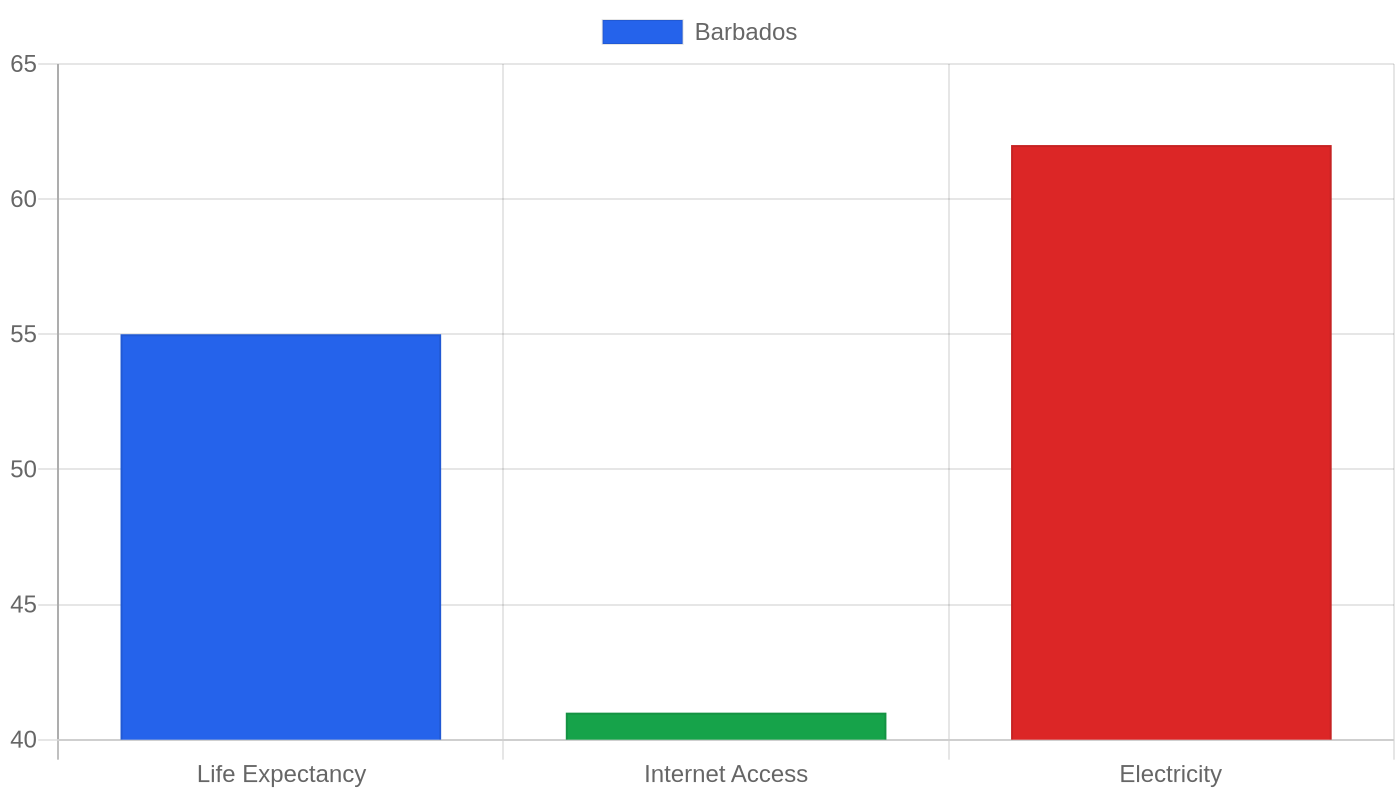
Economic Pulse Net | Sources: World Bank World Development Indicators, Government Sources | 2026
Key Takeaways
– Barbados operates as a parliamentary republic modelled on the British Westminster system, having achieved independence on 30 November 1966, and now functions with a President as head of state and a Prime Minister as head of government.
– The nation’s economic backbone rests on a diverse mix of utilities, consumer goods, financial services, and telecommunications, with a notable cluster of homegrown companies dominating the landscape.
– The Barbados Stock Exchange and a robust financial sector signal an economy with institutional depth beyond its small physical size.
– State-owned enterprises in energy and water, alongside private utilities, illustrate a hybrid economic model where government and market forces coexist.
– While comprehensive macroeconomic indicators from the World Bank are currently unavailable, the structure of the economy offers clear signals about where the country’s priorities lie.
The Economic Engine — Utilities, Breweries, and the Business of Daily Life
The World Bank’s latest snapshot of Barbados does not currently provide GDP growth figures, inflation rates, or unemployment data, leaving analysts to read the country’s economic character through its industrial composition. What emerges from the available data is a picture of an economy built around essential services and consumer staples.
The presence of the Barbados Light and Power Company and the Barbados Water Authority as major corporate entities underscores how central utility provision is to the national economic framework. These are not marginal players; they are foundational to how the country functions, powering homes, businesses, and the tourism infrastructure that historically anchors the Barbadian economy.
The consumer goods sector reveals a similar story of domestic production meeting local demand. Banks Barbados Brewery and the Barbados Ice Cream Company represent a manufacturing base focused on everyday consumption, suggesting an economy that has developed import-substitution capabilities in certain niches.
The Barbados Advocate and the Caribbean Broadcasting Corporation speak to a media landscape that is locally owned and operated, which is significant for a small nation seeking to maintain cultural and informational sovereignty. The Barbados National Oil Company Limited, despite its name, signals the country’s engagement with energy security, an increasingly pressing concern for island nations dependent on imported fuels.
The financial sector, anchored by the Barbados Stock Exchange, provides a formal mechanism for capital raising and investment, a crucial feature for a country that must attract both domestic savings and foreign capital. CariAccess in telecommunications demonstrates participation in the digital economy, which will be vital for diversification.
The World Bank data may be incomplete, but the corporate roster tells a story of a nation that has built a surprisingly comprehensive economic structure, one that balances state involvement in critical infrastructure with private enterprise in consumer markets.
Housing and the Cost of Living — The Price of Paradise
Without current inflation or cost-of-living indices from the World Bank, assessing the financial pressure on Barbadian households requires inference from the economic structure itself. An economy heavily reliant on imported goods, which is typical for Caribbean island nations, tends to experience higher consumer prices due to shipping costs and import duties.
The prominence of local food and beverage producers like Banks Barbados Brewery and the Barbados Ice Cream Company suggests that efforts to produce domestically are not merely commercial ventures but also pragmatic responses to the high cost of bringing goods to the island.
The housing market in Barbados has historically been characterised by a significant divide between luxury coastal properties aimed at foreign buyers and more modest inland housing for the local population. The utilities that dominate the corporate landscape — water and electricity — are essential considerations for any household budget, and the presence of the Barbados National Oil Company indicates that energy costs are a national concern.
For residents, the cost of living is likely shaped by these utility bills, food prices, and transportation costs, all of which can fluctuate with global commodity prices. The balance between rent and homeownership is a perennial question in Caribbean economies, where land is finite and property values in desirable areas can be prohibitive for younger generations.
Investment Climate — A Market of Scale and Substance
For investors looking at Barbados, the corporate landscape offers a blend of stability and niche opportunity. The presence of the Barbados Stock Exchange provides a regulated venue for equity investment, and the diversity of listed companies — from utilities to breweries to media — offers exposure to different facets of the consumer economy.
The utilities sector is particularly noteworthy; Barbados Light and Power and the Water Authority represent regulated, essential services that typically offer predictable returns, albeit with government oversight on pricing. The energy sector, including the National Oil Company, may present opportunities related to energy transition and fuel security, a growing priority for island nations.
The telecommunications sector, represented by CariAccess, is where growth potential may lie, as digital connectivity becomes ever more integral to economic participation. The business environment is shaped by the country’s political stability and its legal framework, which is rooted in the Westminster system, providing a familiar structure for investors from Commonwealth countries.
Governance, Safety, and the Quality of Life
The political landscape of Barbados is defined by its post-colonial evolution. Since independence in 1966, the country has transitioned from a constitutional monarchy to a parliamentary republic, a significant step in its national identity. The current President, Jeffrey Bostic, serves as head of state, elected by Parliament for a four-year term, while the Prime Minister holds the reins of government.
This structure, with 30 representatives in the House of Assembly and an appointed Senate, mirrors the British system but with a distinctly Barbadian character. The peaceful functioning of this political model is itself an economic asset, providing the stability that businesses and investors require. The World Bank does not currently provide crime or safety indices for Barbados, but the country’s reputation as a relatively safe and stable Caribbean destination is a key component of its quality of life.
This environment, combined with the cultural institutions represented by the local media, contributes to a society that values its sovereignty and its social fabric.
Current Affairs — Navigating the Present with an Eye on the Future
Barbados is presently engaged in the ongoing work of defining its economic path in a post-colonial, post-pandemic world. The shift to a republic, completed with the election of President Bostic, is not merely symbolic; it signals a nation confidently managing its own affairs.
The composition of its top companies reveals a government and private sector working in tandem to address fundamental needs — energy security through the National Oil Company, water management through the Water Authority, and financial infrastructure through the Stock Exchange. The continued operation of the Caribbean Broadcasting Corporation and The Barbados Advocate highlights the importance placed on local media and national dialogue.
There is likely ongoing debate about economic diversification, reducing reliance on traditional sectors, and embracing digital and green economies. The presence of CariAccess in the telecommunications field suggests that connectivity is a priority. The country’s economic managers are presumably focused on fiscal responsibility and creating conditions for sustainable growth, even as global headwinds such as energy prices and supply chain disruptions pose challenges to all small island states.
The evolution of the utilities sector, particularly around renewable energy, is a space to watch, as is the development of the financial services industry.
The Bottom Line
Barbados is a country that has successfully navigated the transition from colony to independent republic and now faces the challenge of economic modernisation. It is a nation for observers who appreciate the intricacies of small-state economics, where utility companies and breweries are not just businesses but pillars of national resilience. Investors should watch Barbados for its stable governance and the potential in its energy and telecommunications sectors.
For those interested in the Caribbean’s future, Barbados serves as a case study in how a small nation leverages its political stability and institutional depth to craft a distinctive economic identity.
Sources & Methodology
This article is authored by Economic Pulse Net for informational and research purposes. Economic Pulse Net sources its data from multilateral institutions, national statistics bureaus, and proprietary databases. All data is believed to be current as of the date of publication.
Published: August 28, 2026 | Category: Research — Barbados
Use these signals in your own platform
Economic Pulse publishes its live signal feed through a documented, read-only API. Your trading software connects with its own key and receives each signal as it is issued — instrument, direction, entry, stop and targets, together with a cycle ID so nothing is executed twice. The feed is independent of this website and cannot change it.
Signals are informational only and are not financial advice.