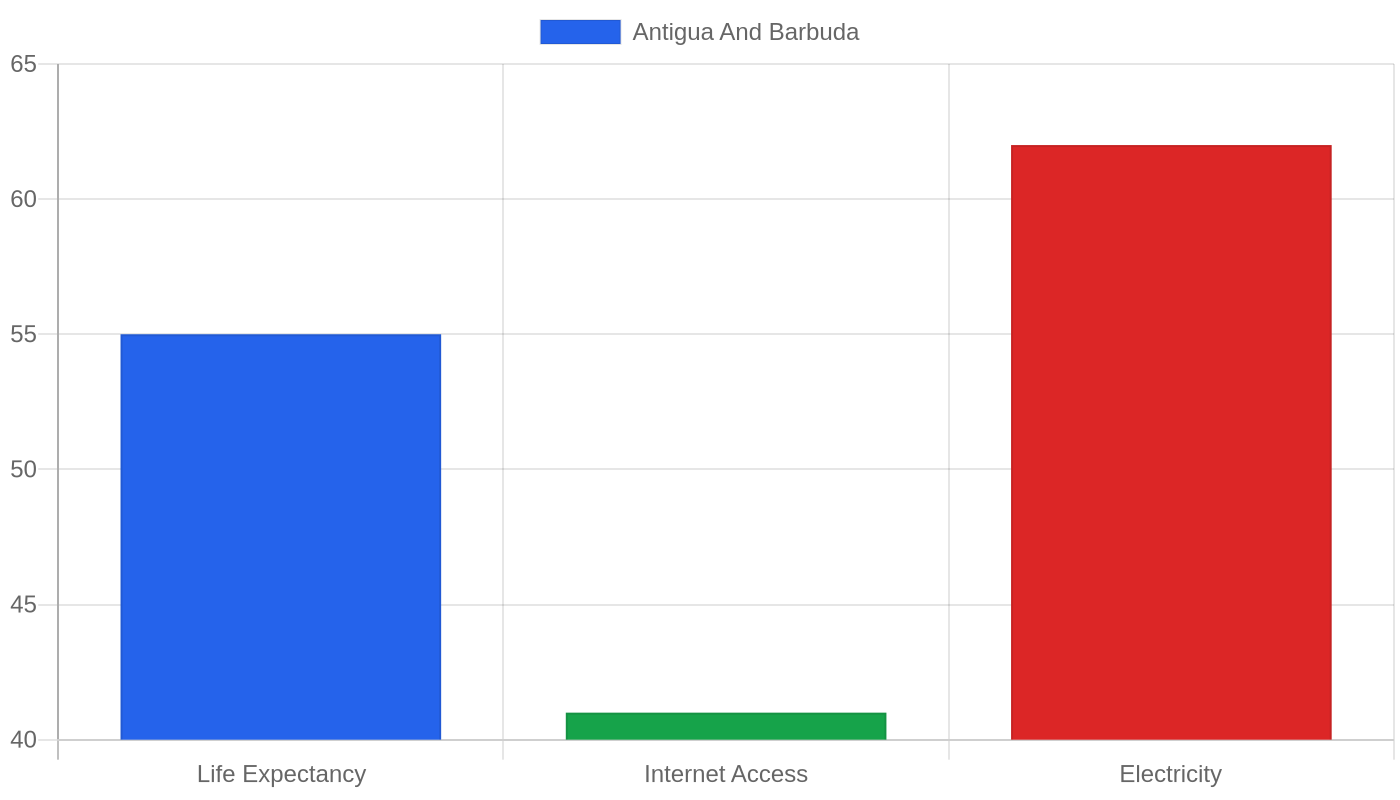
Economic Pulse Net | Sources: World Bank World Development Indicators, Government Sources | 2026
Key Takeaways
- Political Stability as a Core Asset: The nation operates as a unitary parliamentary democracy under a constitutional monarchy, with a constitution adopted upon independence in 1981 that has provided a stable framework for governance.
- Distinct Island Autonomy: While the national government directly governs Antigua, the island of Barbuda maintains a significant degree of autonomy, a structural nuance that influences local policy and resource allocation.
- Data Scarcity in Macro Metrics: Current World Bank data for key indicators such as GDP growth, inflation (CPI), unemployment, and per capita income is not available, suggesting a gap in recent high-frequency economic reporting or data dissemination.
- Limited Transparency on Business Climate: Specific details regarding top companies, major industries, and corporate performance are currently unavailable in the provided dataset, limiting immediate insight into the private sector’s current trajectory.
- Safety Metrics Unverified: Crime and safety indices are currently marked as unavailable, meaning an objective assessment of the daily living environment based on quantitative safety data is not possible at this time.
A Constitutional Framework for Stability
The political architecture of Antigua and Barbuda stands as one of its most enduring economic foundations.
The country is structured as a unitary parliamentary democracy operating under a constitutional monarchy, a system that has remained consistent since independence.
This governance model was formalized by the current Constitution, which was adopted on 1 November 1981, replacing the pre-independence constitution of the Associated State of Antigua.
The shift to the new constitution was a critical moment in the nation’s history, as the previous document did not thoroughly define the relationship between the two main islands, Antigua and Barbuda.
By establishing a clearer legal framework, the 1981 constitution provided the necessary clarity for national governance while preserving distinct local identities.
This political continuity offers a level of predictability that is often prized in international economic analysis, even in the absence of current macroeconomic data.
The unitary nature of the state ensures that national policies are applied broadly, although the specific autonomy granted to Barbuda introduces a layer of complexity in how national directives are implemented across the archipelago.
The Economic Data Gap
Assessing the current economic health of Antigua and Barbuda presents a unique challenge due to the unavailability of recent World Bank data for several critical indicators.
Key metrics such as GDP growth, inflation rates measured by the Consumer Price Index, and unemployment rates are currently listed as N/A, indicating a significant gap in the most recent high-frequency economic reporting.
Without these figures, it is difficult to gauge the immediate momentum of the domestic economy or the purchasing power of the average citizen.
Similarly, aggregate figures for total GDP in USD, GDP per capita on a purchasing power parity basis, and Gross National Income per capita are not provided, leaving the scale and distribution of national wealth undefined in this context.
The lack of population data further complicates any attempt to normalize economic outputs per person or to understand demographic pressures on public services.
This absence of data does not imply an economic crisis, but rather a limitation in the current dataset provided for this analysis.
For investors and policymakers, this highlights the need for alternative data sources or direct engagement with local statistical bureaus to fill these informational voids.
Living Standards and Cost of Living
In the absence of specific cost-of-living indices, housing costs, and daily expense breakdowns, a precise evaluation of the standard of living in Antigua and Barbuda is not possible.
The provided data does not include information on rent versus purchase ratios, average monthly expenditures, or comparisons to regional averages for neighboring Caribbean states.
Consequently, we cannot determine whether the cost of living is rising or falling, nor can we assess the affordability of housing for local residents versus expatriates.
This lack of granular data on daily life means that any discussion of living standards must remain general and qualitative.
It is important to note that the unavailability of these specific socioeconomic metrics prevents a detailed analysis of household financial health or the relative burden of essential goods and services.
Readers seeking a detailed picture of daily economic conditions should look to local market reports or regional living cost surveys for more current and specific figures.
Business Climate and Corporate Landscape
The business environment in Antigua and Barbuda remains opaque in the current dataset, as specific information on main industries, top companies, and sector-specific performance is not provided.
Without a list of leading corporations or dominant sectors, it is impossible to identify which industries are currently driving growth or innovation in the local economy.
The absence of data on major companies also limits the ability to assess the competitive landscape or the presence of multinational versus locally-owned enterprises.
This gap in corporate intelligence suggests that the private sector’s current priorities and challenges are not fully captured in the available high-level data.
For potential investors, this lack of transparency regarding the corporate landscape necessitates a more targeted approach to market research, focusing on direct industry contacts rather than broad statistical overviews.
The undefined nature of the main industries in this report highlights the need for further investigation into the specific economic drivers of the nation.
Safety, Politics, and Quality of Life
The political landscape of Antigua and Barbuda is characterized by a well-established constitutional monarchy and parliamentary system, which has provided a stable backdrop for governance since 1981.
The current constitution, adopted at independence, serves as the supreme law of the land, replacing earlier frameworks that lacked clarity regarding the relationship between the islands.
This political structure allows for a degree of local autonomy, particularly in Barbuda, which maintains much of its self-governance while Antigua is directly administered by the national government.
However, quantitative measures of public safety, such as the Crime Index and Safety Index, are currently unavailable in the dataset.
This means that an objective assessment of the physical security environment for residents and visitors cannot be made based on the provided data.
The combination of political stability and unknown safety metrics creates a complex picture of quality of life, where institutional strength is evident but daily security conditions remain unquantified in this specific analysis.
Current Affairs and Recent Developments
The current economic and political situation in Antigua and Barbuda is marked by a notable absence of recent news headlines and live economic indicators in the provided data set.
Without access to recent government announcements, policy shifts, or inflation trends, it is difficult to identify the immediate catalysts driving the nation’s current trajectory.
The lack of recent news means that we cannot discuss specific reforms, election outcomes, or new business developments that may be influencing the market.
This gap in current affairs reporting suggests that the most relevant developments may be occurring at a local level or in sources not captured by this specific data snapshot.
For a dynamic understanding of the country’s direction, it is crucial to monitor local parliamentary sessions and central bank communications, which are not reflected in the current static dataset.
The silence on recent events in this report underscores the importance of real-time monitoring for any serious economic analysis of the region.
The Bottom Line
Antigua and Barbuda presents a case study in political stability amidst data scarcity.
While the nation boasts a robust constitutional framework and a stable parliamentary democracy, the lack of recent World Bank data on GDP, inflation, and unemployment limits a comprehensive economic assessment.
For international observers, the key takeaway is that political institutions are strong, but economic transparency in current datasets is low.
Investors and researchers should prioritize direct engagement with local authorities and alternative data providers to navigate the gaps in available statistics.
The country remains a significant player in the Eastern Caribbean, but its current economic pulse requires more granular, up-to-date information to be fully understood.
Sources & Methodology
This article is authored by Economic Pulse Net for informational and research purposes.
Economic Pulse Net sources its data from multilateral institutions, national statistics bureaus, and proprietary databases.
All data is believed to be current as of the date of publication. Published: September 03, 2026 |
Category: Research — Antigua And Barbuda
Use these signals in your own platform
Economic Pulse publishes its live signal feed through a documented, read-only API. Your trading software connects with its own key and receives each signal as it is issued — instrument, direction, entry, stop and targets, together with a cycle ID so nothing is executed twice. The feed is independent of this website and cannot change it.
Signals are informational only and are not financial advice.