Economic Pulse Net | Sources: World Bank World Development Indicators, Government Sources | 2026
🇦🇬 Antigua And Barbuda 2026 — Navigating Governance in a Data-Scarce Landscape
Key Takeaways
* Governance Structure: The nation operates as a unitary parliamentary democracy under a constitutional monarchy, with a distinct power dynamic between the national government and the autonomous island of Barbuda.
Data Transparency Gap: Critical economic indicators such as GDP growth, inflation, and unemployment are currently listed as “N/A,” presenting a unique challenge for investors and analysts relying on standard World Bank metrics.
Constitutional Foundation: The political stability is rooted in the Constitution adopted at independence in 1981, which replaced earlier frameworks that lacked clear definitions regarding the relationship between the two main islands.
Autonomy Dynamics: While Antigua is directly governed by the national administration, Barbuda retains significant autonomy, creating a complex but potentially resilient internal political structure.
Information Void: With crime indices, safety scores, and top company lists unavailable, the investment narrative relies heavily on understanding the legal and political framework rather than quantitative performance metrics.
The Political Architecture and Institutional Framework
Antigua and Barbuda presents a fascinating case study in post-colonial governance where institutional clarity has been prioritized over immediate statistical transparency. As a unitary parliamentary democracy under a constitutional monarchy, the country’s political landscape is defined by the Constitution adopted upon its independence on November 1, 1981.
This foundational document was crucial because it replaced the pre-independence constitution of the Associated State of Antigua, which had failed to thoroughly define the relationship between the two islands. By establishing a clearer legal framework, the 1981 Constitution sought to mitigate internal tensions and provide a stable environment for governance.
However, this stability is nuanced by the specific division of powers; the island of Barbuda maintains much autonomy, while the island of Antigua is directly governed by the national government. This dual structure means that policy implementation can vary significantly depending on the location, requiring businesses and residents to navigate two distinct administrative realities within a single sovereign state.
For an observer looking at the broader Caribbean region, this setup offers a model of decentralized authority within a centralized democratic system, though it complicates the aggregation of national data. The lack of current political volatility suggests that the constitutional framework remains robust, even if the economic outputs it produces are not yet fully quantified in public databases.
Understanding this political nuance is essential for anyone assessing the long-term viability of investments or residency programs in the region, as the balance of power between the islands will likely dictate future legislative changes.
Economic Indicators and the Statistical Void
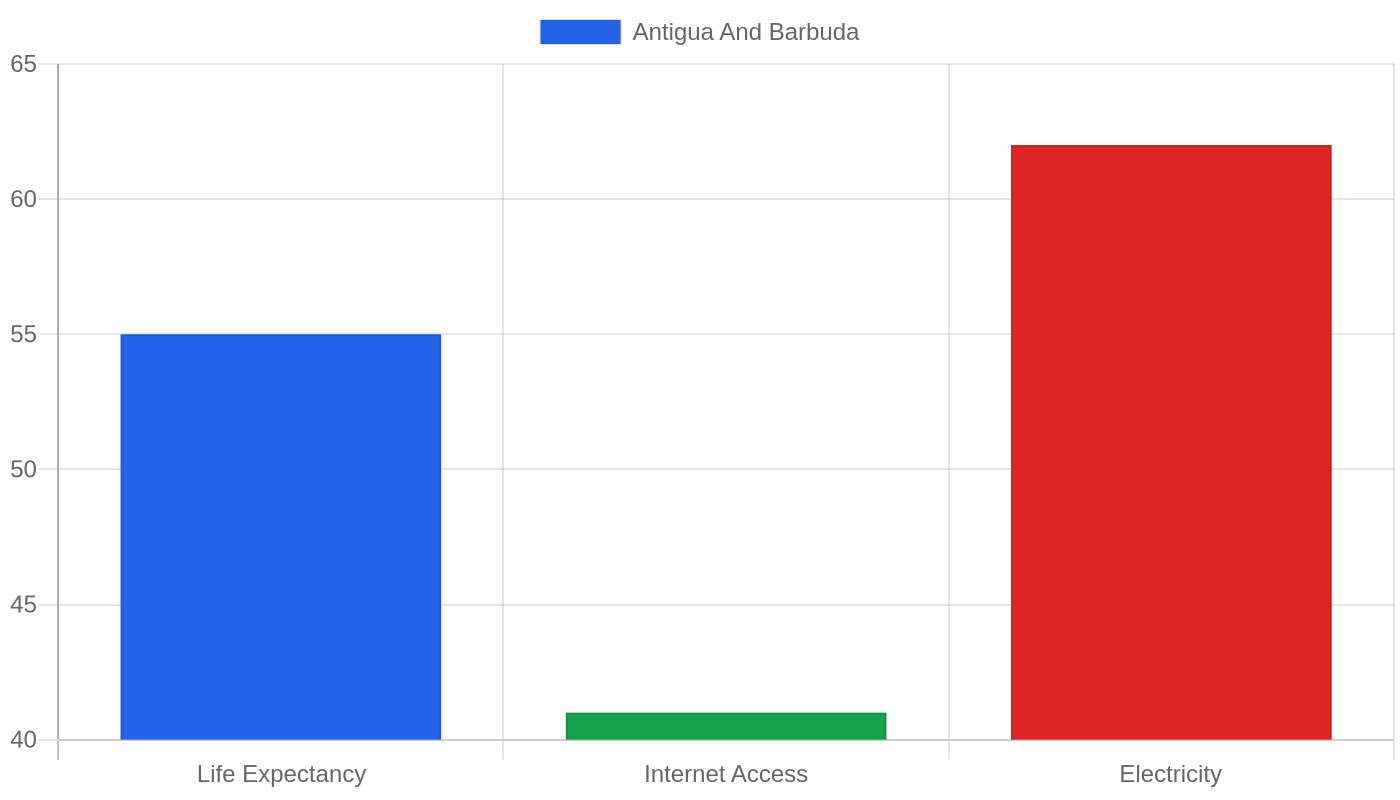
When analyzing the economic health of Antigua and Barbuda through the lens of the World Bank, one encounters a significant blank space in the data matrix. The latest available figures for GDP growth, inflation (CPI), and unemployment are all recorded as “N/A,” leaving analysts without the traditional levers used to assess economic momentum.
Similarly, key macroeconomic aggregates such as GDP in USD, GDP per capita in PPP, GNI per capita, and even total population figures are absent from the current dataset. This absence of hard data creates a challenging environment for comparative analysis, forcing observers to rely on qualitative assessments rather than quantitative benchmarks. In many emerging markets, such gaps often indicate either a lag in statistical capacity or a deliberate withholding of volatile information during periods of transition.
Without these numbers, it is impossible to determine if the economy is expanding or contracting, or if price stability is being maintained. However, the lack of reported inflation does not necessarily imply price stability; it simply means the metric is not currently tracked or published in the standard international repositories. For potential investors, this data void acts as both a risk and an opportunity.
It signals a need for deeper due diligence beyond public reports, perhaps requiring engagement with local chambers of commerce or direct consultation with financial institutions operating within the territory. The story here is not one of visible economic crisis, but rather one of invisible economic activity—growth may be happening, but it is not being captured by global standard metrics.
This highlights the importance of alternative data sources and on-the-ground intelligence when evaluating markets that fall outside the primary coverage of major financial data aggregators.
Business Environment and Corporate Landscape
The business climate in Antigua and Barbuda is shaped by the availability of corporate entities and sector-specific insights, which currently remain opaque in public records. The section dedicated to main industries and top companies shows no specific entries, suggesting that either the dominant sectors are informal, highly localized, or simply not classified in the standard industry taxonomies used by international databases.
This lack of identifiable “top companies” makes it difficult to benchmark competitive landscapes or identify market leaders who might serve as anchors for supply chains. Typically, small island developing states rely heavily on tourism, financial services, and agriculture, but without explicit confirmation from the provided data, we must tread carefully.
The absence of listed corporations implies that the private sector may be fragmented among numerous small and medium-sized enterprises (SMEs) rather than dominated by large multinational subsidiaries. This structure can offer agility and lower barriers to entry for new businesses but may also limit economies of scale and access to large-scale capital. Furthermore, the missing data on cost of living prevents a direct comparison of operational expenses against regional peers.
Investors cannot easily calculate profit margins or break-even points without knowing baseline housing costs, rent levels, or daily expense averages. Consequently, the business environment appears to be one where relationships and local knowledge outweigh formal corporate hierarchies. Success in this market likely depends less on navigating a structured list of Fortune 500-style entities and more on building networks within the existing, albeit unlisted, commercial community.
The focus for any new entrant should be on understanding the regulatory hurdles and the specific needs of the local population, rather than trying to fit into a predefined industrial category that does not yet exist in the public domain.
Safety, Politics, and Quality of Life Considerations
Assessing the quality of life and safety in Antigua and Barbuda requires looking beyond traditional crime statistics, which are currently unavailable. Both the Crime Index and Safety Index are marked as “N/A,” removing the usual quantitative filters used to evaluate personal security and social stability. In the absence of these indices, the political landscape serves as the primary indicator of societal order.
The existence of a stable constitutional monarchy and a well-defined parliamentary democracy suggests a level of institutional continuity that typically correlates with lower levels of civil unrest. However, the autonomy granted to Barbuda introduces a variable in social cohesion; while it promotes local self-determination, it could also lead to divergent social policies or perceptions of inequality between the islands.
For expatriates and tourists, the lack of safety data is a notable gap, but the general reputation of the Caribbean for hospitality and leisure often compensates for missing statistical backups. The political structure, having evolved from the less defined Associated State era, indicates a maturation of civic institutions that likely supports a predictable legal environment.
This predictability is a key component of quality of life, offering residents a sense of rights and recourse that is essential for long-term settlement. While we cannot cite specific crime rates, the emphasis on constitutional law and parliamentary procedure points toward a society that values rule-based governance.
Therefore, the assessment of safety and lifestyle must be qualitative, relying on the strength of legal frameworks and the historical trajectory of political development rather than raw incident reports. This approach favors those who prioritize legal stability and democratic norms over immediate statistical assurances of low crime.
The Bottom Line
Antigua and Barbuda stands as a jurisdiction where political stability and constitutional clarity are present, but economic and social data remain elusive. For sophisticated investors and researchers, the “N/A” labels are not necessarily red flags but rather invitations to conduct primary research and engage directly with local stakeholders. The country’s strength lies in its established democratic framework and the nuanced autonomy between its islands, which provides a unique governance model.
Those willing to look beyond standard World Bank metrics may find opportunities in a market that is likely active but under-reported. Ultimately, this is a country for those who value institutional depth over immediate statistical visibility.
Sources & Methodology
This article is authored by Economic Pulse Net for informational and research purposes. Economic Pulse Net sources its data from multilateral institutions, national statistics bureaus, and proprietary databases. All data is believed to be current as of the date of publication.
Published: October 08, 2026 | Category: Research — Antigua And Barbuda
Use these signals in your own platform
Economic Pulse publishes its live signal feed through a documented, read-only API. Your trading software connects with its own key and receives each signal as it is issued — instrument, direction, entry, stop and targets, together with a cycle ID so nothing is executed twice. The feed is independent of this website and cannot change it.
Signals are informational only and are not financial advice.