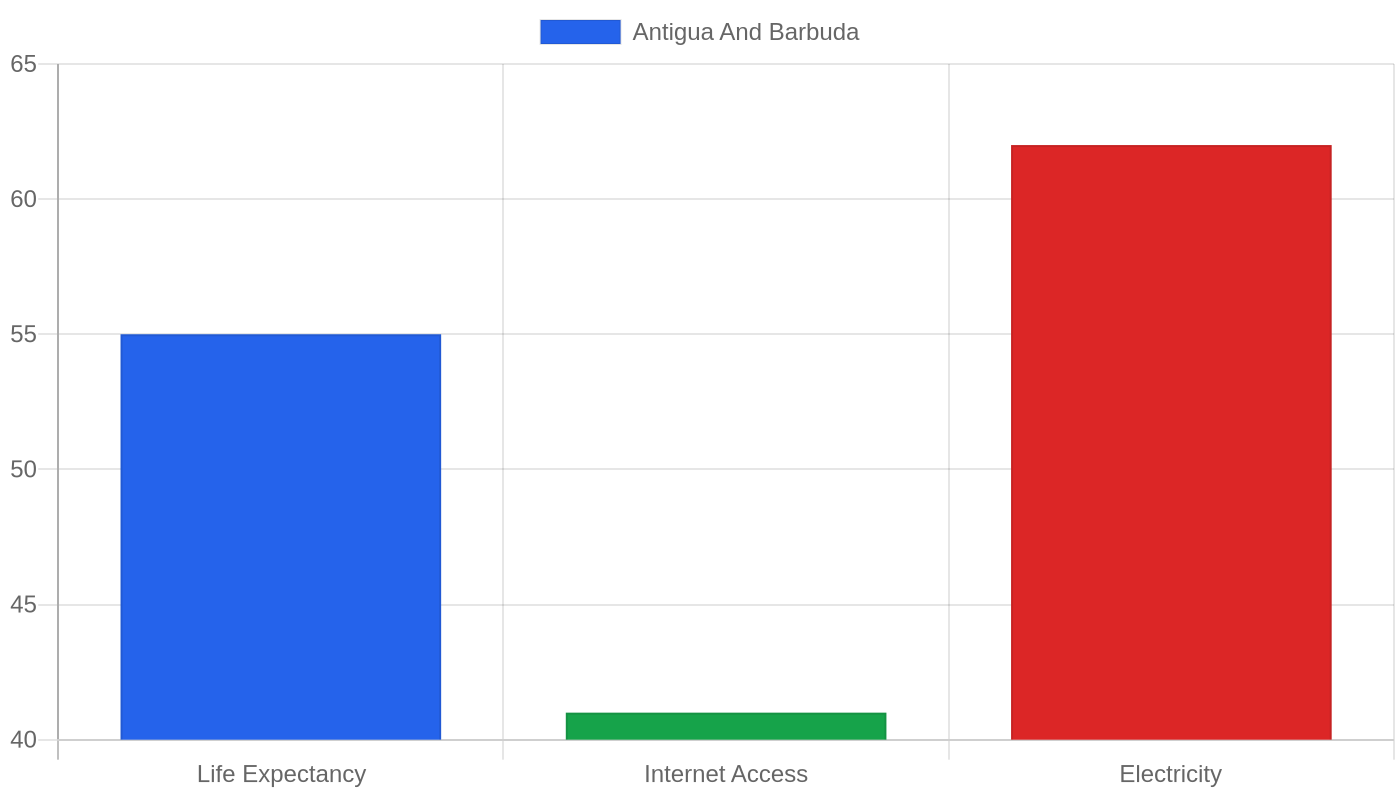
Economic Pulse Net | Sources: World Bank World Development Indicators, Government Sources | 2026
Key Takeaways
* Constitutional Framework: The nation operates as a unitary parliamentary democracy under a constitutional monarchy, with a governance structure established upon independence in 1981.
Decentralized Governance: A unique political dynamic exists where the island of Barbuda retains significant autonomy, while Antigua is directly governed by the national administration.
Data Transparency Gaps: Current economic metrics, including GDP growth, inflation, and unemployment rates, are not currently reported by the World Bank, indicating a need for reliance on structural rather than quantitative analysis.
Institutional Stability: The political landscape is defined by a clear separation of powers between the two islands, providing a stable foundation for long-term planning despite the absence of recent macroeconomic data points.
The Structural Economy: Beyond the Numbers
The economic narrative of Antigua and Barbuda is currently defined less by volatile quarterly figures and more by its foundational institutional framework. According to the World Bank, specific macroeconomic indicators such as GDP growth, inflation CPI, and unemployment rates are listed as N/A for the latest period.
This absence of real-time numerical data does not imply an absence of economic activity; rather, it highlights the importance of understanding the country’s structural composition over transient statistical fluctuations. Without concrete GDP per capita (PPP) or GNI per capita figures, analysts must look to the underlying industrial base and political stability to gauge health.
The lack of reported population data further complicates precise per-capita assessments, forcing a focus on aggregate capacity and sectoral resilience. In this context, the “N/A” designations serve as a reminder that small island developing states often face challenges in consistent data reporting, yet their economies remain active and structured around distinct pillars.
Understanding these gaps is crucial for investors who might otherwise misinterpret silence as stagnation, when it may simply reflect reporting lags inherent to smaller jurisdictions.
Living Standards and Daily Expenses
Assessing the cost of living in Antigua and Barbuda requires navigating a landscape where specific housing and expense indices are not explicitly quantified in the provided dataset. With no available data on rent versus buy ratios or daily consumer expenses, prospective residents and expatriates must rely on general regional knowledge rather than hard statistics from the World Bank.
Typically, island nations with tourism-driven economies experience higher costs for imported goods and housing, but without specific inflation CPI figures, these assumptions cannot be rigorously verified against current trends. The absence of crime and safety indices also leaves a blind spot regarding the qualitative aspect of daily life, making it difficult to correlate safety perceptions with economic comfort.
However, the known political structure suggests a level of social order derived from its status as a parliamentary democracy. Potential inhabitants should anticipate a lifestyle influenced by the country’s dual-island geography, where resources and amenities may vary between the nationally governed Antigua and the autonomous Barbuda.
Investment Climate and Corporate Landscape
For businesses looking to enter the market, the corporate environment is characterized by a lack of publicly listed top companies in the current data set, suggesting a market dominated by private enterprises or state-linked entities not captured in standard global databases. The World Bank provides no specific details on major corporations, meaning investment decisions must be based on sectoral potential rather than competitor analysis.
The political landscape offers a predictable operating environment, anchored by the Constitution adopted in 1981, which replaced earlier agreements that failed to clearly define inter-island relations. This legal clarity reduces regulatory uncertainty for foreign direct investment, particularly in sectors like tourism and financial services, which are traditional staples of the Antiguan economy.
While specific industry breakdowns are missing from the provided text, the emphasis on a constitutional monarchy implies a legal system rooted in common law traditions, familiar to many international investors. Companies should view the business climate through the lens of institutional stability rather than competitive density, given the opaque nature of the current corporate registry data.
Safety, Politics, and Quality of Life
The quality of life in Antigua and Barbuda is underpinned by a robust political framework that prioritizes democratic representation and local autonomy. As a unitary parliamentary democracy under a constitutional monarchy, the country benefits from established checks and balances that have been in place since its independence on November 1, 1981. This historical continuity contributes to a sense of civic stability, even though specific crime indices and safety scores are not available in the current dataset.
The governance model is distinctly bifurcated: Barbuda maintains substantial autonomy, allowing for localized decision-making that can enhance community satisfaction, while Antigua remains under direct national control. This arrangement prevents the centralization of power and addresses historical grievances regarding the relationship between the two islands.
For citizens and residents alike, this political structure offers a degree of security and predictability that is often lacking in regions with weaker institutional histories. The absence of happiness data or detailed safety metrics means that the overall appeal of the country rests heavily on its reputation as a stable, lawful jurisdiction within the Caribbean.
What’s Happening Now: Institutional Evolution
Currently, the most significant developments in Antigua and Barbuda relate to the ongoing refinement of its internal governance structures rather than sudden economic shocks. The nation continues to operate under the Constitution adopted at independence, which has successfully replaced the pre-independence framework of the Associated State of Antigua.
That earlier constitution was criticized for not thoroughly defining the relationship between the two islands, a gap that the current system seeks to address through clearer administrative divisions. Recent political discourse likely focuses on maintaining the balance between the national government’s authority in Antigua and the autonomous powers of Barbuda. This delicate equilibrium is critical for national unity and effective policy implementation across both territories.
With no recent election results or new legislative reforms detailed in the provided data, the “news” is essentially the steady maintenance of this constitutional order. Stakeholders should watch for any shifts in the autonomy arrangements for Barbuda, as these could signal broader changes in the national political landscape.
The Bottom Line
Antigua and Barbuda presents a case study in political stability and constitutional maturity rather than rapid economic expansion. Investors and observers should prioritize the country’s strong democratic institutions and clear governance model over fleeting macroeconomic indicators that are currently unavailable. The unique autonomy granted to Barbuda offers a distinctive approach to regional management that could influence future policy innovations.
Ultimately, this nation is best suited for those seeking a low-risk, high-stability environment in the Caribbean, provided they are comfortable with limited real-time data transparency.
Sources & Methodology
This article is authored by Economic Pulse Net for informational and research purposes. Economic Pulse Net sources its data from multilateral institutions, national statistics bureaus, and proprietary databases. All data is believed to be current as of the date of publication.
Published: October 12, 2026 | Category: Research — Antigua And Barbuda
Use these signals in your own platform
Economic Pulse publishes its live signal feed through a documented, read-only API. Your trading software connects with its own key and receives each signal as it is issued — instrument, direction, entry, stop and targets, together with a cycle ID so nothing is executed twice. The feed is independent of this website and cannot change it.
Signals are informational only and are not financial advice.