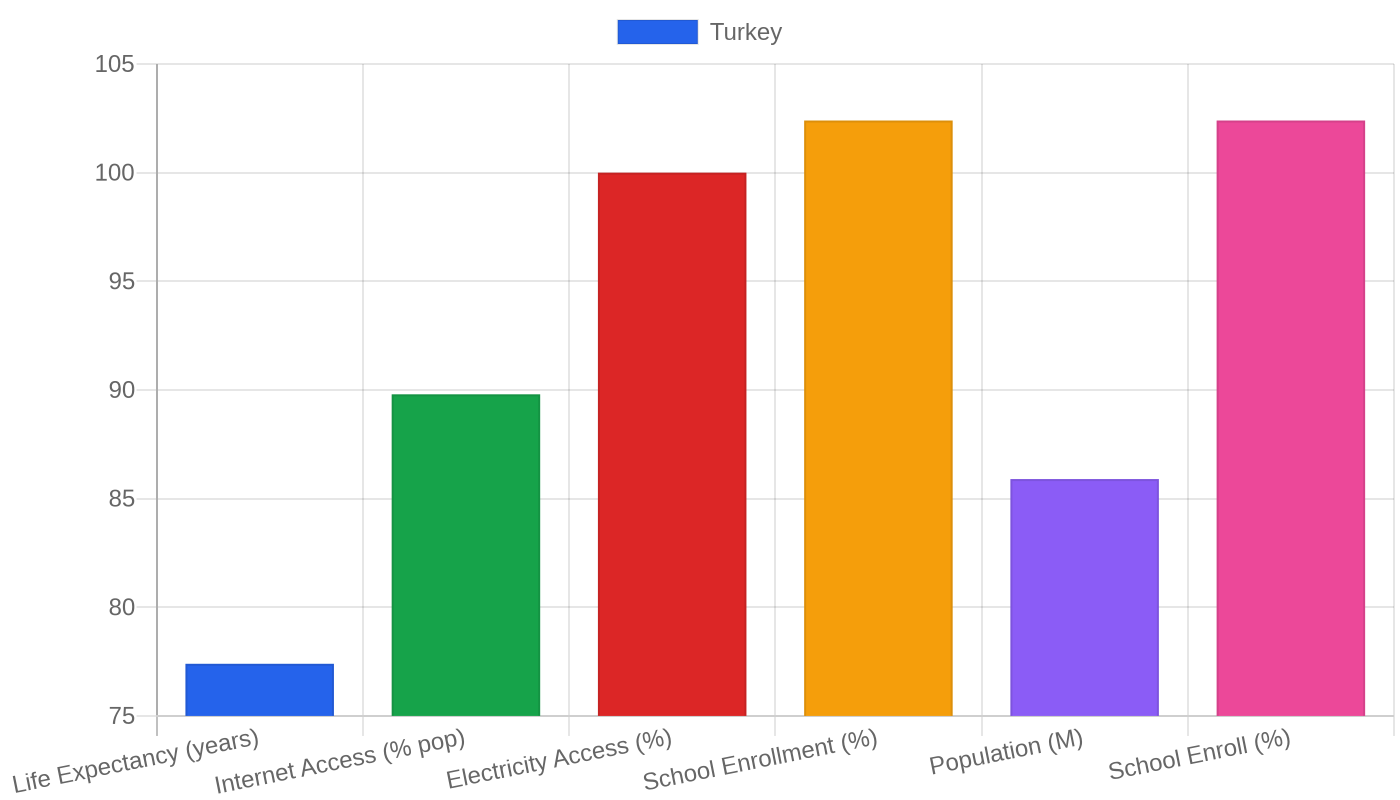
Economic Pulse Net | Sources: World Bank World Development Indicators, Government Sources | 2026
Key Takeaways
* Robust Growth vs. Price Pressures: Turkey’s economy is expanding at a solid pace of 3.6% in 2025, yet this growth occurs against a backdrop of persistent high inflation, with the Consumer Price Index (CPI) hovering near 34.9%.
Large Economic Footprint: As one of the world’s larger economies by nominal GDP, Turkey boasts a gross domestic product exceeding $1.59 trillion, supported by a population of nearly 86 million people.
Political Tightening: The nation operates under a presidential republic that has increasingly been characterized as a competitive or fully authoritarian system due to judicial capture and repression of dissent.
Industrial Base Strength: Major domestic conglomerates dominate key sectors including financials, industrials, consumer goods, and telecommunications, providing a stable core for business operations despite macroeconomic volatility.
Economic Engine: Growth Amidst Volatility
Turkey’s economic landscape in 2025 presents a complex duality of strong expansion and significant price instability. According to World Bank data, the country’s GDP growth rate stands at approximately 3.6%, indicating a resilient engine capable of absorbing external shocks while maintaining momentum. This growth contributes to a total GDP of roughly $1.597 trillion, underscoring Turkey’s status as a major emerging market player with substantial aggregate economic output.
However, the benefits of this growth are tempered by severe inflationary pressures; the CPI has reached nearly 34.9%, eroding purchasing power and complicating long-term planning for both consumers and businesses. Unemployment remains at 8.52%, suggesting that while the economy is growing, labor market absorption is not keeping pace with the expansion of output.
On a per-capita basis, the picture is mixed: while GDP per capita measured by Purchasing Power Parity (PPP) is robust at over $45,000, the GNI per capita sits lower at $16,300, highlighting disparities in income distribution and wealth retention within the population of 85.9 million. These figures matter because they reveal an economy that is large and active but faces structural challenges in translating nominal growth into stable, affordable prosperity for its citizens.
Cost of Living: The Burden of High Prices
The daily reality for residents in Turkey is heavily influenced by the sharp divergence between nominal economic growth and actual living costs. With inflation rates approaching 35%, the cost of essential goods and services has risen dramatically, placing significant strain on household budgets across the nation.
While specific rental indices are not provided in the current dataset, the high CPI suggests that housing, food, and utility costs have likely surged, making affordability a critical concern for the middle class and low-income earners alike. For expatriates or investors, the gap between PPP-adjusted income ($45,288) and nominal GNI ($16,300) indicates that while local purchasing power may be higher than nominal wages suggest, the overall environment requires careful financial management.
Compared to regional averages where inflation might be more contained, Turkey’s price environment demands that businesses and individuals account for rapid erosion of value in cash holdings. Consequently, budgeting for daily expenses involves navigating a volatile market where prices can shift significantly within short timeframes, affecting everything from basic groceries to durable goods purchases.
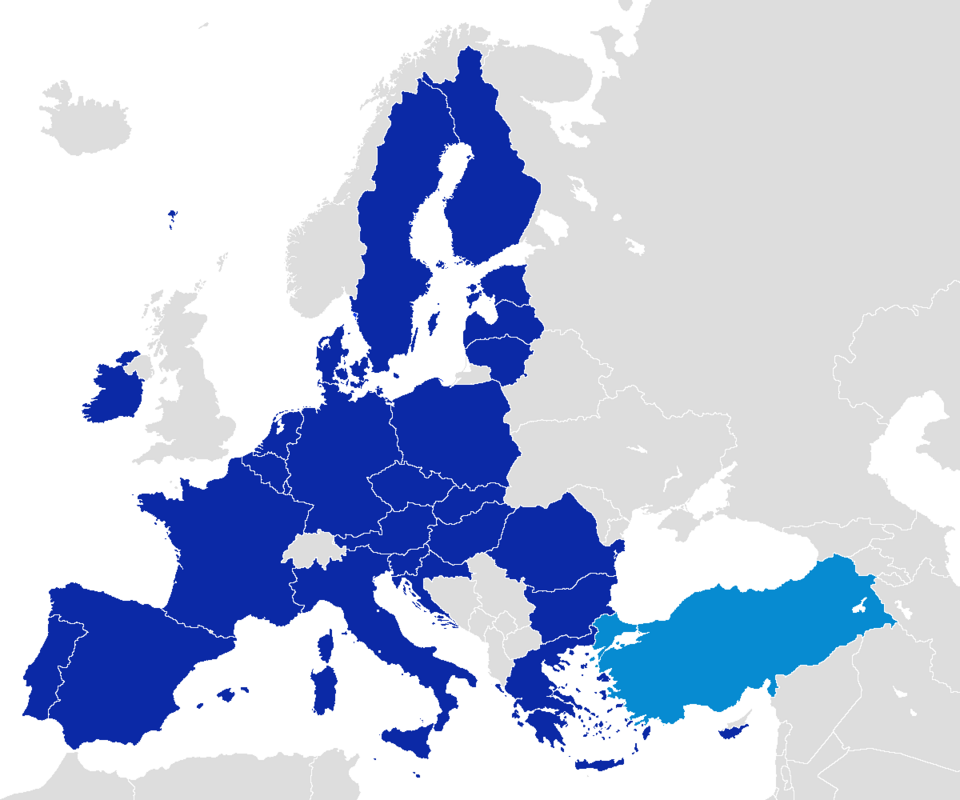
Investment & Business Climate: Conglomerates Lead the Way
Despite macroeconomic headwinds, Turkey’s corporate sector remains vibrant, anchored by a diverse array of established industrial and service giants. The business landscape is dominated by major players such as Akbank in financials, which provides critical banking infrastructure, and Alarko Holding in industrials, reflecting the country’s strong manufacturing base.
In the consumer goods sector, brands like Arçelik and Anadolu Isuzu demonstrate Turkey’s capacity for producing high-quality, export-ready products that compete globally. Meanwhile, companies like Avea in telecommunications and Aselsan in defense-industrial applications highlight strategic sectors where technology and national security intersect, offering potential avenues for specialized investment.
Basic materials firms such as Aksa and Arkem further illustrate the depth of Turkey’s industrial supply chain, supporting both domestic construction and international trade. For foreign investors, these entities represent points of entry into a market that, while politically constrained, possesses a sophisticated private sector capable of navigating regulatory complexities.
The presence of such diversified holdings suggests that opportunities exist in both traditional industries and emerging tech-driven segments, provided investors remain attuned to the shifting political winds.
Safety, Politics & Quality of Life: A Changing Social Fabric
Turkey’s social and political environment is undergoing a profound transformation that impacts quality of life and safety perceptions. Politically, the nation functions as a presidential republic within a multi-party framework, but recent years have seen a consolidation of power that many observers describe as moving toward a competitive or fully authoritarian system.
Reports of judicial capture, imprisonment of opposition politicians, and repression of protest movements indicate a tightening space for civil liberties and free expression. The 1982 Constitution continues to define the state’s structure, but its application is increasingly viewed through the lens of executive dominance rather than democratic checks and balances.
Regarding safety, specific crime and safety indices are currently listed as N/A, leaving a gap in quantifiable metrics for personal security assessments. However, the political climate itself introduces a form of institutional risk that affects the broader sense of stability and rule of law. For residents and visitors, this means that while physical crime statistics may be unclear, the political atmosphere demands heightened awareness of legal and civic boundaries.
The interplay between state control and societal unrest creates an environment where quality of life is closely tied to one’s alignment with or distance from prevailing political narratives.
What’s Happening Now: Navigating the New Normal
Currently, Turkey is grappling with the immediate aftermath of policy shifts aimed at stabilizing its high-inflation economy while managing political tensions. The government’s approach to monetary policy and fiscal discipline appears to be evolving in response to the sustained 34.9% inflation rate, forcing businesses to adapt to rapidly changing cost structures.
Recent developments suggest a focus on maintaining the 3.6% growth trajectory despite the pressure on consumer spending power, indicating a delicate balancing act between stimulus and restraint. In the corporate sphere, major companies continue to expand their operational footprints, leveraging Turkey’s strategic location and large population base to drive revenue even amid uncertainty.
Political discourse remains intense, with the administration facing criticism over human rights practices and judicial independence, which could influence international relations and foreign investment flows. Simultaneously, the labor market’s 8.52% unemployment rate highlights ongoing challenges in job creation, prompting debates over educational reforms and industrial incentives.
As we move through 2025, the key theme is resilience; stakeholders are watching closely to see whether economic stabilization measures will gain traction or if political consolidation will further isolate the country from global norms.
The Bottom Line
Turkey offers a compelling but cautionary case study for investors and analysts seeking exposure to emerging markets with significant scale and industrial depth. The country’s ability to generate $1.6 trillion in GDP growth amidst 35% inflation demonstrates remarkable economic agility, albeit at a high social cost.
Prospective participants must weigh the opportunities presented by dominant local corporations against the risks associated with an increasingly authoritarian political framework and volatile price levels. Ultimately, Turkey remains a critical node in Eurasian trade and industry, requiring a nuanced, long-term perspective that accounts for both its economic potential and its political realities.
Sources & Methodology
This article is authored by Economic Pulse Net for informational and research purposes. Economic Pulse Net sources its data from multilateral institutions, national statistics bureaus, and proprietary databases. All data is believed to be current as of the date of publication.
Published: October 04, 2026 | Category: Research — Turkey
Use these signals in your own platform
Economic Pulse publishes its live signal feed through a documented, read-only API. Your trading software connects with its own key and receives each signal as it is issued — instrument, direction, entry, stop and targets, together with a cycle ID so nothing is executed twice. The feed is independent of this website and cannot change it.
Signals are informational only and are not financial advice.