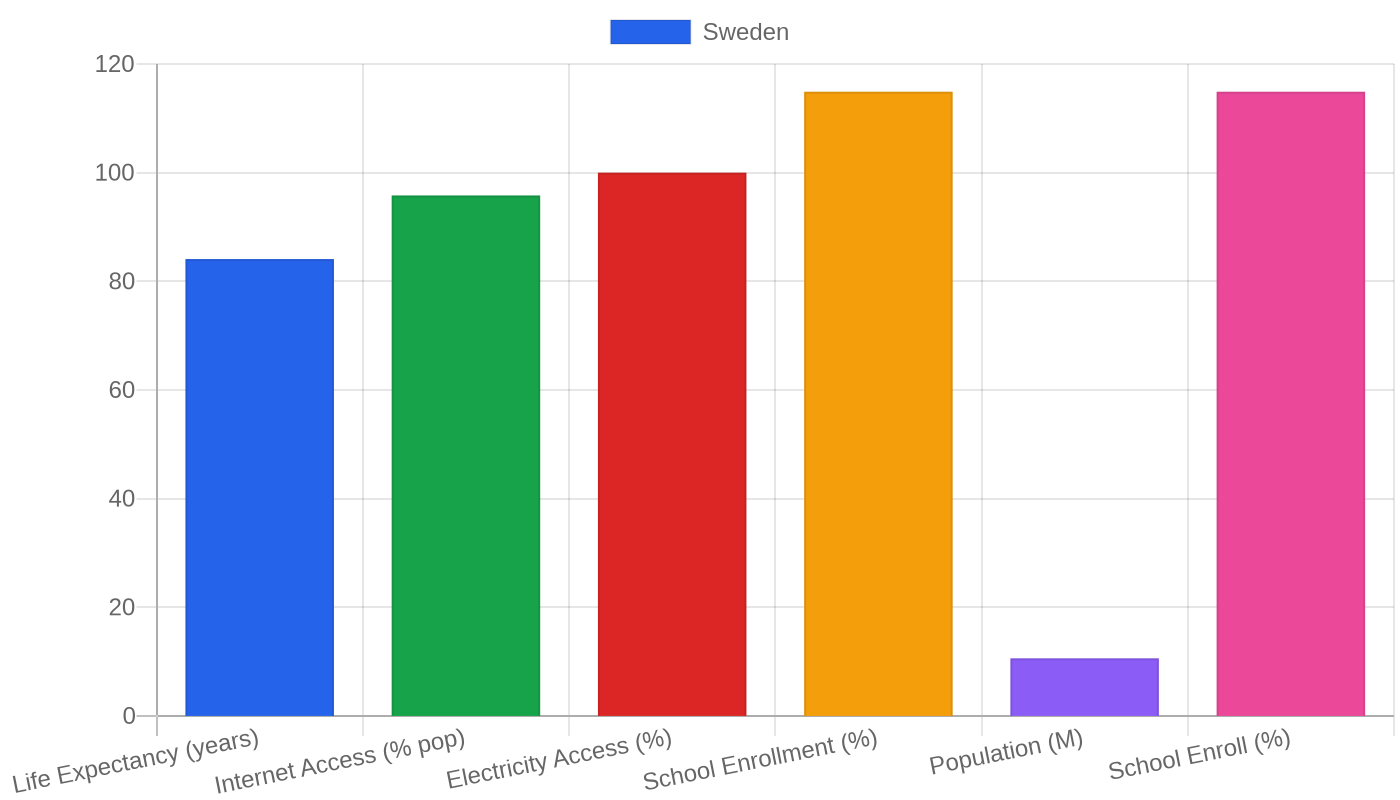
Economic Pulse Net | Sources: World Bank World Development Indicators, Government Sources | 2026
🇸🇪 Sweden 2025: Steady Growth Amidst High Unemployment
Key Takeaways
- Modest Economic Expansion: According to the World Bank, Sweden’s GDP is projected to grow by approximately 1.54% in 2025, signaling a period of stability rather than rapid acceleration.
- Low Inflation Environment: Consumer Price Index (CPI) inflation remains exceptionally low at roughly 0.68%, providing significant purchasing power relief for households and businesses.
- Elevated Unemployment Challenge: Despite stable growth, the unemployment rate stands at 8.69%, indicating a labor market that is not fully absorbing the workforce.
- High Standard of Living: With a GDP per capita (PPP) of over $72,000, Sweden maintains one of the highest standards of living globally, supported by a robust social safety net.
- Diverse Corporate Landscape: The business sector is anchored by a mix of technology, industrial, and consumer goods firms, reflecting a diversified economic base.
A Stable Economy in the Slow Lane
The Swedish economy in 2025 is defined by a quiet steadiness rather than dynamic surges.
According to data from the World Bank, the country’s Gross Domestic Product (GDP) is estimated at approximately $669 billion, with a growth rate of 1.54316373266217%.
While this figure may appear modest compared to high-growth emerging markets, it represents a resilient performance for a mature, developed economy.
This moderate expansion suggests that while the engine is turning, it is not revving at full throttle, which is typical for large, industrialized nations navigating global headwinds.
One of the most striking aspects of the current economic landscape is the taming of inflation.
The World Bank reports a Consumer Price Index (CPI) inflation rate of just 0.679869285243995%.
In plain English, this means that the cost of everyday goods and services is rising at a nearly negligible rate.
For the average Swede, this translates to preserved purchasing power; wages that might be stagnant elsewhere are effectively growing in real terms because prices are not eroding their value.
This low-inflation environment is a critical component of the Swedish model, allowing for stable monetary policy and predictable business planning.
However, the labor market presents a more complex picture.
The unemployment rate sits at 8.694% (World Bank), a figure that remains notably higher than the historical lows often associated with Nordic economies.
This suggests that while the economy is growing, it is not doing so at a pace sufficient to rapidly reduce joblessness.
The gap between economic output and employment absorption is a key area of focus for policymakers.
Despite this, the overall wealth distribution remains strong, with a GNI per capita of $63,010 and a GDP per capita (PPP) of $72,528.89, indicating that the average citizen still enjoys a very high standard of living relative to the global average.
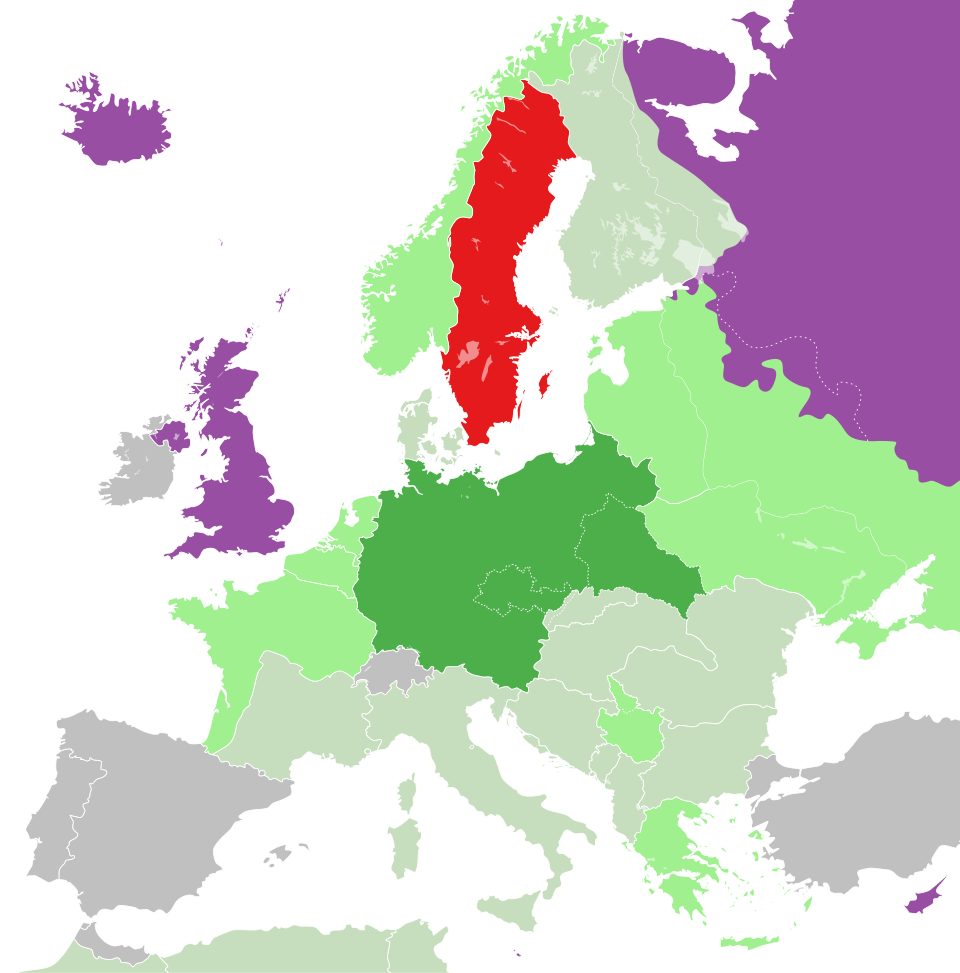
The High Price of Comfort
Living in Sweden comes with a premium, a reality reflected in the country’s high income levels.
While specific cost-of-living breakdowns are not detailed in the current dataset, the high GDP per capita of over $72,000 (PPP) implies that daily expenses, particularly for housing, utilities, and food, are significantly above global averages.
For residents, this high cost is often balanced by the quality of public services, including healthcare and education, which are largely funded through the tax system.
The concept of “rent vs. buy” in Sweden is influenced by this high baseline cost.
Given the substantial income levels, many Swedes can afford the high price tags associated with property ownership, though the high cost of living means that savings are often directed toward maintaining quality of life rather than aggressive asset accumulation.
The low inflation rate of 0.68% (World Bank) offers a slight buffer, as the real cost of these expenses does not escalate rapidly.
This stability is crucial for long-term financial planning, allowing households to predict their spending with greater confidence than in countries experiencing double-digit inflation.
Innovation and Industry: The Corporate Backbone
Sweden’s business environment is characterized by a strong culture of innovation and a diverse array of leading companies.
The top companies list reveals a balanced mix of sectors, from healthcare and technology to consumer goods and industrials.
Firms such as 3H Biomedical in healthcare and Acando and Acast in technology highlight the country’s strength in the digital and biomedical sectors.
These companies are not just local players but often have significant international reach, contributing to the export-driven nature of the Swedish economy.
The presence of established brands like Acne Studios and Abba Seafood in consumer goods demonstrates that Swedish design and quality are recognized globally.
Meanwhile, industrials giants like AFRY and energy-related entities like AGA indicate a robust foundation in manufacturing and resource management.
This diversity ensures that the economy is not overly reliant on a single sector, providing resilience against sector-specific shocks.
The business climate benefits from the stability of the macroeconomic environment, with low inflation and moderate growth creating a predictable backdrop for corporate investment and expansion.
Safety, Politics, and the Social Contract
Sweden’s political landscape is deeply rooted in its tradition of “popular movements” (Folkrörelser), which have historically driven social change through trade unions, women’s movements, and other civic groups.
This legacy continues to shape the country’s approach to governance, emphasizing consensus, social welfare, and individual rights.
Notably, Sweden was the first country in the world to outlaw corporal punishment of children by their parents, a landmark decision that began with the removal of the “right to spank” in 1966 and was explicitly prohibited by law thereafter.
This early adoption of progressive social policies reflects a societal commitment to the well-being of individuals, particularly the vulnerable.
Regarding safety, specific Crime and Safety Index data are currently not available in the provided dataset.
However, the strong social fabric and high levels of trust inherent in the Swedish model suggest a generally secure environment.
The political involvement of ordinary people ensures that policy decisions are often aligned with broad societal values, fostering a sense of inclusion and stability.
The focus on intellectual property and piracy movements, mentioned in the historical context, also points to an ongoing cultural and legal debate about access to information and creativity, which is a relevant issue in the digital age.
Current Affairs: Navigating the 2025 Landscape
As 2025 progresses, the Swedish economy is navigating a period of cautious optimism.
The World Bank’s projection of 1.54% GDP growth suggests that the country is maintaining its footing in a challenging global environment.
The low inflation rate of 0.68% is a significant positive development, as it allows the central bank and government to focus on structural issues rather than emergency measures to curb price rises.
However, the unemployment rate of 8.69% remains a critical challenge that requires targeted policy interventions, such as workforce retraining and support for sectors experiencing slower growth.
The business sector is likely focusing on maintaining competitiveness in a low-growth environment.
Companies like Acast and Acando, which are part of the technology sector, may be driving innovation to offset slower traditional industrial growth.
The political landscape, influenced by long-standing social movements, is likely to continue advocating for strong social safety nets and labor protections, which can impact business costs but also contribute to social stability.
As the year unfolds, the interplay between maintaining low inflation, reducing unemployment, and supporting innovation will be the key determinants of Sweden’s economic trajectory.
The Bottom Line
Sweden in 2025 presents a compelling case for those seeking stability and high quality of life, even if hyper-growth is not on the menu.
The combination of low inflation, high per capita wealth, and a diversified corporate base makes it a resilient economy.
However, the elevated unemployment rate is a clear signal that the labor market needs attention.
For investors and observers, the key takeaway is that Sweden is a “steady hand” in the global economic deck—a place where the fundamentals are strong, the social contract is intact, and the focus is on sustainable, human-centered progress rather than rapid expansion.
Sources & Methodology
This article is authored by Economic Pulse Net for informational and research purposes.
Economic Pulse Net sources its data from multilateral institutions, national statistics bureaus, and proprietary databases.
All data is believed to be current as of the date of publication. Published: September 03, 2026 |
Category: Research — Sweden
Use these signals in your own platform
Economic Pulse publishes its live signal feed through a documented, read-only API. Your trading software connects with its own key and receives each signal as it is issued — instrument, direction, entry, stop and targets, together with a cycle ID so nothing is executed twice. The feed is independent of this website and cannot change it.
Signals are informational only and are not financial advice.