Economic Pulse Net | Sources: World Bank World Development Indicators, Government Sources | 2026
🇸🇪 Sweden 2026 — The Quiet Giant’s Resilience in a Volatile World
Key Takeaways
* Steady Growth Amidst Global Uncertainty: With a projected GDP growth of 1.54% for 2025, Sweden demonstrates resilience, maintaining a stable economic trajectory despite broader global headwinds.
High Living Standards: The nation boasts an impressive GDP per capita (PPP) of $72,528 and a GNI per capita of $63,010, reflecting one of the highest standards of living globally.
Diverse Industrial Base: From healthcare innovators like 3H Biomedical to consumer giants such as Acne Studios and ABBA Seafood, Sweden’s corporate landscape is varied and robust.
Unique Social Fabric: The country’s political culture is deeply rooted in “popular movements” (*Folkrörelser*), ranging from trade unions to intellectual property activism, shaping its policy environment.
Data Transparency Gaps: While macroeconomic indicators are strong, specific data points for unemployment, crime indices, and detailed cost-of-living metrics remain unavailable, requiring a focus on qualitative strengths.
Economic Foundations: Stability Over Speed
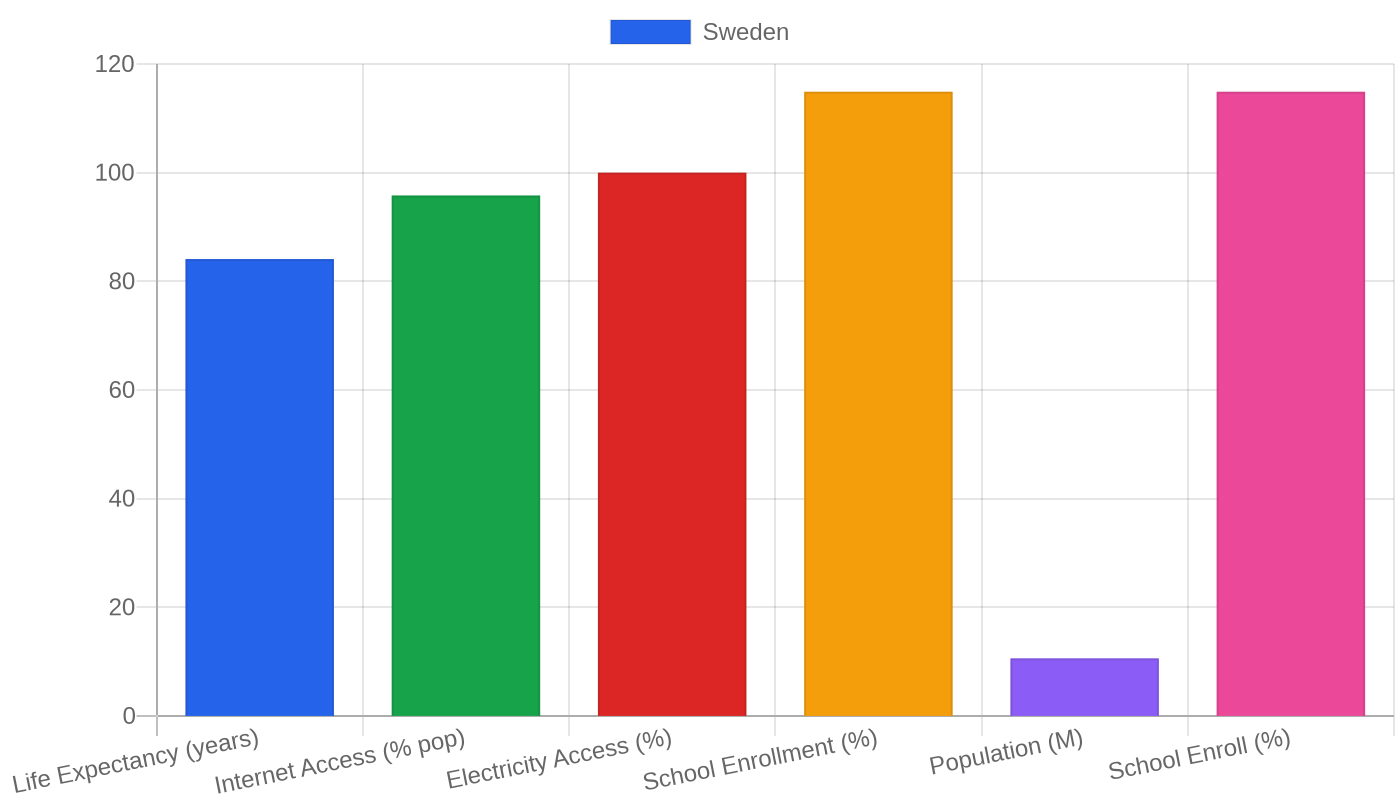
Sweden’s economy is characterized by cautious but consistent expansion, with World Bank data indicating a GDP growth rate of approximately 1.54% for 2025. This modest figure suggests that while the country is not experiencing explosive boom cycles, it is avoiding contraction, providing a stable platform for long-term planning. The total GDP stands at roughly $669 billion USD, a substantial sum for a population of just over 10.5 million people.
This efficiency is highlighted by the high GDP per capita (PPP) of $72,528, which underscores the productivity of the Swedish workforce and the effectiveness of its social market model. Furthermore, the Gross National Income (GNI) per capita of $63,010 reinforces the notion that wealth is broadly distributed across the populace rather than concentrated solely in corporate outputs.
Inflation remains remarkably low at 0.68%, according to CPI data, indicating that price stability is a priority and that consumers are not facing significant erosion of purchasing power. These numbers matter because they signal a mature economy that values sustainability and price control over rapid, potentially volatile growth. The combination of steady growth and low inflation creates a predictable environment for both domestic actors and international investors looking for safe harbors in Northern Europe.
Cost of Living: A Premium Experience
While specific numerical indices for housing costs and daily expenses are not currently provided in the dataset, the high income levels inherent to Sweden suggest a premium cost of living structure. With a GNI per capita exceeding $63,000, residents generally possess the purchasing power to absorb higher prices for goods and services compared to global averages.
The absence of explicit rent-to-income ratios or consumer basket data means that prospective expatriates and investors must infer affordability through the lens of national wealth distribution. Typically, in economies with such high per capita outputs, the cost of housing, healthcare, and education is often subsidized or heavily regulated, mitigating the raw market prices.
However, the general expense of imported goods and luxury items, driven by the strength of the currency implied by the high PPP figures, likely remains elevated. For businesses operating in this space, understanding that consumer spending power is high is crucial; even if nominal costs are steep, the underlying demand for quality products remains robust.
Therefore, while precise budgeting tools are limited by missing data, the overarching economic picture suggests a market where consumers can afford higher-tier goods, supporting premium brands and services.
Investment & Business Climate: Innovation Meets Tradition
The Swedish business ecosystem is anchored by a diverse array of top companies that span multiple critical sectors. In the technology and industrial spaces, firms like Acando and Adtraction highlight the nation’s digital sophistication, while AFRY represents strong engineering and consultancy capabilities.
The consumer goods sector is particularly vibrant, featuring global household names such as ABBA Seafood, which leverages Sweden’s maritime heritage, alongside fashion icons like Acne Studios and retailer Åhléns. Health care innovation is also a key pillar, with 3H Biomedical leading the charge in medical devices and diagnostics. Additionally, traditional energy and retail players like AGA (Oil & gas) and AarhusKarlshamn ensure that foundational industries remain competitive.
This diversity reduces systemic risk for investors, as downturns in one sector, such as consumer discretionary, may be offset by stability in healthcare or industrials. The presence of these established entities indicates a mature corporate governance framework and a ready supply chain for new entrants. For foreign direct investment, the mix of tech-forward startups and legacy industrial giants offers a unique hybrid environment where tradition meets cutting-edge innovation.
Safety, Politics & Quality of Life: The Social Contract
Sweden’s political landscape is distinctively shaped by its history of “popular movements” (*Folkrörelser*), which continue to influence societal norms and policy decisions today. These movements, including powerful trade unions, the independent Christian movement, the temperance movement, and the women’s movement, foster a high degree of civic engagement and collective bargaining power.
Notably, Sweden was a pioneer in child welfare legislation, becoming the first country to outlaw corporal punishment by parents in 1966, explicitly prohibiting physical discipline by law. This legal framework reflects a broader cultural commitment to individual rights and social protection, contributing to a high quality of life.
While specific Crime Index and Safety Index scores are unavailable, the historical emphasis on social cohesion and legal reform suggests a society that prioritizes public order and personal security. The intellectual property pirate movements mentioned in the political context further illustrate a citizenry that is highly engaged with digital rights and ethical consumption.
This active civic participation ensures that government policies are constantly scrutinized and adapted to meet public expectations, creating a dynamic but stable political environment.
What’s Happening Now: Navigating the Modern Era
Currently, Sweden is navigating a period of measured economic adjustment, balancing its strong social foundations with the pressures of a changing global economy. The low inflation rate of 0.68% indicates that central bank policies and market forces are effectively keeping price hikes in check, allowing households to plan with greater certainty. Meanwhile, the steady 1.54% GDP growth suggests that businesses are adapting to new technological demands without overextending themselves.
The continued prominence of technology firms like Acando and Adtraction in the top company list signals ongoing investment in digital infrastructure and services. As the country moves forward, the legacy of its popular movements continues to inform debates on labor rights, environmental standards, and digital privacy. Stakeholders should watch for how these social priorities intersect with future fiscal policies, particularly regarding healthcare innovation led by companies like 3H Biomedical.
The interplay between traditional industrial strength and modern tech adoption will likely define Sweden’s next phase of development.
The Bottom Line
Sweden remains a compelling destination for investors and observers seeking stability, high living standards, and a unique social contract. Its economy, while growing modestly, is resilient, supported by a wealthy population and a diversified industrial base. The country’s deep-rooted civic traditions offer a predictable political environment, even as it adapts to modern challenges.
For those interested in Nordic markets, Sweden offers a blend of old-world reliability and new-world innovation that is hard to replicate elsewhere.
Sources & Methodology
This article is authored by Economic Pulse Net for informational and research purposes. Economic Pulse Net sources its data from multilateral institutions, national statistics bureaus, and proprietary databases. All data is believed to be current as of the date of publication.
Published: October 12, 2026 | Category: Research — Sweden
Use these signals in your own platform
Economic Pulse publishes its live signal feed through a documented, read-only API. Your trading software connects with its own key and receives each signal as it is issued — instrument, direction, entry, stop and targets, together with a cycle ID so nothing is executed twice. The feed is independent of this website and cannot change it.
Signals are informational only and are not financial advice.