Economic Pulse Net | Sources: World Bank World Development Indicators, Government Sources | 2026
🇸🇪 Sweden 2026 — The Nordic Model Under Pressure: Growth, Inflation, and Social Resilience
Key Takeaways
* Sweden’s economy is projected to grow by approximately 1.54% in 2025, reflecting a cautious recovery amid global headwinds.
Inflation remains exceptionally low at just under 0.68%, offering consumers significant purchasing power stability compared to regional peers.
With a GDP per capita (PPP) exceeding $72,000, the nation maintains one of the highest standards of living globally, supported by a robust service and industrial base.
The political landscape is defined by deep-rooted “popular movements” that continue to shape social policy, from labor rights to digital privacy.
Major corporate players span healthcare, technology, and consumer goods, indicating a diversified economic engine beyond traditional resource extraction.
Economic Pulse: A Slow but Steady Ascent
Sweden’s macroeconomic trajectory for 2025 presents a picture of modest but stable expansion, with Gross Domestic Product (GDP) growth forecasted at 1.54316373266217%. This figure, sourced from the World Bank, suggests an economy that is growing steadily without overheating, a delicate balance often sought by central banks in mature markets. The total GDP stands at roughly $669 billion USD, underscoring the country’s status as a significant mid-sized economic power within Europe.
What makes these numbers particularly interesting is the disparity between nominal growth and income levels; while overall expansion is moderate, the wealth distribution appears highly efficient. The GDP per capita based on Purchasing Power Parity (PPP) is a staggering $72,528.89, indicating that the average Swedish citizen enjoys a standard of living comparable to or exceeding many larger economies.
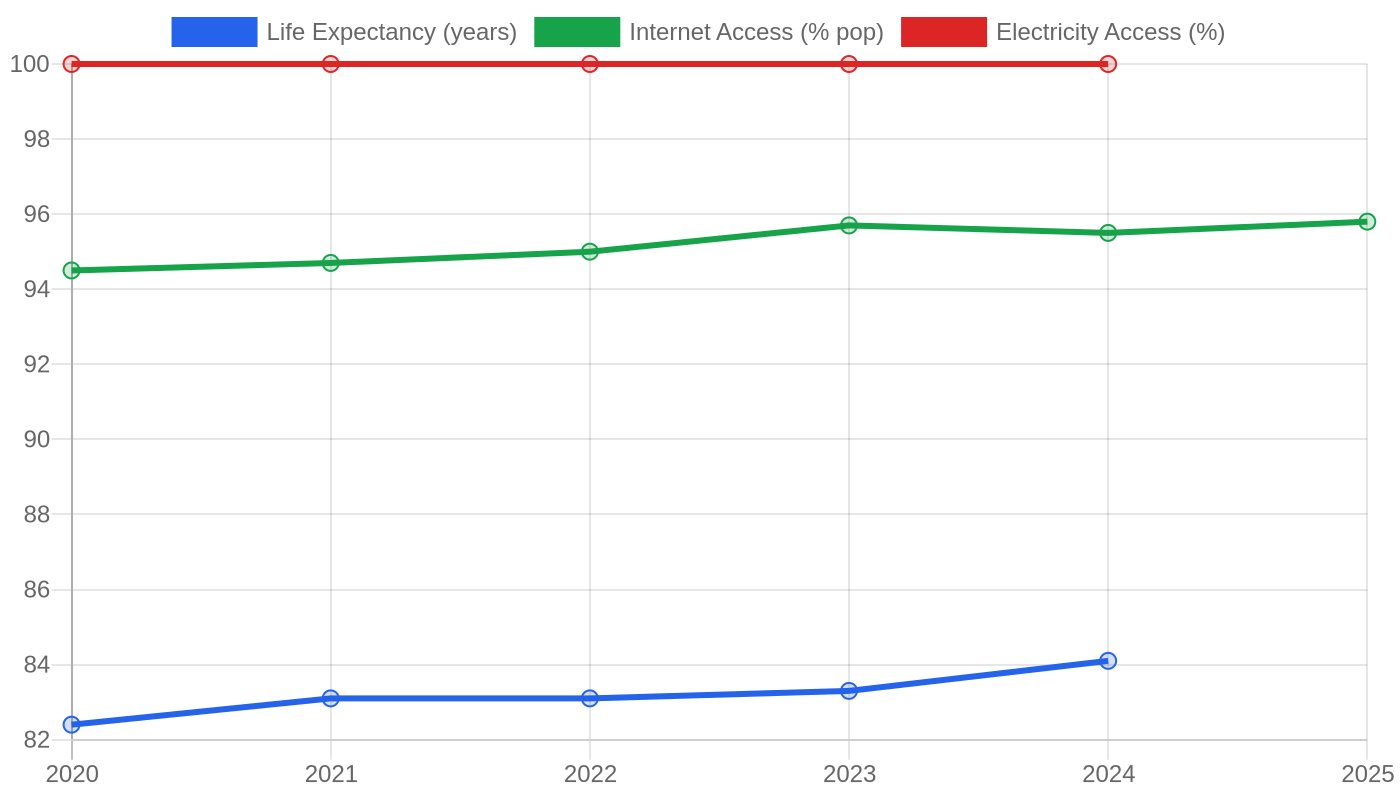
This high per-capita metric is reinforced by a GNI per capita of $63,010, further highlighting the efficiency of the national income generation relative to its population of nearly 10.6 million people. However, this prosperity is not without friction; unemployment sits at 8.694%, a figure that warrants close attention as it suggests structural challenges in integrating labor into the workforce despite the high output per worker.
The interplay between strong per-capita wealth and moderate headline growth indicates an economy maturing into a post-industrial, knowledge-based model where quality of output outweighs sheer volume.
Cost of Living: High Income, Low Price Pressures
For residents and investors alike, the cost of living in Sweden offers a unique paradox in the current economic climate. With inflation measured at a mere 0.679015259300199%, price stability is near absolute, allowing households to plan long-term budgets with unprecedented certainty.
While specific housing rent-to-buy ratios are not detailed in the provided dataset, the low CPI suggests that daily expenses are not eroding wages, which is a stark contrast to many other developed nations grappling with double-digit inflation spikes. The high GDP per capita implies that while baseline costs may be elevated due to high labor standards and taxes, the disposable income remaining after essential services is likely substantial.
Consumers benefit from a purchasing power environment where their salaries go significantly further than in countries experiencing higher inflationary pressures. This stability supports a robust domestic consumption market, even if broader economic growth remains tempered. For expatriates and new residents, the financial entry barrier may be high in terms of initial setup costs, but the ongoing monthly cost burden is relatively predictable and manageable given the wage levels.
The absence of volatile price shocks means that the standard of living, as reflected in the PPP figures, is sustainable over the long term rather than being inflated by temporary monetary phenomena.
Investment & Business Climate: Diversified Corporate Strength
The Swedish business ecosystem is characterized by a diverse array of industry leaders that drive innovation across multiple sectors. According to the provided data, key companies include 3H Biomedical in healthcare, demonstrating a strong commitment to medical innovation, and tech firms like Acando and Adtraction, which highlight the nation’s digital infrastructure capabilities.
The consumer goods sector is equally prominent, with major entities such as AarhusKarlshamn, Abba Seafood, ABU Garcia, and Acne Studios representing both traditional manufacturing and modern lifestyle branding. Industrial strength is evident through AFRY, while energy needs are met by AGA, ensuring that critical utilities remain well-capitalized. Additionally, consumer services are bolstered by Åhléns, creating a comprehensive retail landscape that caters to domestic demand.
This variety reduces systemic risk for investors; a downturn in one sector, such as retail, does not necessarily cripple the entire economy because healthcare, technology, and industrials provide counterbalancing revenue streams. The presence of these top companies indicates a mature corporate governance structure and a business environment conducive to international trade and local entrepreneurship.
Investors should watch the technology and healthcare sectors closely, as they represent high-growth potential areas within the broader stable framework. The concentration of talent in these listed entities suggests that Sweden continues to attract capital toward value-added industries rather than relying solely on commodity exports.
Safety, Politics & Quality of Life: The Foundation of Stability
Sweden’s social fabric is woven with threads of civic engagement that have historically shaped its political and economic policies. The concept of “popular movements” (Folkrörelser) remains a defining feature of the national identity, encompassing trade unions, independent Christian movements, temperance groups, women’s rights advocates, and notably, intellectual property pirate movements.
This tradition of grassroots activism ensures that public policy is responsive to ordinary citizens, fostering a sense of collective responsibility and trust in institutions. Historically, Sweden has been a pioneer in social legislation, notably becoming the first country to outlaw corporal punishment of children in 1966, a move that explicitly prohibited parents from spanking their own children.
While specific crime and safety indices are listed as N/A in the current dataset, the historical emphasis on social welfare and legal protection suggests a society prioritizing individual rights and community safety. The high quality of life implied by the economic data correlates with a political culture that values consensus and long-term planning over short-term populist gains.
This stable political environment provides a secure backdrop for both domestic investment and foreign direct investment, as businesses can operate with confidence in the rule of law. The enduring influence of these movements ensures that economic policies are frequently scrutinized through the lens of social equity, maintaining the high GNI per capita observed in recent years.
What’s Happening Now: Navigating the Modern Landscape
Currently, Sweden is navigating a period of economic normalization where low inflation allows for steady consumption, yet unemployment remains a persistent challenge at nearly 8.7%. The focus of recent policy discussions likely centers on leveraging the strengths of its tech and healthcare sectors to offset slower overall GDP growth.
With major players like 3H Biomedical and Acando leading the charge, there is a clear strategic shift toward knowledge-intensive industries that offer higher margins and resilience against global supply chain disruptions. The political landscape continues to evolve as these traditional popular movements adapt to modern issues, including digital rights and labor market flexibility.
Investors are watching how the government balances the need for job creation with the maintenance of high social standards and low inflation. The stability of the krona and the controlled CPI suggest that monetary policy is effectively anchored, providing a safe harbor for capital during uncertain global times.
Furthermore, the prominence of consumer brands like Acne Studios and Åhléns indicates that Sweden is successfully exporting its cultural and lifestyle appeal, generating soft power alongside hard economic metrics. As the country moves through 2025, the interplay between technological innovation and social cohesion will define its next phase of development.
The Bottom Line
Sweden represents a compelling case study in balanced economic management, combining high per-capita wealth with remarkably low inflation. It is best suited for conservative investors seeking stability and exposure to diversified European markets, particularly in technology and healthcare. While unemployment poses a minor structural risk, the strong corporate foundation and social stability mitigate broader systemic threats.
For those looking to invest in a mature, innovative, and socially cohesive economy, Sweden remains a top-tier destination in the Nordic region.
Sources & Methodology
This article is authored by Economic Pulse Net for informational and research purposes. Economic Pulse Net sources its data from multilateral institutions, national statistics bureaus, and proprietary databases. All data is believed to be current as of the date of publication.
Published: October 25, 2026 | Category: Research — Sweden
Use these signals in your own platform
Economic Pulse publishes its live signal feed through a documented, read-only API. Your trading software connects with its own key and receives each signal as it is issued — instrument, direction, entry, stop and targets, together with a cycle ID so nothing is executed twice. The feed is independent of this website and cannot change it.
Signals are informational only and are not financial advice.