Economic Pulse Net | Sources: World Bank World Development Indicators, Government Sources | 2026
Key Takeaways
- Resilient Growth: Sweden is maintaining a steady economic pulse with GDP growth of approximately 1.54% in 2025, according to the World Bank, signaling a mature economy focused on stability rather than rapid expansion.
- Deflationary Tendencies: Inflation has cooled significantly to under 1% (0.68%), suggesting that price pressures have eased, which benefits consumers and stabilizes purchasing power.
- High Value Output: Despite a moderate unemployment rate of 8.69%, the country boasts a high GDP per capita on a purchasing power parity basis, exceeding $72,000, reflecting a highly productive workforce.
- Diverse Corporate Landscape: The business sector is driven by a mix of legacy consumer goods brands and emerging technology firms, indicating a robust ecosystem that balances tradition with innovation.
The Numbers Behind the Nordic Steadfastness
To understand the current economic climate in Sweden, one must look beyond the surface level of growth rates and examine the underlying structural health of the nation.
According to the World Bank, Sweden’s GDP growth for 2025 stands at 1.54316373266217%, a figure that, while modest by emerging market standards, represents a healthy and sustainable trajectory for a developed economy.
This growth rate is particularly notable when viewed alongside the country’s total GDP of approximately $668.9 billion, indicating a substantial economic engine that continues to generate significant value.
The inflation rate, measured by the Consumer Price Index, has dropped to a remarkably low 0.679869285243995%, suggesting that the era of high price volatility has receded, allowing for greater predictability in both personal finance and corporate planning.
Employment figures present a more complex picture, with unemployment recorded at 8.694% by the World Bank.
While this rate may appear higher than the historical averages associated with the Nordic model, it must be contextualized within the broader labor market dynamics and the specific methodological definitions used in international comparisons.
What truly defines Sweden’s economic stature, however, is its productivity per individual; the GDP per capita on a purchasing power parity (PPP) basis stands at $72,528.89, underscoring the high standard of living and the efficiency with which the economy converts labor into wealth.
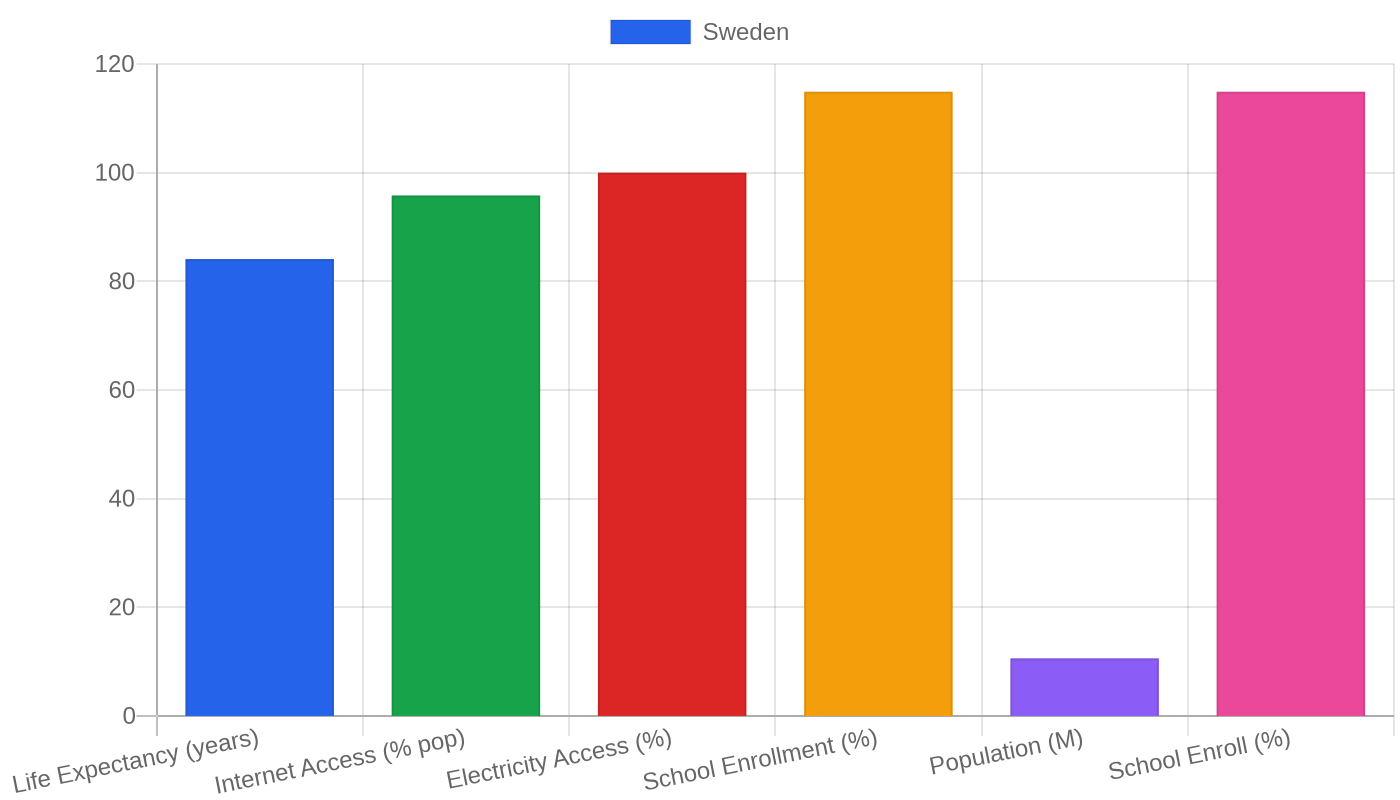
With a population of just over 10.5 million, as reported by the World Bank, Sweden punches above its weight in global economic terms, maintaining a high GNI per capita of $63,010.
These metrics collectively paint a picture of an economy that is not chasing hyper-growth but is instead prioritizing stability, quality of life, and sustainable development.
Living Well: The Economics of Daily Life
The cost of living in Sweden is intrinsically linked to the high productivity and income levels of its residents, creating a balanced ecosystem where high wages often offset higher prices.
While specific housing and retail data points are not detailed in the current dataset, the high GDP per capita of $72,528.89 (PPP) serves as a proxy for the purchasing power available to the average citizen.
This level of income generally supports a standard of living that is among the highest in the world, allowing for significant disposable income even after accounting for the comprehensive social services and taxes that characterize the Nordic model.
The stability of inflation at under 1% further aids in managing daily expenses, as consumers can expect price levels for essentials such as food, energy, and transport to remain relatively predictable.
This economic environment fosters a sense of security, where the cost of living is less of a burden and more of a managed component of a well-structured lifestyle.
For residents, the focus is less on accumulating wealth through asset appreciation and more on maintaining a high quality of life through stable incomes and accessible services.
Innovation and Industry: The Corporate Backbone
Sweden’s business landscape is a fascinating blend of historic consumer brands and cutting-edge technological innovators, reflecting a diverse economic base that is not overly reliant on a single sector.
The top companies in the country, as listed in available data, span a wide array of industries, including healthcare, consumer goods, technology, and industrials.
Notable entities such as 3H Biomedical and Acando highlight the country’s strength in specialized healthcare and technology solutions, sectors that are increasingly critical in the global economy.
On the consumer front, brands like Acne Studios, Åhléns, and Abba Seafood demonstrate Sweden’s enduring influence on global fashion, retail, and food culture, showcasing a strong export-oriented capability in lifestyle and luxury goods.
The presence of firms like AFRY in industrials and AGA in oil and gas further illustrates the nation’s deep roots in engineering and energy sectors.
This diversity ensures that the Swedish economy is resilient to shocks in any single industry, as strength in technology and consumer goods can offset challenges in traditional energy or industrial markets.
The business climate appears conducive to both established enterprises and new entrants, fostering an environment where innovation is not just a buzzword but a core economic driver.
Society, Safety, and The Civic Fabric
The social fabric of Sweden is as strong as its economic indicators, characterized by a deep tradition of civic engagement and high social trust.
Historically, Sweden has been defined by its “popular movements” (Folkrörelser), which include trade unions, the independent Christian movement, the temperance movement, and the women’s movement.
These movements have played a pivotal role in shaping the nation’s progressive social policies and robust welfare state.
A testament to this progressive social stance is Sweden’s status as the first country in the world to outlaw corporal punishment of children by their parents, a legal milestone that began with the removal of parents’ rights to spank in 1966 and was explicitly prohibited by law thereafter.
This early adoption of progressive child welfare laws reflects a societal value system that prioritizes the well-being of individuals and collective responsibility.
Although specific crime and safety indices are not provided in the current dataset, the historical emphasis on social cohesion and the strength of these popular movements suggest a society that values order, equality, and community.
The political landscape remains dynamic, with ordinary people maintaining a strong voice in national affairs through these established channels of participation, ensuring that policy shifts are often driven by broad societal consensus rather than partisan extremes.
Current Affairs: Navigating the New Normal
The current economic narrative for Sweden in 2025 is one of cautious optimism, driven by the stabilization of macroeconomic indicators.
The World Bank’s data indicates that the economy is operating with a GDP growth rate of 1.54%, which, while not explosive, provides a stable foundation for long-term planning and investment.
The sharp decline in inflation to 0.68% is a significant development, signaling that the central bank’s monetary policies have successfully tempered price rises, thereby protecting the real incomes of households and businesses.
This low inflation environment is likely to encourage consumer spending and business investment, as the uncertainty associated with rising costs diminishes.
However, the unemployment rate of 8.69% suggests that the labor market is still undergoing adjustments, possibly reflecting structural shifts in the economy or ongoing integration challenges within the workforce.
As Sweden moves forward, the focus will likely remain on leveraging its high GDP per capita and diverse industrial base to sustain growth while addressing labor market inefficiencies.
The interplay between stable prices, moderate growth, and a highly productive workforce positions Sweden to navigate global economic uncertainties with a degree of resilience that many other nations lack.
The Bottom Line
Sweden in 2025 stands as a beacon of economic stability and social progress, offering a compelling case study for how developed nations can maintain high living standards in a volatile global environment.
For investors and policymakers, the country’s combination of low inflation, robust GDP per capita, and diverse corporate sector presents a low-risk, high-quality opportunity.
The deep roots of civic engagement and progressive social policies further enhance the country’s appeal as a destination for talent and long-term capital.
As the world grapples with rising costs and political polarization, Sweden’s model of balanced growth and social cohesion remains a relevant and attractive blueprint for sustainable development.
Sources & Methodology
This article is authored by Economic Pulse Net for informational and research purposes.
Economic Pulse Net sources its data from multilateral institutions, national statistics bureaus, and proprietary databases.
All data is believed to be current as of the date of publication. Published: September 05, 2026 |
Category: Research — Sweden
Use these signals in your own platform
Economic Pulse publishes its live signal feed through a documented, read-only API. Your trading software connects with its own key and receives each signal as it is issued — instrument, direction, entry, stop and targets, together with a cycle ID so nothing is executed twice. The feed is independent of this website and cannot change it.
Signals are informational only and are not financial advice.