Economic Pulse Net | Sources: World Bank World Development Indicators, Government Sources | 2026
Key Takeaways
* Robust Growth Trajectory: Spain is projected to achieve a GDP growth rate of nearly 2.83% in 2025, signaling strong economic momentum and recovery potential.
High Value Per Capita: Despite an unemployment rate above 10%, the country boasts a high GDP per capita (PPP) of approximately $59,867, indicating significant wealth generation relative to population size.
Industrial & Tech Strength: Major corporate players like Amadeus IT Group and Acciona highlight a diversified economy with strong footholds in technology, industrials, and basic materials.
Stable Political Foundation: The nation’s modern political stability rests on the enduring framework of the 1978 Constitution, which continues to guide governance and democratic processes.
Moderate Inflationary Pressure: With CPI inflation hovering around 2.67%, Spain maintains price stability that supports consumer confidence without overheating the economy.
Economic Engine: Growth Amidst Structural Challenges
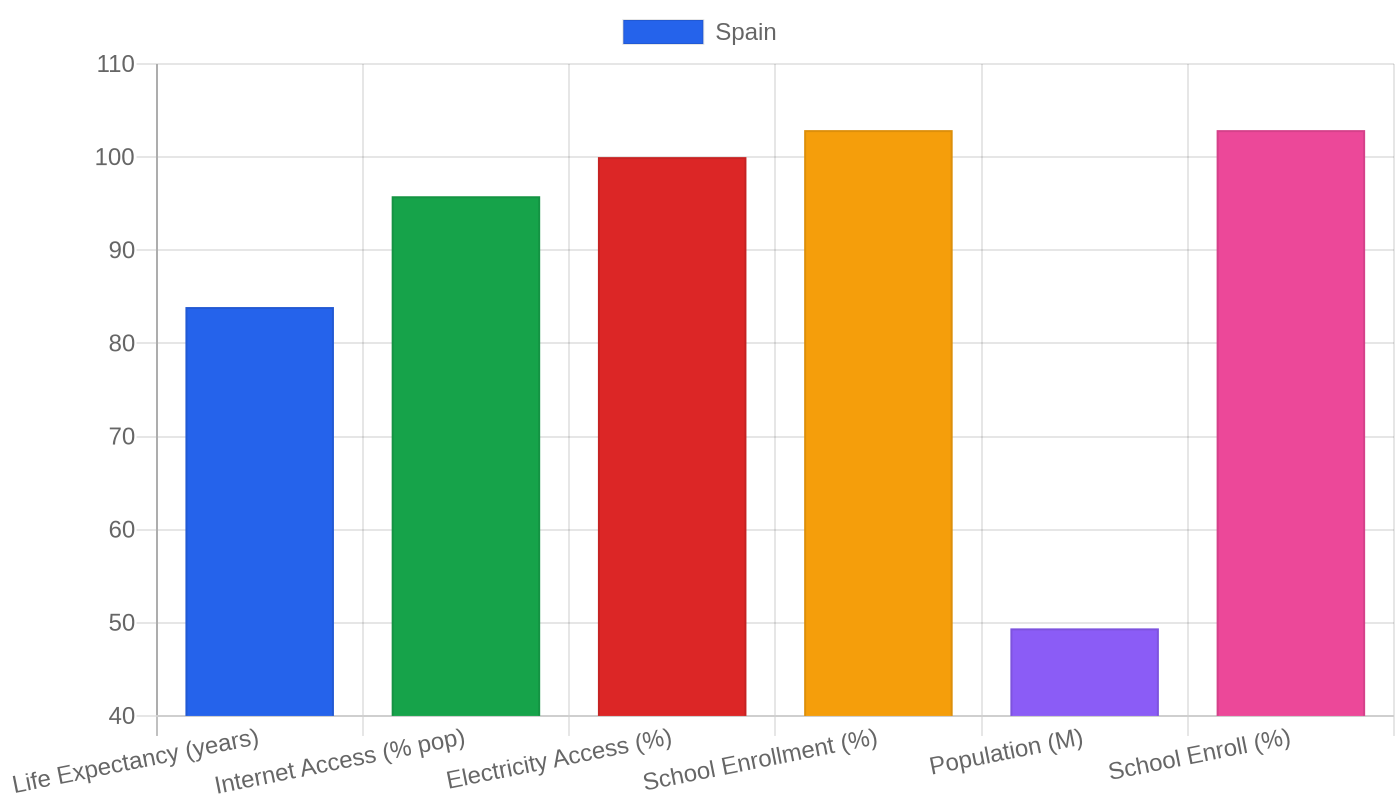
Spain’s economic landscape in 2025 presents a compelling narrative of resilience and expansion. According to World Bank data, the nation’s GDP is valued at approximately $1.9 trillion, reflecting its status as a major European economy. The projected GDP growth for 2025 stands at 2.82495400578509%, a figure that underscores a healthy pace of expansion. This growth is particularly notable when viewed against the backdrop of an unemployment rate of 10.376%.
While double-digit unemployment remains a structural challenge, it coexists with a remarkably high GDP per capita (PPP) of 59867.6944716701. This disparity suggests that while job creation needs acceleration, the value generated by those employed is substantial, contributing to a GNI per capita of 37,120.0. For a population of 49,355,143.0, this indicates a high standard of living potential, driven by productivity rather than sheer labor volume.
The inflation rate, measured by CPI, sits at 2.67326741144651%, which is within manageable bounds for central bank policy, allowing for steady investment planning. These figures collectively paint a picture of an economy that is generating significant wealth per person, even as it navigates the complexities of labor market integration.
Cost of Living: Balancing Affordability and Quality
For residents and expatriates alike, understanding the cost of living in Spain requires looking beyond headline inflation numbers. With a CPI inflation rate of roughly 2.67%, daily expenses are rising but not at a pace that erodes purchasing power rapidly. The high GDP per capita (PPP) of nearly $60,000 implies that domestic prices are calibrated to support a relatively affluent lifestyle compared to many other regions.
However, the 10.376% unemployment rate suggests that income distribution may vary significantly across different demographics and regions. Housing costs, while not explicitly detailed in the provided metrics, are generally influenced by this broader economic context; areas with higher employment opportunities likely command premium rents, whereas less industrialized zones may offer more affordable options.
The interplay between the high national wealth indicators and the moderate inflation rate creates an environment where quality of life can remain high, provided individuals have access to stable income streams. Investors and migrants should note that while the macroeconomic data points to prosperity, the reality on the ground is shaped by individual employment status and regional economic disparities.
Investment & Business Climate: Powerhouses of Industry
The Spanish business ecosystem is anchored by a diverse array of large-cap companies that drive innovation and infrastructure development. Amadeus IT Group leads the charge in technology, providing critical digital solutions that connect the global travel industry, showcasing Spain’s strength in service-oriented tech exports. In the industrial sector, giants like Acciona and ACS Group are pivotal, managing complex projects that span construction, energy, and environmental services.
The basic materials sector is represented by Acerinox, highlighting the country’s capability in metal production and manufacturing inputs. Furthermore, conglomerates such as Abengoa and specialized firms like Almirall in health care demonstrate a broad-based industrial depth. Utilities are supported by entities like the Arteche Group, ensuring stable infrastructure for both domestic consumption and industrial output.
Consumer services are also well-represented by Atresmedia and Afinsa, indicating a robust domestic market for media and financial services. This corporate diversity provides a fertile ground for foreign direct investment, particularly in sectors that align with Spain’s established strengths in engineering, technology, and healthcare. The presence of these top-tier companies offers a stable platform for business partnerships and long-term capital deployment.
Safety, Politics & Quality of Life: A Democratic Anchor
Spain’s political stability is deeply rooted in its constitutional history, which serves as a bedrock for social cohesion and legal certainty. The modern democratic era began in earnest in June 1976, when King Juan Carlos dismissed Prime Minister Carlos Arias Navarro and appointed Adolfo Suárez, a key reformer. This decisive move paved the way for the general election in 1977, which convened the Constituent Cortes to draft the current constitution.
Following a national referendum on December 6, 1978, an overwhelming 88% of voters approved the new charter, legitimizing the transition to democracy. This historical foundation continues to influence the contemporary political landscape, fostering a predictable environment for governance. Regarding safety, specific crime and safety indices are currently listed as N/A in the provided data, meaning precise quantitative assessments cannot be made from this dataset alone.
However, the strong democratic institutions and historical continuity suggest a society with established rule-of-law mechanisms. For citizens and businesses, the political clarity provided by the 1978 Constitution remains a vital asset, reducing uncertainty and supporting long-term planning in a volatile global environment.
What’s Happening Now: Navigating the Post-Reform Era
The current economic narrative in Spain is defined by the implementation of policies stemming from the democratic reforms of the late 1970s. The appointment of Adolfo Suárez by King Juan Carlos marked a turning point that has evolved into the current structured economy seen in 2025. Today, the focus is on sustaining the 2.82% growth trajectory while addressing the persistent issue of 10.376% unemployment.
Policymakers are likely balancing inflation control, currently at 2.67%, with measures to stimulate job creation in key sectors like technology and industrials. The performance of major corporations such as Amadeus and Acciona reflects the success of these strategies, as they expand globally while contributing to domestic GDP. The high GDP per capita (PPP) indicates that recent economic activities have been productive, though the challenge remains to distribute these gains more evenly across the workforce.
As the country moves forward, the legacy of the 1978 referendum continues to provide a stable framework for adapting to new economic realities. Stakeholders are watching closely to see how the government leverages this political stability to further reduce unemployment and maintain price stability.
The Bottom Line
Spain represents a unique investment case where high per-capita wealth coexists with significant labor market challenges. Investors should focus on the robust corporate sector, particularly in technology and industrials, where companies like Amadeus and Acciona demonstrate global competitiveness. The political stability derived from the 1978 Constitution offers a reliable backdrop for long-term strategic planning.
While unemployment remains a concern, the strong GDP growth and manageable inflation rates suggest a resilient economy capable of absorbing shocks. For those seeking exposure to Southern Europe, Spain offers a blend of mature infrastructure, democratic stability, and dynamic industrial output.
Sources & Methodology
This article is authored by Economic Pulse Net for informational and research purposes. Economic Pulse Net sources its data from multilateral institutions, national statistics bureaus, and proprietary databases. All data is believed to be current as of the date of publication.
Published: October 24, 2026 | Category: Research — Spain
Use these signals in your own platform
Economic Pulse publishes its live signal feed through a documented, read-only API. Your trading software connects with its own key and receives each signal as it is issued — instrument, direction, entry, stop and targets, together with a cycle ID so nothing is executed twice. The feed is independent of this website and cannot change it.
Signals are informational only and are not financial advice.