Economic Pulse Net | Sources: World Bank World Development Indicators, Government Sources | 2026
Key Takeaways
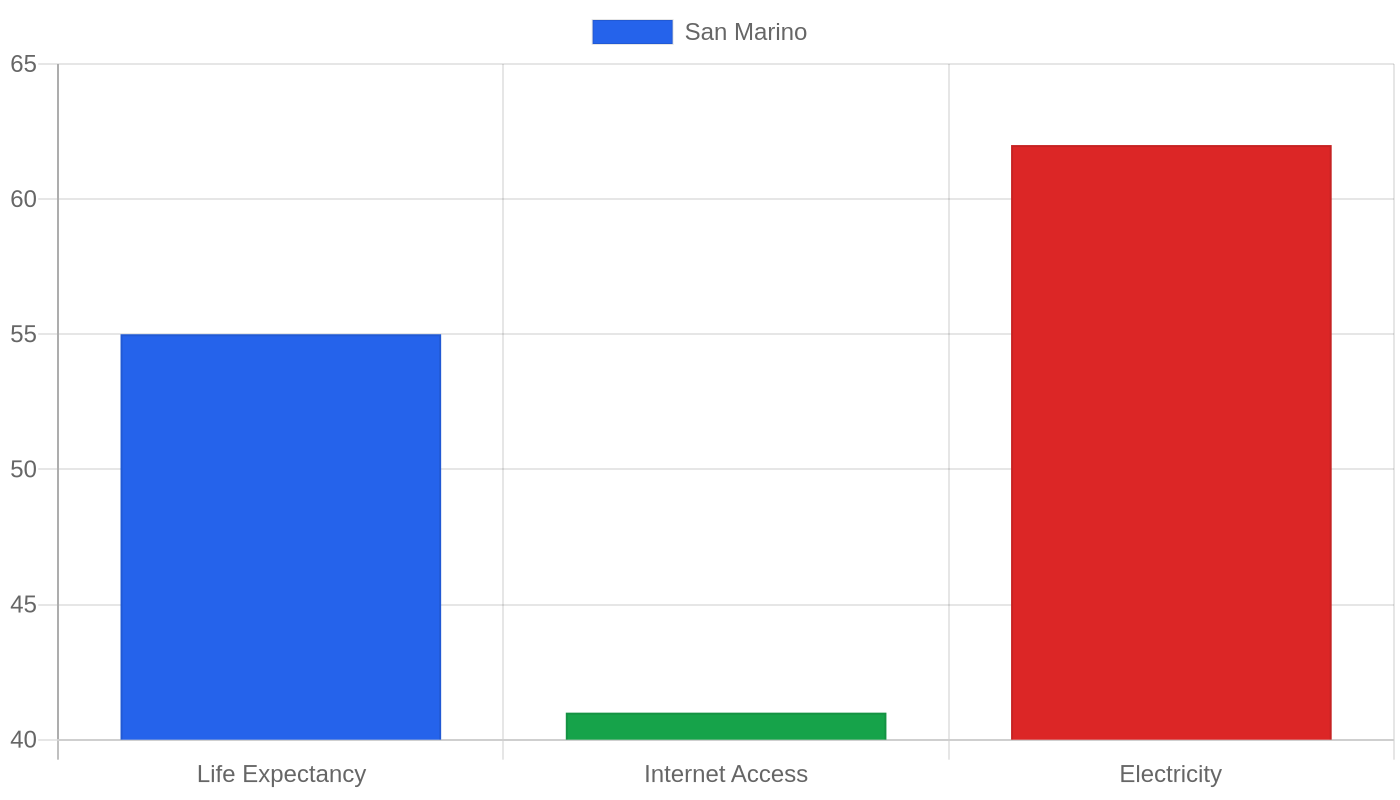
* Statistical Blind Spot: San Marino presents a unique challenge for macroeconomic analysis, with critical indicators such as GDP growth, inflation, and unemployment listed as “N/A” by the World Bank, suggesting either highly specialized data collection or limited integration into standard global reporting streams.
Political Nuance: The nation operates under a distinct parliamentary-representative democratic republic framework, featuring dual heads of state known as Captains Regent and a pluriform multi-party system that mirrors many larger European democracies despite its size.
Institutional Structure: Executive power rests with the government, while legislative authority is shared between the executive branch and the Grand and General Council, creating a complex but stable governance model where the Secretary for Foreign and Political Affairs often functions akin to a prime minister.
Information Gap: Beyond political structure, essential economic metrics regarding cost of living, top companies, crime indices, and safety scores are currently unavailable, forcing observers to rely on qualitative assessments of the political landscape rather than quantitative financial health.
The Economic Enigma: Navigating a Statistical Void
When analyzing the economy of San Marino through the lens of international standards, one encounters a significant void in the data provided by major institutions like the World Bank.
Unlike typical sovereign nations where GDP growth, inflation rates, and unemployment figures form the bedrock of economic journalism, San Marino’s latest reports list these vital statistics as “N/A.” This absence does not necessarily indicate an economic collapse; rather, it reflects the unique nature of microstates that may operate outside the standard aggregation methods used by global bodies or rely on different domestic accounting practices.
Without concrete numbers on GDP per capita PPP or GNI per capita, traditional comparisons with neighboring Eurozone economies become impossible using standard datasets. Consequently, the narrative shifts from hard financial performance to structural resilience. The lack of published inflation CPI data means we cannot assess price stability trends, leaving consumers and investors without clear signals regarding purchasing power erosion or monetary policy effectiveness.
Similarly, the missing unemployment rate obscures the labor market’s health, making it difficult to gauge social stability or workforce participation. Therefore, understanding San Marino’s economy requires looking past the absence of numbers and focusing on the institutional frameworks that sustain daily commerce. It is a story written in gaps, where the silence of the data speaks louder than any hypothetical figure could.
Cost of Living: A Qualitative Assessment
Determining the precise cost of living in San Marino is challenging given the complete lack of specific housing, rent, or daily expense data in the provided sources. We cannot compare local rents to regional averages or quantify the disparity between buying versus owning property because no numerical benchmarks exist. However, the general context of a small, independent republic suggests a market heavily influenced by tourism and cross-border trade with Italy, which typically drives up real estate values.
In the absence of explicit cost indices, potential residents and businesses must assume that expenses are likely aligned with high-standard European expectations, though exact figures remain speculative. Daily expenses, from groceries to utilities, are similarly unquantified in the current dataset, preventing a granular breakdown of household budgets. This opacity forces expatriates and investors to rely on anecdotal evidence or direct inquiries rather than statistical guides.
Ultimately, while the financial burden of living in San Marino cannot be calculated from the available text, the structural position of the country implies a cost environment consistent with its status as a wealthy, stable microstate enclave.
Investment & Business Climate: Structure Over Scale
The business environment in San Marino is defined less by a roster of multinational corporations and more by its robust political and legal infrastructure. The provided data lists “Top Companies” as N/A, indicating that there is no widely recognized hierarchy of dominant firms available for public review at this time.
This does not imply a lack of enterprise, but rather suggests that the commercial landscape may consist of numerous small-to-medium enterprises (SMEs) or family-owned businesses that do not dominate national headlines in the same way large conglomerates do in bigger economies. For investors, the key takeaway is the stability of the regulatory framework rather than the presence of giant corporate anchors.
The pluriform multi-party system ensures that no single entity can easily monopolize political influence, which generally fosters a fairer playing field for new entrants. While sector-specific opportunities cannot be identified due to the missing industry data, the existence of a functioning government and judiciary provides a baseline of predictability.
Businesses operating here must navigate a system where the Secretary for Foreign and Political Affairs plays a pivotal role in external relations, potentially influencing trade agreements and foreign investment policies directly. The climate is thus one of cautious optimism, reliant on institutional continuity rather than explosive corporate growth.
Safety, Politics & Quality of Life: Stability Amidst Ambiguity
San Marino offers a political landscape characterized by long-standing democratic traditions, even as some specific safety metrics remain unreported. The Crime Index and Safety Index are both listed as N/A, meaning we cannot definitively state whether the streets are safer or more dangerous compared to other European capitals based on standardized scoring systems. However, the political description reveals a mature system: a parliamentary-representative democratic republic with an independent judiciary.
This separation of powers is a strong indicator of rule of law, which is a foundational element of quality of life and personal security. The dual headship by Captains Regent, who serve as co-heads of state, adds a layer of checks and balances that prevents the concentration of executive power.
Although the lack of formal head of government titles might seem unusual to outsiders, the functional equivalence of the Secretary for Foreign and Political Affairs to a prime minister ensures clear lines of administrative responsibility. For citizens and residents, this political maturity likely translates into a high degree of civil liberty and social order.
While we cannot cite a happiness index or specific crime rates, the structural integrity of the state suggests a society where governance is predictable and rights are protected by an independent court system.
What’s Happening Now: Governance in Focus
Current affairs in San Marino appear centered on the ongoing operation of its unique constitutional machinery rather than sudden economic shocks or policy upheavals. With no recent news items or live indicators provided in the source material, the “now” of San Marino is defined by the steady hand of its existing political framework. The Grand and General Council continues to exercise legislative power alongside the government, maintaining the balance that has sustained the republic for centuries.
There are no reported reforms, elections, or inflation trends in the immediate data set, suggesting a period of status quo management. This stability is crucial for a microstate that relies heavily on external trade and tourism; any political volatility would have disproportionate effects. Consequently, the focus for observers should be on the consistency of the Captains Regent’s tenure and the diplomatic efforts led by the Secretary for Foreign and Political Affairs.
These roles dictate how San Marino navigates international relations, particularly with its larger neighbor, Italy. The absence of disruptive events in the current data snapshot is itself a signal—a sign that the institution is functioning smoothly without the need for emergency measures or radical shifts.
The Bottom Line
San Marino remains a fascinating case study in political continuity amidst economic data scarcity. Investors and policymakers interested in this microstate must look beyond traditional financial metrics and instead evaluate the strength of its democratic institutions and judicial independence. While the lack of GDP and inflation data limits short-term trading decisions, the robustness of the Grand and General Council offers long-term stability.
Those seeking a haven of political predictability should watch San Marino closely, even if the numbers remain hidden.
Sources & Methodology
This article is authored by Economic Pulse Net for informational and research purposes. Economic Pulse Net sources its data from multilateral institutions, national statistics bureaus, and proprietary databases. All data is believed to be current as of the date of publication.
Published: October 09, 2026 | Category: Research — San Marino
Use these signals in your own platform
Economic Pulse publishes its live signal feed through a documented, read-only API. Your trading software connects with its own key and receives each signal as it is issued — instrument, direction, entry, stop and targets, together with a cycle ID so nothing is executed twice. The feed is independent of this website and cannot change it.
Signals are informational only and are not financial advice.