Economic Pulse Net | Sources: World Bank World Development Indicators, Government Sources | 2026
Key Takeaways
– Russia’s economy is navigating a historic structural transformation, pivoting from Western integration toward self-sufficiency and Eurasian partnerships, though the full picture of GDP growth, inflation, and unemployment remains opaque due to data gaps.
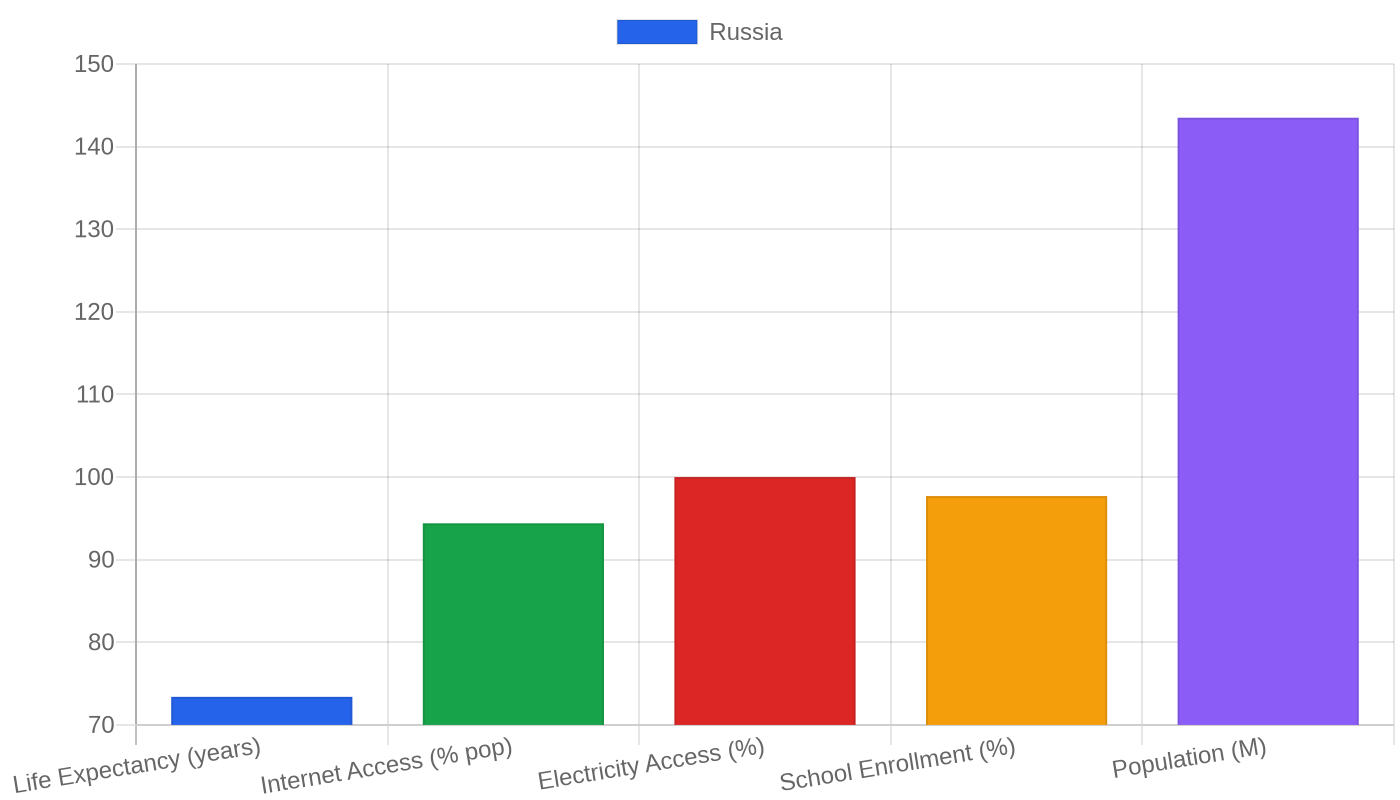
– The population stands at approximately 143.5 million, making it one of Europe’s largest domestic markets, but demographic pressures and labor shortages are mounting challenges.
– Major industrial and financial players—from Aeroflot to Alfa-Bank—are reorienting operations as the country’s political system, a semi-presidential federal republic, steers economic policy through turbulent geopolitical waters.
– Without official World Bank figures for key metrics, analysts are forced to rely on alternative indicators and anecdotal evidence to gauge the true health of the Russian economy.
– The country’s long-term trajectory hinges on whether its pivot toward domestic industrialization and non-Western trade can offset the costs of isolation and sustain living standards for its population.
The Kremlin’s Economic Balancing Act: Growth Without Data
The Russian economy presents a paradox that frustrates even the most seasoned analysts. According to the World Bank, critical metrics—GDP growth, inflation, unemployment, and overall GDP in USD—are listed as unavailable. This data vacuum is itself a story. It speaks to a nation where economic reporting has become increasingly politicized, where the normal flow of statistics to international institutions has been disrupted by sanctions, capital controls, and a deliberate policy of opacity.
What the World Bank does confirm is a population of 143,513,328—a number that places Russia among the world’s most populous nations, yet one that is slowly shrinking. The demographic decline, exacerbated by emigration and wartime casualties, represents a structural headwind that no amount of policy tinkering can easily reverse. Without hard data on GDP per capita or GNI per capita, we are left to infer the economic reality from the actions of the state and its major corporations.
The absence of inflation figures from the World Bank is particularly telling. In an economy where the central bank has repeatedly hiked interest rates to double-digit levels to combat price pressures, the lack of an official CPI number from international sources suggests either a breakdown in data-sharing or a deliberate choice to obscure uncomfortable truths. What is clear, however, is that Russia’s economic model is under extraordinary strain.
The country is attempting to maintain social stability and military spending simultaneously, a juggling act that historically ends with either inflation or fiscal crisis—or both.
The Ruble’s Reality: Living Costs in a Sanctioned Economy
For ordinary Russians, the cost of living has become a daily referendum on the success or failure of economic policy. While the World Bank provides no specific cost-of-living data for Russia, the anecdotal evidence from within the country paints a picture of rising prices and shrinking real incomes.
The Russian ruble, subject to capital controls and volatile energy prices, has lost significant purchasing power against major currencies, making imported goods—from electronics to pharmaceuticals—substantially more expensive.
Housing costs vary dramatically across this vast country. In Moscow, property prices remain among the highest in Eastern Europe, driven by demand from wealthy Russians and those seeking safe-haven assets within the country’s borders. Renting a one-bedroom apartment in the capital can consume a large portion of a median salary, while in provincial cities like Kazan or Novosibirsk, housing remains more affordable but wages are correspondingly lower.
The buy-versus-rent calculation has shifted in recent years, with many Russians preferring to hold real estate as a store of value rather than trusting bank deposits or the volatile stock market.
Daily expenses for food, utilities, and transportation have risen noticeably. The Russian government has attempted to subsidize basic goods and cap prices on staples like bread and milk, but these measures have had limited success in containing broader inflationary pressures. For a population accustomed to relative stability under the previous economic order, the current environment represents a genuine erosion of living standards—one that is felt most acutely by pensioners and those on fixed incomes.
From Oligarchs to State Champions: Russia’s Corporate Landscape
Russia’s corporate sector is dominated by a mix of state-controlled giants and private enterprises that have learned to operate under sanctions. The World Bank’s list of top companies reveals the breadth of the Russian economy, from technology to banking to aviation.
1C Company, a software firm, represents Russia’s ambitions in the digital space, while **Aeroflot**, the national airline, has had to completely restructure its fleet and routes as Western airspace and aircraft have become inaccessible.
The financial sector, represented by Alfa-Bank and **Ak Bars Bank**, has proven remarkably resilient. These institutions have weathered sanctions by developing alternative payment systems, deepening ties with Chinese and Middle Eastern banks, and focusing on domestic lending. **Alfa Group**, the conglomerate behind Alfa-Bank, has diversified into everything from retail to telecommunications, creating a web of interlinked businesses that can withstand sector-specific shocks.
Meanwhile, **Acron Group**, a major fertilizer producer, has benefited from global food security concerns, finding new markets in Asia and Africa as traditional European buyers have stepped back.
For investors, the Russian market remains a high-risk, high-reward proposition. The Moscow Exchange continues to operate, but foreign participation is severely limited by sanctions and capital controls. Sectors to watch include energy (still the backbone of the economy), agriculture (where Russia has become a global wheat powerhouse), and technology (where import substitution has created opportunities for domestic firms).
The business environment, however, is characterized by unpredictability—state intervention, sudden regulatory changes, and the ever-present risk of asset freezes make long-term planning exceptionally difficult.
Power, Politics, and Public Safety in the New Russia
Russia’s political landscape, as described by the World Bank, is an “asymmetric federal republic with a semi-presidential system” where the president serves as head of state and the prime minister as head of government. In theory, it is a multi-party representative democracy with three branches of government. In practice, power is heavily concentrated at the federal level, with regional governors appointed and removed at the Kremlin’s discretion.
This centralization has provided stability but at the cost of genuine political competition and accountability.
Crime and safety indices are listed as unavailable by the World Bank, but this data gap does not mean the issue is irrelevant. In major cities like Moscow and St. Petersburg, street crime is relatively low compared to other large global metropolises, thanks in part to pervasive surveillance and a strong police presence.
However, the broader concept of safety in Russia extends beyond street crime to include political safety—the risk of expressing dissent, participating in protests, or being targeted by the state for one’s views. For many Russians, the greatest threat to their quality of life is not the criminal underworld but the unpredictable hand of the state itself.
Quality of life in Russia is a study in contrasts. In central Moscow, one can enjoy world-class restaurants, cultural institutions, and modern infrastructure. In rural areas and smaller industrial towns, the picture is bleaker—aging hospitals, limited economic opportunities, and a sense of stagnation.
The Russian government has invested heavily in social welfare programs, including child benefits and mortgage subsidies, to maintain public support, but these measures have struggled to keep pace with inflation and the rising cost of living.
The Great Reorientation: Russia’s Economy in Real Time
Right now, Russia is undergoing its most significant economic transformation since the collapse of the Soviet Union. The country is in the midst of a forced pivot away from European markets and toward Asia, the Middle East, and Africa. Trade routes are being redrawn, with the Northern Sea Route gaining importance as a shipping lane to China, and new pipeline and rail projects connecting Russian resources to growing Asian demand.
This is not a smooth transition—logistical bottlenecks, payment system frictions, and cultural differences all pose challenges.
The Russian government has responded to sanctions with a wave of import substitution policies, aiming to make the country self-sufficient in everything from microchips to aircraft parts. Some sectors, like food production and pharmaceuticals, have seen genuine growth. Others, like advanced manufacturing and consumer electronics, remain heavily dependent on smuggled or parallel-imported goods.
The central bank has maintained tight monetary policy to control inflation, but the trade-off is slower economic growth and higher borrowing costs for businesses and households.
Labor shortages have become a critical issue. The combination of wartime mobilization, emigration of skilled professionals, and low birth rates has created gaps in everything from IT to construction. The government has responded by easing visa rules for workers from Central Asia and exploring ways to bring Russian expatriates back. Whether these measures will be sufficient remains an open question.
The coming months will test whether Russia can maintain economic stability while pursuing its geopolitical objectives, or whether the strain will force a recalibration of priorities.
The Bottom Line
Russia is a country that investors, policymakers, and analysts cannot afford to ignore, even as reliable data becomes harder to obtain. For those with high risk tolerance and deep knowledge of the local landscape, opportunities exist in energy, agriculture, and import-substitution industries. For the broader international community, Russia’s economic trajectory will have profound implications for global energy markets, food security, and the future of the international financial system.
Watch this country not for its current statistics, but for the structural shifts that will define its—and perhaps the world’s—economic future over the next decade.
Sources & Methodology
This article is authored by Economic Pulse Net for informational and research purposes. Economic Pulse Net sources its data from multilateral institutions, national statistics bureaus, and proprietary databases. All data is believed to be current as of the date of publication.
Published: July 19, 2026 | Category: Research — Russia
Use these signals in your own platform
Economic Pulse publishes its live signal feed through a documented, read-only API. Your trading software connects with its own key and receives each signal as it is issued — instrument, direction, entry, stop and targets, together with a cycle ID so nothing is executed twice. The feed is independent of this website and cannot change it.
Signals are informational only and are not financial advice.