Economic Pulse Net | Sources: World Bank World Development Indicators, Government Sources | 2026
Key Takeaways
– Russia’s economy is navigating a structural transformation away from Western integration toward self-sufficiency and Eurasian partnerships, though comprehensive World Bank data gaps obscure the full picture.
– The country’s political system remains a semi-presidential federal republic structured as a multi-party democracy, with the president wielding significant executive authority over economic policy direction.
– Major homegrown companies like Aeroflot, Alfa-Bank, and 1C Company dominate key sectors from aviation to finance to software, reflecting a resilient domestic corporate ecosystem.
– Cost of living pressures and business climate dynamics are increasingly shaped by geopolitical realignment rather than traditional market forces, making Russia a high-risk, high-complexity environment for outside observers.
– The nation’s economic trajectory now hinges on its ability to balance state-led development with private sector innovation amid ongoing international sanctions and shifting trade patterns.
The Ruble’s New Reality — Understanding Russia’s Economic Transformation
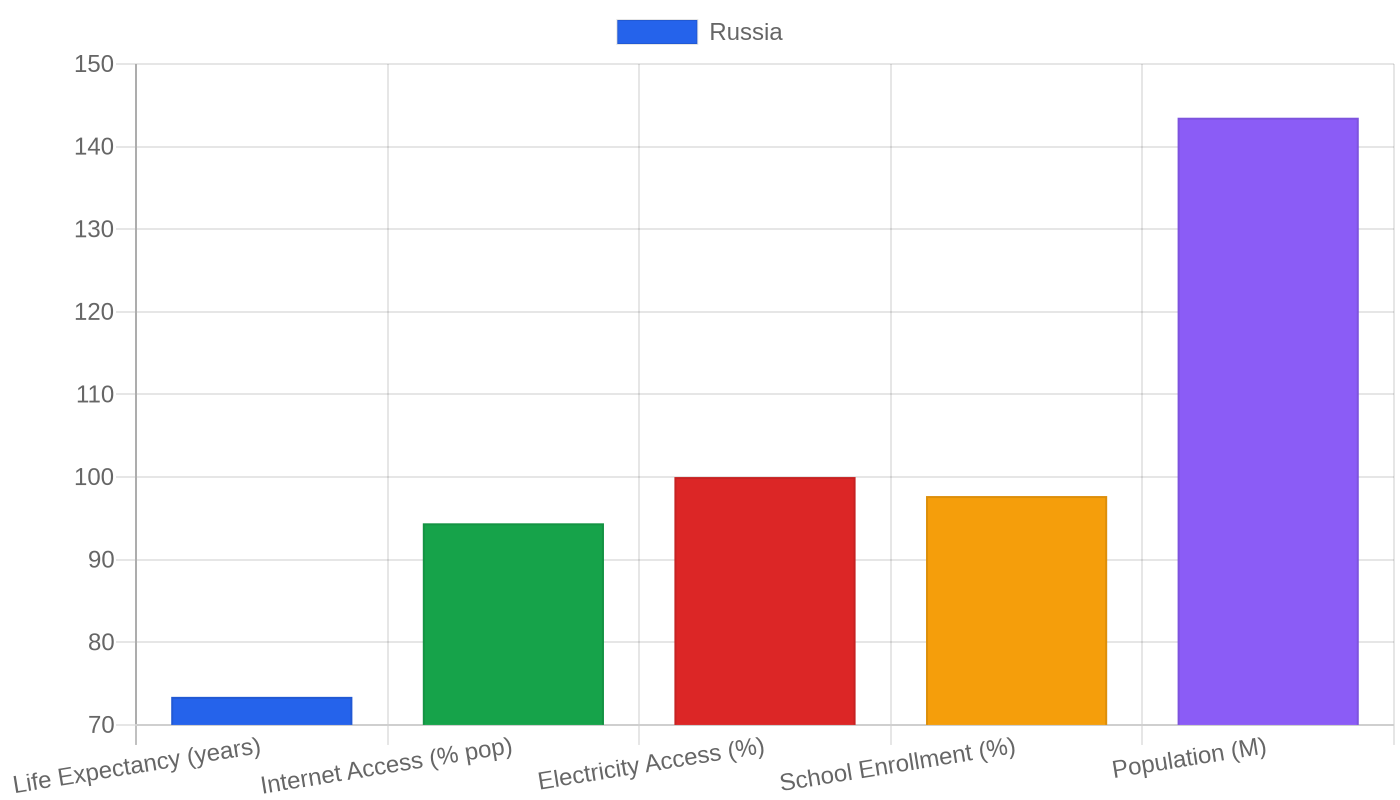
Russia’s economy exists in a state of profound recalibration, one that the World Bank’s sparse data set only hints at through its very silence. With key indicators like GDP growth, inflation, and unemployment marked as unavailable in the latest global database, analysts must piece together the narrative from structural clues rather than precise figures. What emerges is the portrait of an economy that has been forced to reinvent its fundamental operating model.
The absence of reliable international data points to a deeper truth: Russia’s economic integration with global institutions has fractured. The country’s GDP per capita, once tracked closely by the World Bank as a benchmark for upper-middle-income status, now operates in a statistical grey zone.
This matters enormously for investors and policymakers because it means traditional metrics of economic health — the kind that guide capital allocation and risk assessment — are no longer readily comparable to peer nations.
What we do know is that Russia’s economic structure rests on a foundation of state-directed priorities, with the Kremlin exerting significant influence over resource allocation. The nation’s industrial base, historically anchored in energy extraction and heavy manufacturing, is undergoing a forced diversification. Domestic technology firms like 1C Company, a software giant, and Alawar Entertainment, a game developer, have stepped into gaps left by departing Western competitors.
This is not simply import substitution — it represents a fundamental reshaping of what the Russian economy produces and for whom.
The unemployment picture, while statistically opaque, likely reflects the dual pressures of labor mobilization and skills shortages in key sectors. Russia’s demographic challenges, long a concern for economists, now intersect with geopolitical factors that limit the free flow of talent across borders. The result is an economy where labor markets are simultaneously tight in defense-related industries and slack in consumer-facing sectors that have lost access to international supply chains.
Inflation, too, tells a story of structural stress. Without the World Bank’s CPI figures, we must infer from the broader context: a currency under managed depreciation, rising input costs from redirected trade routes, and the classic symptoms of an economy running hot on state spending while consumer goods availability remains constrained. The Central Bank of Russia has been forced to walk a tightrope between supporting growth and preventing the ruble’s purchasing power from eroding too quickly.
The Price of Survival — Housing and Daily Life in a Changing Economy
For ordinary Russians, the cost of living has become a daily referendum on the country’s economic direction. Housing markets, traditionally a bellwether of middle-class confidence, now reflect the peculiar dynamics of a nation where domestic savings have few safe havens. With international investment options curtailed, real estate in major cities like Moscow and St. Petersburg has become a store of value as much as a place to live.
The rent-versus-buy calculation has shifted dramatically. Mortgage rates, influenced by the central bank’s policy rate, have made borrowing expensive for all but the most creditworthy borrowers. This has pushed many Russians toward the rental market, where landlords increasingly demand payment in cash or through informal arrangements that bypass the formal banking system.
The result is a dual-track housing economy: a visible market tracked by official statistics, and a shadow market that operates on trust and personal networks.
Daily expenses tell a similar story of bifurcation. Imported goods — from electronics to luxury foods — have become prohibitively expensive for most households, while domestically produced alternatives have filled shelves at more accessible price points. This is not the same as affordability, however. The quality and variety of consumer goods have narrowed, forcing households to adapt their consumption patterns in ways that would have seemed unimaginable five years ago.
Compared to regional averages, Russian living costs present a paradox. For those earning in rubles and spending primarily on domestic goods, the cost of basic necessities may appear stable. But for anyone needing imported medicines, spare parts for foreign cars, or international travel, the effective cost of living has soared. This creates a society where economic well-being is increasingly determined by one’s ability to navigate the new restrictions rather than by traditional measures of income.
The Kremlin’s Boardroom — Investment Climate and Corporate Power
Russia’s corporate landscape is dominated by names that reflect the country’s industrial heritage and its digital future. Aeroflot, the national carrier, remains the face of Russian aviation despite the loss of international routes and aircraft maintenance access. Alfa-Bank and Ak Bars Bank represent a financial sector that has been forced to build parallel payment systems and correspondent banking relationships outside the SWIFT network.
The Alfa Group conglomerate, with its sprawling interests from telecom to retail, exemplifies the concentration of economic power that characterizes Russian capitalism.
The business climate today is shaped by two contradictory forces. On one hand, the state has actively courted domestic entrepreneurs, offering tax incentives and regulatory simplifications for companies that can replace Western imports. On the other hand, the unpredictability of sanctions regimes — both those imposed externally and those enforced internally — creates an environment where long-term planning is exceptionally difficult.
Companies like Acron Group, a major fertilizer producer, have navigated this by pivoting export routes toward Asia and the Middle East, demonstrating that adaptation is possible but costly.
For foreign investors, the landscape is starkly different from the pre-2022 era. The departure of many multinational corporations has created vacuums that domestic firms like 1C Company and Akella are racing to fill. Yet the barriers to entry for new foreign capital are formidable: currency controls, repatriation restrictions, and the constant threat of asset freezes make Russia one of the world’s most challenging investment destinations.
The companies that remain are often those with deep historical ties, specialized expertise, or willingness to accept political risk as a cost of doing business.
Sectors to watch include technology, where Russian software developers have proven globally competitive, and agriculture, where the country has emerged as a major wheat exporter despite logistical complications. The energy sector, long the backbone of the Russian economy, continues to generate revenue through redirected pipeline routes and LNG development, though at reduced margins compared to the European market that once absorbed the bulk of exports.
Beyond the Headlines — Safety, Politics, and the Texture of Daily Life
Russia’s political landscape, as defined by its constitution, is that of an asymmetric federal republic with a semi-presidential system. The president serves as head of state while the prime minister leads the government, and the system is officially structured as a multi-party representative democracy with three branches of government.
This constitutional framework, however, exists alongside a political culture that concentrates decision-making authority in the executive branch to a degree that shapes every aspect of economic life.
For the average Russian, the safety index — though not quantified in available data — is experienced differently than in Western countries. Crime in major cities is generally low compared to the 1990s, but the nature of risk has shifted. Economic crime, fraud, and the uncertainties of contract enforcement in a rapidly changing legal environment create a different kind of insecurity.
The safety that matters most to businesses and individuals is not physical protection but legal predictability — and that has become increasingly scarce.
Quality of life in Russia is a study in contrasts. In Moscow and St. Petersburg, residents enjoy world-class cultural institutions, reliable public transportation, and a vibrant service economy that has adapted to new realities. In smaller cities and rural areas, the picture is markedly different: aging infrastructure, limited access to imported goods, and economic opportunities that are heavily dependent on state employment or resource extraction industries.
The political system’s stability, while a source of confidence for some investors, also imposes costs. The absence of meaningful electoral competition means that economic policy can shift abruptly based on leadership priorities rather than market signals. For Russians navigating daily life, this creates a peculiar form of resilience: the ability to adapt to sudden changes in rules, prices, and opportunities has become a survival skill as important as any professional qualification.
The New Silk Road — Russia’s Current Economic Reorientation
Right now, Russia is executing what may be the most consequential economic pivot since the collapse of the Soviet Union. Trade flows are being rerouted in real time, with container ships from China filling ports that once served European markets and railway connections across Central Asia carrying goods that previously moved through Baltic corridors.
This is not a smooth transition — logistics bottlenecks, payment system frictions, and quality control issues plague the new supply chains — but it is happening at remarkable speed.
The domestic technology sector is experiencing a boom of necessity. Companies like 1C, which produces enterprise software, and Alawar, in gaming, are seeing demand surge as Russian businesses seek alternatives to Microsoft, Oracle, and other Western platforms. This has created a virtuous cycle of investment and talent development, though it also raises questions about long-term competitiveness when shielded from global competition.
In the financial sector, Alfa-Bank and other major institutions are pioneering new payment systems and cross-border settlement mechanisms that bypass traditional Western financial infrastructure. These innovations, born of necessity, may ultimately create parallel systems that could persist even if sanctions were lifted. The ruble’s role in international trade, while still limited, is expanding as Russia pushes trading partners to accept payment in its national currency.
The agricultural sector continues to surprise, with Russian wheat exports reaching record volumes despite logistical challenges. Companies like Acron Group have demonstrated that Russian producers can compete globally in commodity markets, though the margins are thinner and the customers are increasingly concentrated in Africa, the Middle East, and Asia. This diversification of export markets represents a structural shift that will outlast any particular political configuration.
The Bottom Line
Russia today is not the country it was five years ago, and it will not be the country it is now in another five years. For investors with high risk tolerance and long time horizons, the opportunities lie in understanding the direction of change rather than the current state. Policymakers and analysts should watch Russia as a laboratory for economic autarky — a test case of whether a major economy can decouple from global systems and still generate prosperity.
For the casual observer, Russia remains a reminder that economic data tells only part of the story; the rest is written in the daily choices of millions of people adapting to a world they did not choose.
Sources & Methodology
This article is authored by Economic Pulse Net for informational and research purposes. Economic Pulse Net sources its data from multilateral institutions, national statistics bureaus, and proprietary databases. All data is believed to be current as of the date of publication.
Published: July 19, 2026 | Category: Research — Russia
Use these signals in your own platform
Economic Pulse publishes its live signal feed through a documented, read-only API. Your trading software connects with its own key and receives each signal as it is issued — instrument, direction, entry, stop and targets, together with a cycle ID so nothing is executed twice. The feed is independent of this website and cannot change it.
Signals are informational only and are not financial advice.