Economic Pulse Net | Sources: World Bank World Development Indicators, Government Sources | 2026
Key Takeaways
– Russia’s GDP grew by just 1.0% in 2025, according to the World Bank, a tepid expansion that signals an economy struggling under the weight of structural constraints and external pressures.
– Inflation surged to 8.7% in 2025, more than eight times the growth rate, eroding household purchasing power and squeezing living standards across the country.
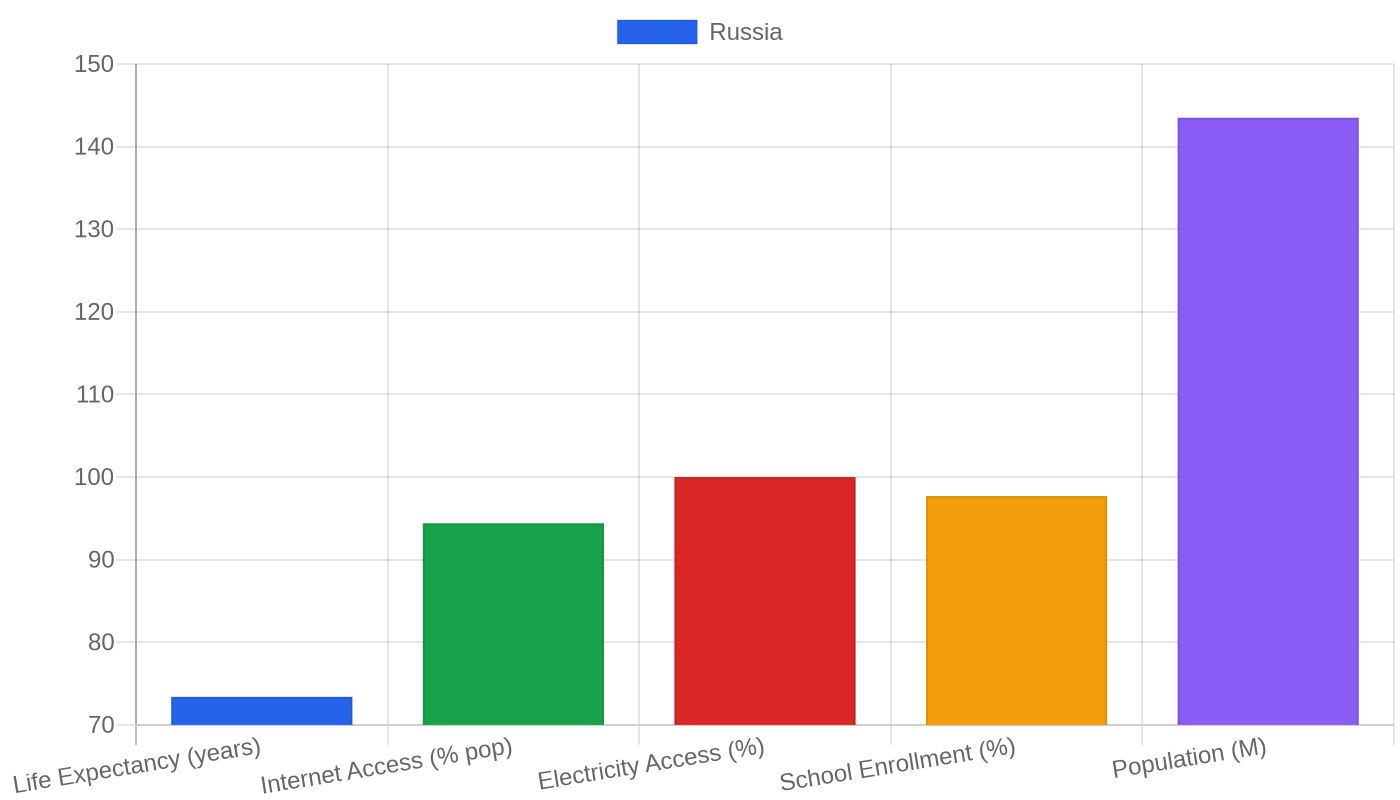
– The population stands at 143.5 million, a demographic base that faces mounting challenges from emigration, an aging workforce, and declining real incomes.
– Russia’s political system operates as a semi-presidential federal republic, but power remains heavily concentrated at the executive level, shaping both economic policy and business conditions.
– Major companies span technology, banking, aviation, and consumer goods, but the absence of foreign investment inflows and sanctions-driven isolation continue to reshape the corporate landscape.
A Growth Mirage — Why 1% Expansion Tells a Troubling Story
The World Bank reports that Russia’s GDP grew by just 1.001% in 2025. On paper, that is positive territory. But any economic journalist worth their salt will tell you that a 1% growth rate for a resource-rich nation with global ambitions is a flashing amber light. When you consider that inflation is running at 8.7%, the gap between nominal activity and real prosperity becomes glaring. The economy is expanding, yes, but the expansion is being devoured by rising prices almost as quickly as it appears.
This is the classic signature of stagflation — low growth paired with high inflation — and it places the Russian consumer in a vice grip. Wages may be rising in nominal terms, but real purchasing power is falling. For every ruble earned, more is lost to the cost of bread, fuel, and rent. The World Bank data does not provide unemployment figures for 2025, but in an environment where growth barely outpaces population expansion, labor market slack is likely higher than official figures suggest.
Without robust job creation, the 1% growth rate becomes less a sign of health and more a measure of how far the economy has fallen from its pre-conflict trajectory.
Russia’s industrial base remains heavily oriented toward energy extraction, metals, and defense. The top companies list — dominated by Aeroflot, Alfa-Bank, and the Acron Group — reflects an economy that still leans on legacy sectors. There is no vibrant tech boom here, no startup ecosystem scaling globally. The presence of firms like 1C Company and Alawar Entertainment suggests pockets of software and gaming innovation, but these are small relative to the broader industrial footprint.
The World Bank’s GDP figure tells us that Russia is treading water, not swimming.
The Ruble’s Reach — Housing, Bread, and the Squeeze on Daily Life
The World Bank provides no specific cost-of-living data for Russia, but the inflation figure of 8.7% speaks volumes. When prices rise at nearly nine times the rate of economic growth, every household budget feels the strain. Food, utilities, and transportation — the non-negotiable pillars of daily expenditure — become battlegrounds. Russian families are likely spending a higher share of their income on essentials than they did five years ago, with little room for savings or discretionary spending.
Housing costs, while not quantified in the data provided, are a perennial pressure point in major cities like Moscow and St. Petersburg. The rental market in the capital has historically been among the most expensive in Eastern Europe, and with inflation running hot, landlords have every incentive to raise rents. For younger Russians, the dream of homeownership recedes further with each percentage point of inflation.
The combination of stagnant growth and rising prices means that real estate, once seen as a safe store of value, becomes increasingly unaffordable for first-time buyers.
What makes this particularly painful is the lack of wage growth commensurate with price increases. Even if nominal salaries have crept upward, the real value of those earnings is being eroded. The cost of a basket of basic goods — milk, eggs, bread, cooking oil — has likely risen sharply. For Russia’s 143.5 million people, the daily calculus of how far the ruble will stretch has become an exhausting arithmetic problem with no good answers.
Business Behind Closed Doors — Russia’s Corporate Landscape Under Pressure
Russia’s top companies offer a window into an economy that is simultaneously resilient and constrained. The list provided includes heavyweights like Aeroflot, the national airline; Alfa-Bank and Ak Bars Bank, major financial institutions; and industrial players like Acron Group. There is also Abrau-Durso, a sparkling wine producer, and Alfa Group, a sprawling conglomerate. This is a corporate ecosystem that has learned to operate under sanctions, currency volatility, and shifting state priorities.
What is striking is the absence of Western multinationals. The top companies list is entirely domestic. This reflects both the forced exit of foreign firms and the Kremlin’s push for import substitution. But self-sufficiency comes at a cost. Without access to global capital markets, advanced technology transfers, or international supply chains, Russian companies must innovate with fewer resources.
The presence of software firms like 1C Company and Alawar Entertainment suggests that the tech sector is finding niches, but these are not yet large enough to drive a structural economic transformation.
For investors — domestic or foreign — the business climate is defined by unpredictability. The political system, which the constitution describes as a multi-party representative democracy with a semi-presidential structure, in practice concentrates decision-making at the top. This means that regulatory changes, tax policies, and property rights can shift with little warning. The companies that survive and even thrive are those that maintain close alignment with state priorities.
For everyone else, the risk premium is enormous.
Power, Order, and the Price of Stability
Russia’s political landscape, as outlined in the data, is an asymmetric federal republic with a semi-presidential system. The president serves as head of state, the prime minister as head of government, and the constitution provides for three branches of government. On paper, this mirrors many Western systems. In practice, the balance of power tilts decisively toward the executive, and political competition is tightly managed.
The World Bank provides no crime or safety indices for Russia, but any discussion of quality of life must acknowledge the trade-offs embedded in this system. Public order is generally maintained, particularly in major cities, but at the cost of political freedoms and civil society space. For ordinary Russians, the bargain is clear: stability in exchange for limited political agency. The question is whether that bargain still holds when the economy is delivering 1% growth and 8.7% inflation.
Happiness data is also absent from the provided figures, but one can infer that the gap between economic reality and political messaging creates a persistent undercurrent of frustration. When prices rise faster than paychecks, and when the future feels uncertain, the social contract frays. Russia’s population of 143.5 million is not restless in the streets — but the quiet erosion of living standards may prove more corrosive than any protest.
The Crossroads of 2026 — Where Policy Meets Reality
This is where the story becomes urgent. The World Bank data for 2025 shows a growth rate of just over 1% and inflation at 8.7%. These are not abstract statistics. They are the raw material of political risk. The Kremlin faces a difficult choice: continue prioritizing military and geopolitical objectives, or pivot toward economic stabilization and household relief.
There is no recent news data provided to indicate specific policy shifts, but the trajectory is clear. Inflation at 8.7% demands a response — either through tighter monetary policy, which would further suppress growth, or through price controls and subsidies, which carry their own distortions. The Central Bank of Russia has historically been hawkish, but it operates within political constraints. The tension between fighting inflation and funding state priorities is the defining economic drama of 2026.
Meanwhile, the corporate sector is adapting. Companies like Aeroflot and Alfa-Bank are finding ways to operate within the new normal. But adaptation is not the same as thriving. The absence of foreign investment, the brain drain of skilled professionals, and the technological isolation all weigh on long-term potential. Russia is not collapsing, but it is drifting. And drift, in economic terms, is rarely neutral.
The Bottom Line
Russia in 2026 is a country where the numbers tell a story of stagnation masked by survival. The World Bank’s 1% growth and 8.7% inflation paint a portrait of an economy that is holding together but not moving forward. For investors, the risk-reward calculus is heavily tilted toward caution. For policymakers, the challenge is to manage expectations while resources grow tighter.
For the 143.5 million Russians going about their daily lives, the question is simpler: can the system deliver a better tomorrow than today? The data suggests the answer is not yet clear — and that uncertainty is the most dangerous variable of all.
Sources & Methodology
This article is authored by Economic Pulse Net for informational and research purposes. Economic Pulse Net sources its data from multilateral institutions, national statistics bureaus, and proprietary databases. All data is believed to be current as of the date of publication.
Published: July 18, 2026 | Category: Research — Russia
Use these signals in your own platform
Economic Pulse publishes its live signal feed through a documented, read-only API. Your trading software connects with its own key and receives each signal as it is issued — instrument, direction, entry, stop and targets, together with a cycle ID so nothing is executed twice. The feed is independent of this website and cannot change it.
Signals are informational only and are not financial advice.