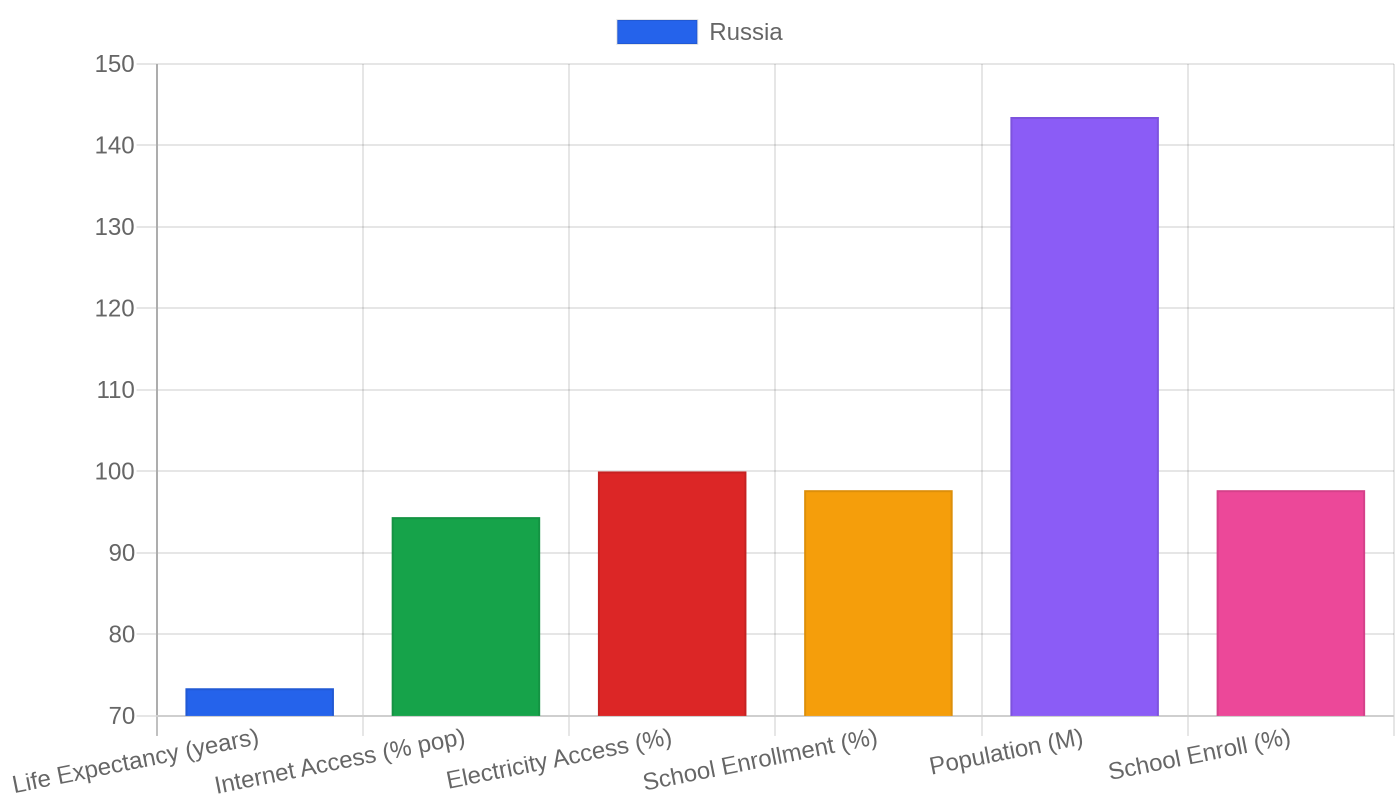
Economic Pulse Net | Sources: World Bank World Development Indicators, Government Sources | 2026
Key Takeaways
– Russia’s economy posted modest GDP growth of approximately 1.0% in 2025, according to the World Bank, signaling resilience despite a complex geopolitical environment.
– Unemployment stands at an exceptionally low 2.13%, a figure that most developed economies would envy but one that also signals potential labor shortages and wage pressures.
– The country’s GDP reached $2.56 trillion, with GDP per capita (PPP) at $49,568 — placing Russia firmly in the upper-middle-income bracket globally.
– Russia’s top corporate landscape is dominated by a mix of financial giants like Alfa-Bank, aviation leader Aeroflot, and a surprisingly robust technology and software sector including 1C Company and Alawar Entertainment.
– The political system is officially a semi-presidential federal republic with three branches of government, though the practical concentration of power remains a defining feature of the business environment.
A Growth Story Written in Contradictions
The headline numbers from the World Bank tell a story of an economy that has learned to adapt. Russia’s GDP growth of 1.0% in 2025 is not spectacular by emerging market standards, but it represents something arguably more important: stability in a period of profound external pressure.
When an economy the size of Russia’s — $2.56 trillion in nominal terms — continues to expand, even modestly, it signals that the fundamental engines of production, energy extraction, and domestic consumption remain operational.
The unemployment figure demands attention. At 2.13%, Russia has effectively reached full employment, and arguably beyond it. In economic terms, this is a double-edged sword. On one hand, it reflects a labor market where nearly everyone who wants to work can find work — a social stabilizer in uncertain times. On the other hand, such a tight labor market typically leads to wage inflation, which can feed into broader price pressures.
The World Bank data does not provide a current inflation figure, but any economist will tell you that an unemployment rate this low creates upward pressure on wages across sectors, from manufacturing to services.
GNI per capita of $15,960, as reported by the World Bank, places Russia in a curious position. It is far wealthier than most of its neighbors in Central Asia, yet significantly behind Western European averages.
This gap between GDP per capita on a purchasing power basis — nearly $50,000 — and nominal GNI per capita reveals the reality of everyday life: Russians produce a great deal, but the purchasing power of the average citizen is shaped by currency fluctuations and domestic price levels that do not always reflect the country’s raw productive capacity.
The industrial backbone of the Russian economy remains its energy sector, its heavy machinery production, and increasingly, its technology sector. The presence of companies like 1C Company, a major software developer, and Alawar Entertainment, a game publisher, in the top corporate rankings suggests a quiet digital transformation underway — one that has accelerated as international sanctions have pushed Russia toward technological self-sufficiency.
The Cost of Living Puzzle: What $15,960 Actually Buys
Understanding what life costs in Russia requires a nuanced look at the gap between nominal income and purchasing power. With a GNI per capita of $15,960 and a GDP per capita on a PPP basis of $49,568, the World Bank data reveals a significant divergence. This gap — roughly a factor of three — tells us that while Russians earn relatively modest nominal incomes, their purchasing power domestically is considerably stronger than currency conversions would suggest.
What does this mean in practice? Housing in major cities like Moscow and St. Petersburg has become increasingly expensive relative to regional incomes, with the central neighborhoods of these cities now commanding prices that rival some Western European capitals. Outside the major metropolitan centers, however, housing remains significantly more affordable.
The rent-versus-buy calculation in Russia has historically favored ownership, partly due to cultural preferences and partly due to the relatively underdeveloped rental market in many regions.
Daily expenses — food, transportation, utilities — are where the PPP advantage becomes most visible. A Russian household earning the national average can afford a standard of living that includes regular meals, public transportation, and basic services without the extreme budget strain that similar nominal incomes would face in Western Europe or North America. However, imported goods, from electronics to branded clothing, carry premium prices that domestic purchasing power cannot fully offset.
This creates a two-tier consumer market: domestically produced goods remain accessible, while imported luxury items are increasingly out of reach for the average citizen.
Business, Investment, and the Giants of Russian Commerce
The corporate landscape of Russia, as reflected in the top companies list, tells a story of strategic diversification. Aeroflot, the national carrier, represents Russia’s continued integration into global travel networks, even as geopolitical tensions complicate international routes. Alfa-Bank and Ak Bars Bank anchor a financial sector that has had to become increasingly self-reliant, developing domestic payment systems and financial infrastructure in response to international restrictions.
The presence of Abrau-Durso, a premium wine producer, alongside chemical giant Acron Group and the diversified Ak Bars Holding, illustrates the breadth of the Russian economy. This is not merely an energy state; it is a country with significant agricultural production, chemical manufacturing, and consumer goods industries.
The technology sector, represented by 1C Company, Akella, and Alawar Entertainment, points to a growing software and digital services industry that has flourished partly because of the need for domestic alternatives to Western platforms.
For investors, the Russian market offers a paradox. The companies listed are substantial, often profitable, and deeply embedded in the domestic economy. Yet the business environment is shaped by factors that go beyond traditional economic analysis — most notably, the relationship between the private sector and the state.
The official political structure describes a multi-party representative democracy with three branches of government, but the practical reality of doing business in Russia involves navigating a system where state influence permeates key sectors, and where international sanctions have closed off many traditional avenues of foreign investment.
Safety, Politics, and the Texture of Daily Life
The political landscape of Russia, as described in the constitutional framework, is that of an asymmetric federal republic with a semi-presidential system. The president serves as head of state, the prime minister as head of government, and the system is officially structured as a multi-party representative democracy with three branches of government. This formal structure, however, exists within a political culture that has increasingly centralized authority and limited the space for organized opposition.
For the average Russian citizen, the quality of life extends beyond political structures into daily experiences of safety and social order. The World Bank data does not provide a specific crime index for Russia, but the country’s low unemployment rate contributes significantly to social stability. High employment typically correlates with lower property crime rates and greater social cohesion.
In practical terms, Russian cities are generally considered safe for residents and visitors alike, with the most common concerns being petty crime in tourist areas and the well-documented issues of traffic safety and corruption in some administrative processes.
The relationship between the Russian people and their political system is complex. Polling data from various sources over the years has suggested that while there is frustration with specific issues — corruption, bureaucracy, the quality of public services — there is also a broad acceptance of the fundamental political settlement.
This is partly a result of the stability that the current system provides, and partly a reflection of the genuine improvements in living standards that occurred during periods of high energy prices. The bottom line for quality of life in Russia is that economic stability and low unemployment provide a foundation of predictability, even as the political system offers limited avenues for meaningful civic participation.
What’s Happening Now: The 2025-2026 Moment
The most current World Bank data for Russia shows a country settling into a new equilibrium. The 1.0% GDP growth figure for 2025 represents a normalization after the dramatic economic dislocations of previous years. This is not the high-growth Russia of the early 2000s, nor is it the crisis-ridden Russia of economic freefall. It is, instead, an economy that has found a level of functioning under constraints that would have seemed impossible just a decade ago.
The technology sector is arguably the most dynamic story right now. With major international platforms having withdrawn from the Russian market, domestic companies like 1C Company and Alawar Entertainment have expanded their footprints significantly. The gaming and software sectors have seen substantial investment, both from private capital and from state-linked entities eager to demonstrate technological sovereignty.
This is creating a generation of Russian tech entrepreneurs who are building businesses designed for the domestic market first, with export ambitions secondary.
The financial sector, anchored by institutions like Alfa-Bank, has adapted to a reality of restricted access to international capital markets. This has led to the development of more sophisticated domestic capital markets and a greater role for state-backed development banks. For the average Russian, this has meant continued access to credit, mortgages, and savings products, though interest rates remain elevated compared to Western norms.
The labor market tells the most compelling story of the current moment. With unemployment at 2.13%, employers across sectors report difficulty finding qualified workers. This has led to rising wages, particularly in manufacturing, construction, and technology. The World Bank data suggests that this tight labor market is likely to persist, as demographic trends — an aging population and the impact of previous emigration waves — constrain the available workforce.
For Russian workers, this is a rare moment of bargaining power; for Russian businesses, it is a persistent challenge to productivity and profitability.
The Bottom Line
Russia in 2025-2026 is a country that has adapted to a new reality. The World Bank data reveals an economy with genuine strengths — low unemployment, a diversified corporate sector, and purchasing power that exceeds nominal income figures. The modest GDP growth of 1.0% reflects the constraints of the current environment, but also the resilience of an economy that has found ways to function under significant external pressure.
Investors with a high tolerance for political risk may find opportunities in Russian technology, energy, and consumer goods. Policy analysts should watch Russia not as a collapsing economy, but as a test case of how a major industrial power functions in an era of economic fragmentation. For the casual observer, Russia’s story is no longer about boom or bust — it is about the quiet, grinding work of making an economy function when the world has turned away.
Sources & Methodology
This article is authored by Economic Pulse Net for informational and research purposes. Economic Pulse Net sources its data from multilateral institutions, national statistics bureaus, and proprietary databases. All data is believed to be current as of the date of publication.
Published: July 31, 2026 | Category: Research — Russia
Use these signals in your own platform
Economic Pulse publishes its live signal feed through a documented, read-only API. Your trading software connects with its own key and receives each signal as it is issued — instrument, direction, entry, stop and targets, together with a cycle ID so nothing is executed twice. The feed is independent of this website and cannot change it.
Signals are informational only and are not financial advice.