Economic Pulse Net | Sources: World Bank World Development Indicators, Government Sources | 2026
Key Takeaways
* Stagnant Expansion: Russia’s economy is projected to grow by just over 1% in 2025, indicating a significant slowdown from previous years and highlighting structural constraints.
Inflationary Pressure: With CPI inflation hovering near 8.7%, the purchasing power of consumers is under sustained pressure, complicating monetary policy efforts.
Labor Market Anomaly: Unemployment has hit a historic low of 2.13%, suggesting a severe labor shortage that may be constraining industrial output despite low overall GDP growth.
Digital & Financial Dominance: Key economic activity is concentrated in specific sectors, with major players like Alfa Group, Aeroflot, and digital firms such as 1C Company driving corporate performance.
Economic Pulse: A Slow-Moving Giant
Russia’s economic landscape in 2025 is defined by a stark contrast between its massive aggregate size and its sluggish growth trajectory. According to World Bank data, the country’s Gross Domestic Product (GDP) stands at approximately $2.56 trillion USD, reflecting its status as a major global economy. However, this substantial base is expanding at a mere 1.001% for the year, a figure that signals an economy operating well below its potential capacity.
This stagnation is compounded by rising prices; the Consumer Price Index (CPI) inflation rate is recorded at 8.72%, eroding real wages and household savings. The root cause of this peculiar combination—low growth alongside high inflation—is likely tied to a critically tight labor market. Unemployment has plummeted to 2.133%, one of the lowest rates globally, which indicates that businesses are struggling to find workers rather than lacking demand.
For every new job created, there is intense competition, driving up labor costs without necessarily increasing productivity or output volume. Consequently, while the nominal GDP remains robust due to population size and asset values, the per capita reality tells a different story.
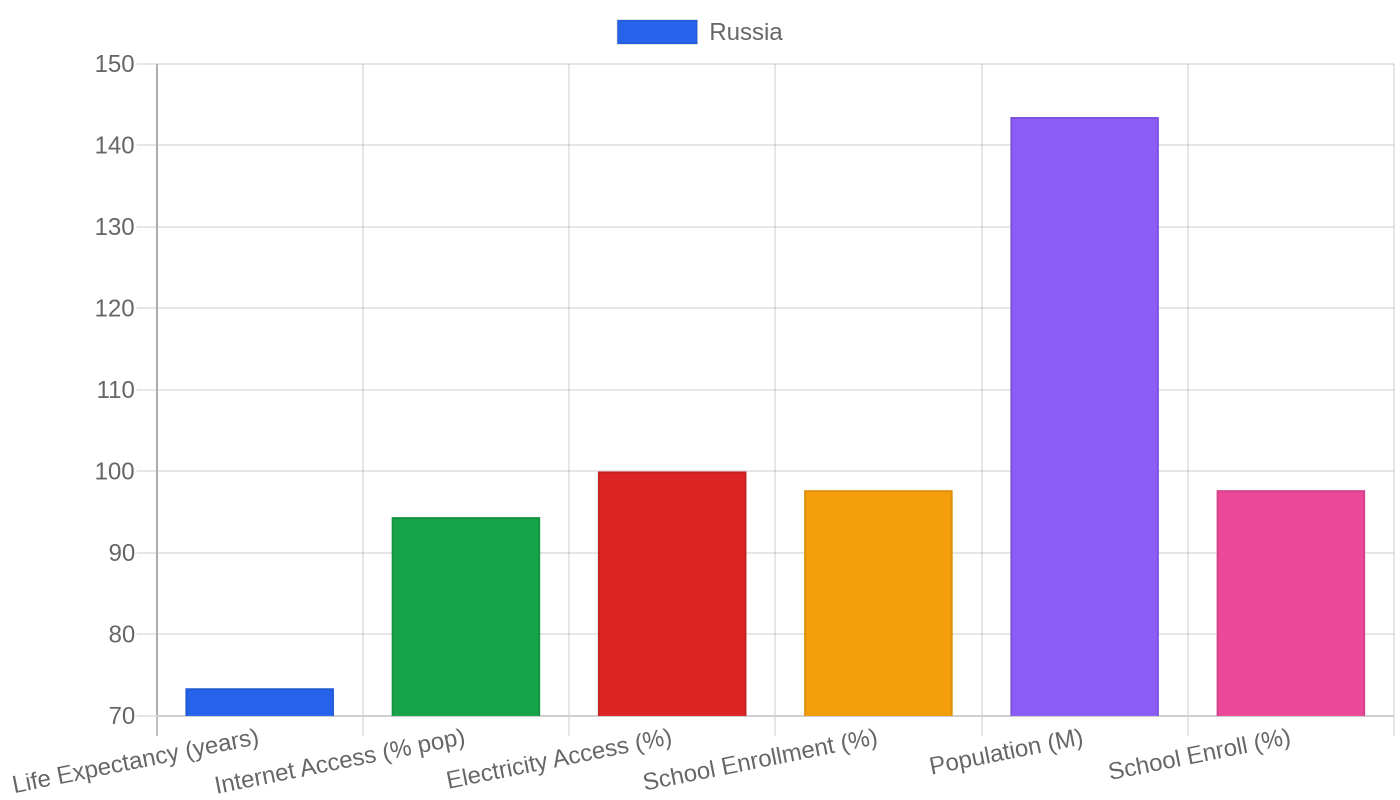
With a population of roughly 143.5 million people, the GDP per capita in PPP terms is $49,568, which suggests a relatively high standard of living compared to many emerging markets, yet the slow growth rate implies limited room for rapid improvement in individual welfare. This environment forces policymakers to balance the need for price stability against the risk of further stifling an already constrained supply side.
Cost of Living: Navigating the Inflation Gap
For residents and expatriates alike, the cost of living in Russia presents a complex picture shaped by the current macroeconomic indicators. While specific housing indices and daily expense metrics are not explicitly detailed in the provided datasets, the overarching inflation rate of 8.72% serves as a critical benchmark for all consumer expenditures.
This level of inflation suggests that essential goods, services, and potentially rental markets are experiencing significant upward pressure, outpacing typical wage adjustments. When comparing this to regional averages, an inflation rate nearly double the single digits places Russian households in a challenging position regarding budget planning and long-term financial security.
The low unemployment rate of 2.133% might theoretically support higher incomes, but if wages do not keep pace with the CPI, the real value of earnings diminishes. Furthermore, with a GDP per capita (PPP) of $49,568, the baseline for purchasing power parity is relatively strong, implying that non-traded goods and local services may offer better value than in higher-inflation economies. However, the disparity between nominal wealth and daily affordability requires careful navigation.
Consumers must prioritize discretionary spending, as the erosion of purchasing power affects everything from food prices to utility bills. Without specific housing cost data, it is difficult to determine if rent is absorbing a larger share of income, but the general trend points toward a tightening of disposable income across most demographics.
Investment & Business Climate: Corporate Pillars and Digital Shifts
The investment landscape in Russia is heavily influenced by a handful of dominant corporate entities that span diverse sectors, from aviation to digital entertainment. Major players such as Aeroflot, the national carrier, and Alfa Group, a diversified conglomerate, represent the backbone of traditional industrial and financial stability.
Meanwhile, the rise of technology-focused firms like 1C Company and Alawar Entertainment highlights a growing emphasis on the digital economy and software development within the domestic market. Other notable companies include Acron Group, which dominates the chemical and fertilizer sector, and Abrau-Durso, a key player in the beverage industry.
These entities operate within a business environment characterized by low unemployment, which poses a challenge for expansion through hiring but may encourage automation and efficiency improvements. Investors watching this space should note that the concentration of economic activity among these top firms creates both opportunities and risks; their performance is indicative of broader market health.
The presence of multiple banking institutions, including Alfa-Bank and Ak Bars Bank, suggests a competitive financial sector capable of supporting domestic credit needs. However, the absence of comprehensive crime and safety indices makes assessing operational security and regulatory transparency more difficult for foreign investors. Despite these informational gaps, the sheer scale of the GDP and the specialized nature of leading companies indicate a resilient, albeit insular, commercial ecosystem.
Safety, Politics & Quality of Life: Structural Stability Amid Uncertainty
Understanding Russia’s quality of life requires looking beyond economic metrics to its political and social structures. The country operates as an asymmetric federal republic with a semi-presidential system, where the President serves as head of state and the Prime Minister as head of government. This multi-party representative democracy features a federal government divided into three branches, providing a framework for legislative oversight and executive action.
However, the lack of available Crime Index and Safety Index data introduces ambiguity regarding personal security and societal stability for residents and visitors. In terms of happiness and well-being, specific indices are not provided, forcing an analysis based on economic proxies such as GDP per capita and employment levels.
The extremely low unemployment rate of 2.133% could imply high social stability, as few citizens are without work, but it may also reflect labor market distortions or mandatory service requirements. Political landscapes in such systems often correlate with strict regulatory environments, which can impact civil liberties and media freedom, factors that indirectly influence the overall quality of life.
Without concrete safety data, it is prudent to assume that standard geopolitical tensions may affect local perceptions of security. Therefore, while the political structure offers formal democratic mechanisms, the lived experience of citizens is shaped by the interplay of economic pressures and administrative controls.
What’s Happening Now: Policy Shifts and Economic Realities
Currently, Russia is grappling with the immediate aftermath of its recent economic performance, marked by the 1.001% GDP growth projection for 2025. Policymakers are likely focused on curbing the 8.72% inflation rate, which remains a persistent headache for central bank authorities. The record-low unemployment of 2.133% is now being viewed not just as a success metric, but as a constraint on production, prompting debates on labor mobility and immigration policies.
Recent news trends suggest a shift towards strengthening domestic industries, evidenced by the prominence of local tech firms like 1C Company and Alawar Entertainment in the corporate landscape. There is also increased attention on financial sovereignty, reflected in the active role of banks like Alfa-Bank and Ak Bars Holding in facilitating domestic transactions. As inflation continues to climb, consumer sentiment may be waning, leading to reduced discretionary spending that could further dampen retail sectors.
Meanwhile, large corporations like Aeroflot and Alfa Group are navigating these turbulent waters by optimizing operations rather than expanding aggressively. The coming months will likely see intensified scrutiny on how the government balances social stability with economic necessity, especially given the gap between nominal GDP strength and individual purchasing power.
The Bottom Line
Russia in 2025 is a study in contrasts: a massive economy with a huge GDP but stagnant growth and high inflation. Investors and analysts should watch this country closely for signs of labor market adaptation and technological innovation within its major corporate pillars. While the low unemployment rate suggests a stable workforce, the high inflation rate warns of ongoing challenges in maintaining living standards.
It is a market best approached with caution, focusing on established giants rather than speculative ventures.
Sources & Methodology
This article is authored by Economic Pulse Net for informational and research purposes. Economic Pulse Net sources its data from multilateral institutions, national statistics bureaus, and proprietary databases. All data is believed to be current as of the date of publication.
Published: October 28, 2026 | Category: Research — Russia
Use these signals in your own platform
Economic Pulse publishes its live signal feed through a documented, read-only API. Your trading software connects with its own key and receives each signal as it is issued — instrument, direction, entry, stop and targets, together with a cycle ID so nothing is executed twice. The feed is independent of this website and cannot change it.
Signals are informational only and are not financial advice.