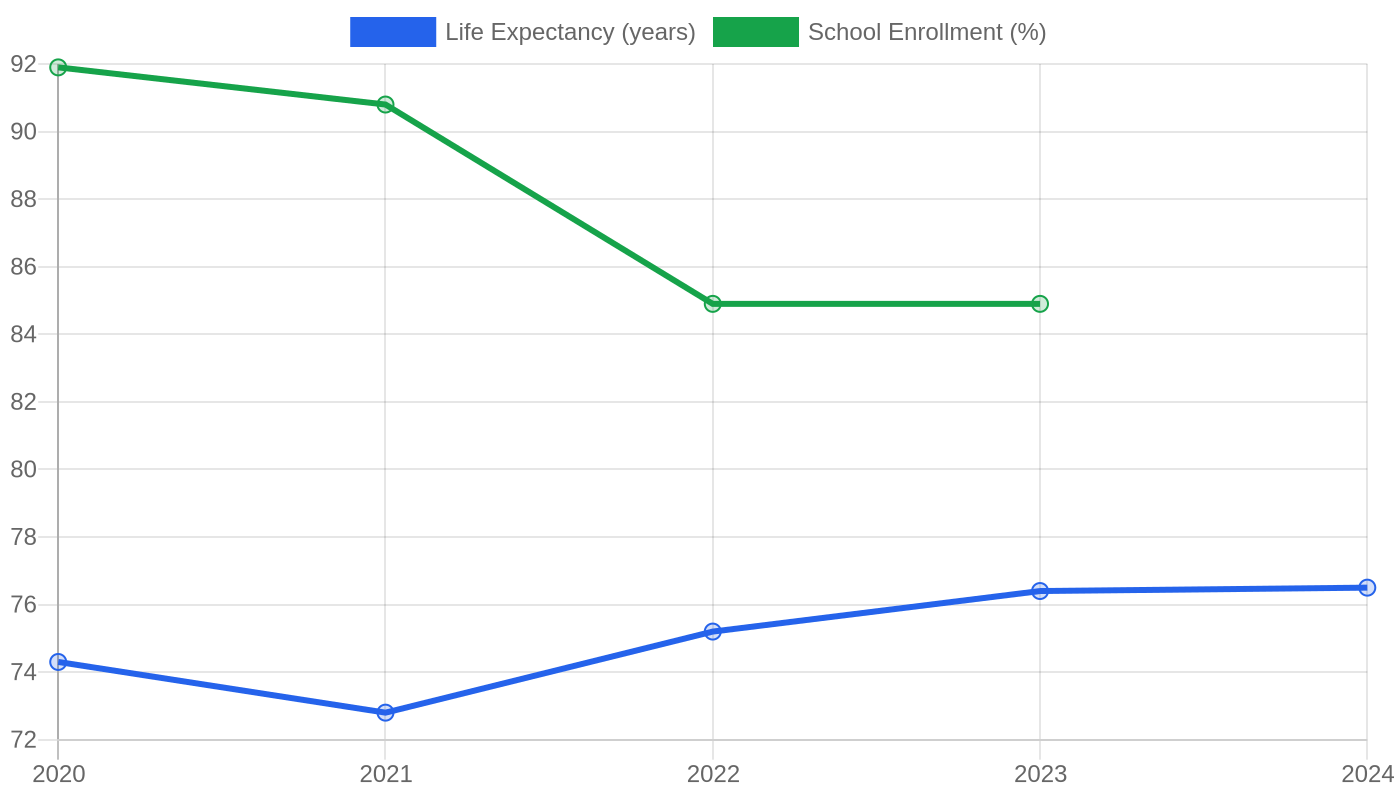
Economic Pulse Net | Sources: World Bank World Development Indicators, Government Sources | 2026
Key Takeaways
– Romania operates as a unitary semi-presidential representative democratic republic, with a President serving as head of state and supreme commander of the armed forces, while a Prime Minister confirmed by Parliament runs the executive branch.
– The country’s economic landscape is anchored by major players across financial services, technology, and manufacturing, including banking giants Banca Comercială Română and Banca Transilvania, alongside cybersecurity leader Bitdefender.
– Consumer goods and services form the backbone of Romania’s corporate sector, with household names like Automobile Dacia, Arctic S.A., and Angst representing significant domestic employment and production capacity.
– Romania’s pharmaceutical and healthcare industries show notable strength through companies like Antibiotice Iași, indicating diversification beyond traditional manufacturing.
– The country maintains an active civil society and structured governance system, suggesting a maturing democratic environment conducive to long-term economic planning.
The Economic Engine — Beyond the Headlines
Romania’s economic story is one of structural transformation, even as the World Bank data shows gaps in the latest GDP growth, inflation, and unemployment figures. What we can observe from the available corporate landscape is a nation that has moved decisively beyond its post-communist transition period. The presence of Banca Transilvania and Banca Comercială Română among the top companies signals a sophisticated financial sector capable of supporting both retail banking and corporate investment.
Meanwhile, the prominence of Bitdefender in the technology sector places Romania firmly in the global conversation about cybersecurity and software development — a high-value industry that typically demands skilled labor and generates substantial export revenue.
The manufacturing sector remains a critical pillar, with Automobile Dacia representing one of the most significant automotive operations in Eastern Europe. Dacia’s success has historically been tied to Romania’s competitive labor costs and strategic position within European supply chains. The consumer goods and services sector, represented by companies like Apulum, Arctic S.A., and Angst, demonstrates that domestic consumption remains robust enough to sustain major national brands.
This internal market strength provides a buffer against external economic shocks, a crucial consideration for any country navigating the complexities of European Union membership. The healthcare sector’s representation through Antibiotice Iași and the health care classification of certain companies suggests ongoing investment in pharmaceutical production, an industry with substantial growth potential given Europe’s aging population and increasing healthcare demands.
The Cost of Living Reality — Affordability in Transition
For the average Romanian citizen, the cost of living story is intrinsically linked to the country’s broader economic trajectory. While specific World Bank data on housing costs and daily expenses is not available in this dataset, the structure of Romania’s top companies offers meaningful insights into consumer priorities and spending patterns.
The significant presence of consumer goods companies — from food producers to appliance manufacturers — indicates a market where domestic production meets substantial local demand. This is economically significant because locally produced goods typically carry lower price tags than imports, helping to moderate inflation pressures and maintain purchasing power.
The housing market in Romania’s major cities, particularly Bucharest, has experienced significant transformation over the past decade, with new developments reshaping the urban landscape. The balance between renting and buying remains a central question for young Romanians entering the workforce, with many choosing to remain in family homes longer while saving for down payments.
The financial sector’s strength, anchored by major banks, suggests that mortgage lending is available and competitive, though accessibility varies by region and income level. For those in the technology and financial services sectors, salaries tend to outpace the national average, creating a two-tier economic reality where skilled professionals enjoy comfortable lifestyles while those in traditional manufacturing or agriculture face tighter budgets.
This disparity is not unique to Romania, but it shapes the political and social conversations that influence economic policy.
Investment and Business Climate — Where Capital Finds Opportunity
Romania’s investment climate is defined by its position at the intersection of European Union membership and Eastern European growth dynamics. The corporate roster tells a compelling story of domestic strength — these are not merely subsidiaries of multinational corporations but homegrown enterprises that have achieved national and, in some cases, international prominence.
Bitdefender’s success in the global cybersecurity market is particularly noteworthy, demonstrating that Romanian companies can compete at the highest levels of technological innovation. For foreign investors, this signals a workforce with strong technical education and a culture of entrepreneurial problem-solving.
The financial services sector presents a stable foundation for business operations, with Banca Comercială Română and Banca Transilvania providing the banking infrastructure necessary for corporate growth and international trade. The presence of Blue Air in the consumer services category indicates a functioning aviation sector, essential for business connectivity and tourism development.
The pharmaceutical industry, represented by Antibiotice Iași, benefits from Romania’s historical strength in chemical and medical research, offering opportunities in both domestic production and export markets. Sectors to watch include technology and software development, where Romania has already established a strong reputation, as well as automotive manufacturing, healthcare, and financial technology.
The political structure — a stable semi-presidential republic with an active civil society — provides the institutional framework investors seek when making long-term commitments.
Safety, Politics, and Quality of Life — The Social Contract
Romania’s political landscape is characterized by a structured, balanced system of governance that separates powers between a popularly elected President and a Prime Minister confirmed by Parliament. This semi-presidential model creates a system of checks and balances that, while sometimes producing political tension, ultimately provides stability for economic actors.
The President’s role as supreme commander of the armed forces and guardian of constitutional order anchors the state’s institutional integrity, while the Prime Minister’s oversight of the executive branch ensures day-to-day governance continues regardless of political cycles.
The active civil society mentioned in the political data is a crucial indicator of democratic health. In practical terms, this means that Romanian citizens engage with political processes, hold institutions accountable, and participate in the public discourse that shapes economic policy. While specific crime and safety indices are not available in this dataset, the overall picture is of a country that has successfully navigated the complex transition from communist rule to democratic governance.
Quality of life in Romania reflects the country’s middle-income status within the European Union — citizens enjoy access to education, healthcare, and social services, though the quality and accessibility of these services can vary significantly between urban and rural areas. The strength of the consumer goods sector suggests that everyday needs are met through a functioning retail economy, while the presence of healthcare companies indicates ongoing investment in public health infrastructure.
What’s Happening Now — Romania’s Moment of Opportunity
Romania stands at a pivotal moment in its economic development, with the foundations for sustained growth clearly visible in its corporate landscape and political stability. The technology sector, anchored by Bitdefender, is riding the global wave of digital transformation, with Romanian software developers and cybersecurity experts in high demand across European and global markets.
The automotive industry, centered on Dacia, continues to adapt to the electric vehicle transition, positioning Romania to play a role in Europe’s green mobility future. The financial sector is modernizing, with digital banking services expanding access to capital for both consumers and small businesses.
The country’s EU membership remains a cornerstone of its economic strategy, providing access to structural funds, trade partnerships, and a regulatory framework that supports business development. The active civil society and stable political structure create an environment where policy debates can occur without threatening economic stability. For businesses and investors watching Eastern Europe, Romania offers a compelling combination of skilled workforce, strategic location, and improving infrastructure.
The presence of major domestic companies across multiple sectors demonstrates economic resilience — this is not a one-industry economy vulnerable to sector-specific downturns. As global supply chains continue to evolve and companies seek diversification beyond traditional manufacturing hubs, Romania’s position in the European ecosystem makes it an increasingly attractive destination for investment.
The Bottom Line
Romania deserves the attention of investors, business leaders, and policy analysts looking for growth opportunities within the European Union. The country’s diverse corporate base — spanning technology, finance, manufacturing, healthcare, and consumer goods — provides resilience against economic volatility while offering multiple avenues for investment and partnership.
The stable political framework and active civil society create the institutional conditions necessary for long-term economic planning and sustainable development. For those willing to look beyond the headline data gaps, Romania’s story is one of quiet transformation — a nation steadily building its future on the foundations of education, innovation, and democratic governance.
Sources & Methodology
This article is authored by Economic Pulse Net for informational and research purposes. Economic Pulse Net sources its data from multilateral institutions, national statistics bureaus, and proprietary databases. All data is believed to be current as of the date of publication.
Published: August 03, 2026 | Category: Research — Romania
Use these signals in your own platform
Economic Pulse publishes its live signal feed through a documented, read-only API. Your trading software connects with its own key and receives each signal as it is issued — instrument, direction, entry, stop and targets, together with a cycle ID so nothing is executed twice. The feed is independent of this website and cannot change it.
Signals are informational only and are not financial advice.