Economic Pulse Net | Sources: World Bank World Development Indicators, Government Sources | 2026
Key Takeaways
– Romania’s economy is barely growing, with World Bank data showing GDP expansion of just 0.68% in 2025 — a figure that raises questions about the country’s post-pandemic recovery trajectory.
– Inflation remains painfully high at 7.19%, according to the World Bank, eroding household purchasing power and complicating the central bank’s policy choices.
– Unemployment stands at a relatively low 5.99%, suggesting the labour market is holding up better than the broader economy — but wage growth may be lagging behind price rises.
– The corporate landscape is dominated by a mix of banking giants like Banca Transilvania and Banca Comercială Română, alongside household names such as Automobile Dacia and the cybersecurity firm Bitdefender.
– Romania’s political system, a unitary semi-presidential republic, faces the challenge of managing fiscal pressures while maintaining the social stability that has underpinned its European Union membership.
The Growth Paradox — Why 0.68% Expansion Matters More Than It Sounds
At first glance, Romania’s 2025 GDP growth figure of 0.68%, as recorded by the World Bank, looks like a rounding error rather than a meaningful economic expansion. But context is everything. This is a country that has, over the past two decades, transformed itself from a post-communist laggard into one of the European Union’s more dynamic emerging economies, often posting growth rates of 3% to 5% before the pandemic. To see that engine sputter is significant.
The culprit is inflation. At 7.19%, according to the World Bank, Romania’s consumer price index is running well above the European Central Bank’s target zone — and above what most economists consider healthy for a middle-income economy. This is not a transitory spike; it is a structural pressure driven by energy costs, food prices, and a labour market that, while not overheating in terms of unemployment, is pushing up wages faster than productivity can absorb.
The 5.99% unemployment rate, also from the World Bank, is enviably low by European standards, but it masks a deeper problem: too few workers chasing too many jobs in certain sectors, while other industries struggle to find buyers for their output.
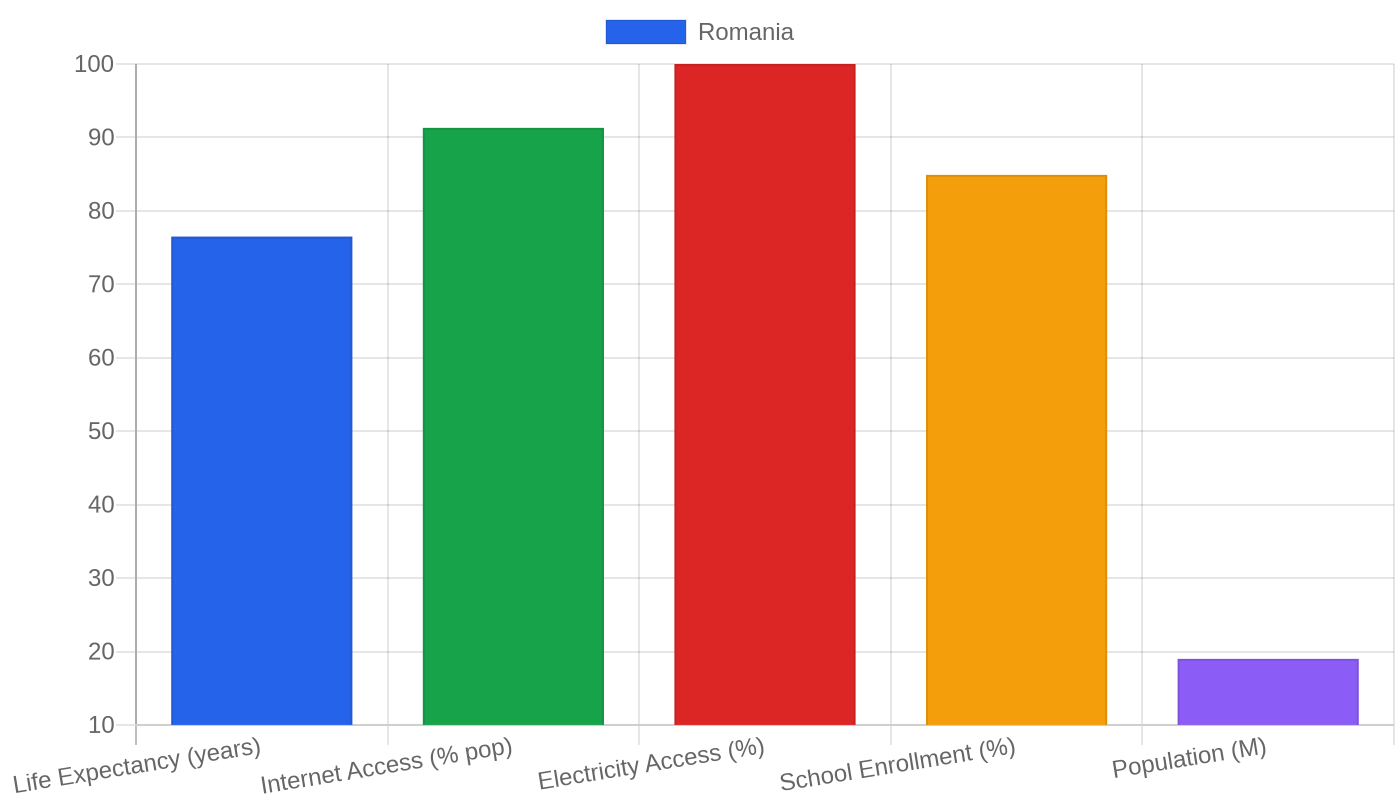
The GDP per capita at purchasing power parity — $50,895, according to the World Bank — tells a more nuanced story. That figure places Romania comfortably above the global average and within striking distance of some Western European peers. But nominal GDP of roughly $428.7 billion, spread across a population of just over 19 million, means the economy is still relatively small and exposed to external shocks. When inflation runs hot and growth runs cold, the margin for error narrows considerably.
The risk is that Romania enters a period of stagflation-lite: rising prices, stagnant output, and a population that feels poorer even as the headline statistics suggest otherwise.
The Price of Living — Housing, Daily Costs, and the Squeeze on Households
For the average Romanian, the inflation numbers are not abstract. They show up in the weekly shopping basket, in the cost of heating a home during the Carpathian winter, and in the monthly rent cheque. While the World Bank data does not provide a detailed cost-of-living breakdown, the 7.19% inflation figure implies that real wages — even if nominally rising — are being eaten alive by price increases.
This is particularly painful for the roughly one-third of the population that lives in rural areas, where access to cheaper alternatives is limited and incomes tend to be lower.
Housing is the great unspoken pressure point. In Bucharest, property prices have climbed steadily over the past decade, driven by foreign investment, a growing middle class, and a chronic shortage of new supply in desirable districts. Rents in the capital now consume a significant share of disposable income for young professionals and families alike.
Outside the major cities, the picture is more mixed: you can still buy a house in a small Transylvanian town for a fraction of the cost in Cluj-Napoca or Timișoara, but job opportunities are correspondingly scarce. The cost-of-living data gap in the provided figures means we cannot make direct regional comparisons, but anecdotal evidence from Romanian media consistently points to a two-speed housing market: overheating in urban centres, stagnation in the countryside.
Daily expenses — food, transport, utilities — have become a source of quiet anxiety. Romania has long been one of the cheaper EU member states for groceries and services, but that advantage is eroding. The inflation rate suggests that basic necessities are rising faster than discretionary spending, which is the classic signature of a cost-of-living crisis. For households on fixed incomes, particularly pensioners, the situation is acute.
Banking, Tech, and Dacia — Where the Money Is
Romania’s corporate landscape is a fascinating mix of legacy industries and digital pioneers. The financial sector is anchored by two heavyweights: Banca Comercială Română and Banca Transilvania, both listed among the top companies in the data. These institutions are not just lenders; they are bellwethers for the health of the broader economy. When they tighten credit, small businesses feel it. When they expand, it signals confidence.
Given the current macroeconomic headwinds, both banks are likely treading carefully, balancing the need to support growth against the risk of rising non-performing loans.
Then there is Automobile Dacia, the carmaker that put Romania on the industrial map. Owned by France’s Renault Group, Dacia has become synonymous with affordable, no-frills vehicles that sell across Europe. Its presence in the top companies list is a reminder that manufacturing remains a cornerstone of the Romanian economy, even as the global auto industry undergoes a painful transition toward electric vehicles.
Dacia’s challenge — and opportunity — is to navigate that shift without losing its cost advantage.
On the technology front, Bitdefender stands out as Romania’s most famous global brand. The cybersecurity firm has carved out a reputation as a serious competitor to American and Israeli giants, and its inclusion in the top companies underscores the depth of Romania’s tech talent pool. The country has quietly become a hub for software development, IT outsourcing, and startup activity, fuelled by a strong education system in STEM fields and relatively low labour costs compared to Western Europe.
For investors looking beyond the headline GDP figures, this is the sector to watch.
Other notable names include Antibiotice Iași in healthcare, Arctic S.A. in consumer goods, and Blue Air in aviation — though the latter has faced well-documented turbulence in recent years. The diversity of the list suggests an economy that is not overly dependent on any single industry, which is a strength. But the absence of energy or mining giants is conspicuous, given Romania’s significant natural gas reserves and potential as a regional energy player.
Democracy, Safety, and the Quality of Life Question
Romania’s political system is described in the data as a unitary semi-presidential representative democratic republic, with a president elected by popular vote serving as head of state and a prime minister confirmed by parliament running the government. On paper, this is a stable framework. In practice, Romanian politics has been anything but dull. Corruption scandals, protests, and frequent changes of government have been features of the post-communist era.
Yet the system has endured, and civil society remains active and vocal — a sign of democratic health that should not be underestimated.
The crime and safety indices are listed as not available in the data, which makes it impossible to offer a quantitative assessment of public security. However, Romania is generally considered a safe country by European standards. Violent crime is rare, and the main concerns for residents and visitors tend to be petty theft and occasional scams targeting tourists. The bigger safety issue is arguably economic: when inflation erodes living standards and growth stalls, social tensions can rise.
So far, Romania has managed to avoid the kind of unrest seen in some of its neighbours, but the risk is worth monitoring.
Quality of life is a mixed picture. The GDP per capita at PPP of nearly $51,000 suggests that, in purchasing power terms, the average Romanian has access to a standard of living comparable to some Western European countries. But averages can be misleading.
Regional disparities are stark: Bucharest and a handful of university cities enjoy modern infrastructure, good healthcare, and vibrant cultural scenes, while rural areas and smaller towns struggle with depopulation, ageing populations, and limited public services. For the educated young, the pull of emigration to Western Europe remains strong, even if the flow has slowed in recent years.
What’s Happening Now — The Political and Economic Crossroads
This is the moment when Romania’s story becomes most urgent. The 2025 GDP growth figure of 0.68% from the World Bank is not just a statistic; it is a warning light on the dashboard. The economy is barely expanding, inflation is running hot, and the government faces a difficult fiscal arithmetic: it must maintain public services and social support without scaring away investors or breaching EU budget rules.
The political calendar adds another layer of complexity. With a presidential system and parliamentary elections looming, the temptation for politicians to promise tax cuts or spending increases is high. But the data suggests there is little room for such largesse. The central bank, meanwhile, is caught between raising interest rates to tame inflation and keeping them low enough to support growth. It is a classic policy dilemma, and there is no easy answer.
On the business front, the presence of companies like Bitdefender and the resilience of Dacia suggest that Romania has genuine competitive advantages that will outlast the current downturn. The question is whether the broader economy can pivot fast enough to capitalise on them. Infrastructure remains a bottleneck — roads, railways, and digital connectivity are improving but still lag behind Western European standards.
EU funding, including from the Recovery and Resilience Facility, provides a once-in-a-generation opportunity to close that gap, but implementation has been slow and bureaucratic.
There is also the geopolitical dimension. Romania shares a border with Ukraine and has been a steadfast supporter of Kyiv since the Russian invasion. It hosts NATO troops and has become a key hub for energy security and military logistics in the region. This strategic importance brings both opportunities — increased investment, stronger alliances — and risks, particularly if the conflict escalates.
For now, the mood in Bucharest is one of cautious resilience, but the economic data suggests that resilience is being tested.
The Bottom Line
Romania is not a country in crisis, but it is a country at a crossroads. The combination of low growth, high inflation, and a tight labour market creates a fragile equilibrium that could tip in either direction. For investors, the long-term case remains compelling: a skilled workforce, a strategic location, and a growing tech sector offer real upside. But the short-term risks — political uncertainty, fiscal pressures, and the lingering effects of inflation — demand careful attention.
Watch Romania for its potential, but go in with your eyes open.
Sources & Methodology
This article is authored by Economic Pulse Net for informational and research purposes. Economic Pulse Net sources its data from multilateral institutions, national statistics bureaus, and proprietary databases. All data is believed to be current as of the date of publication.
Published: July 24, 2026 | Category: Research — Romania
Use these signals in your own platform
Economic Pulse publishes its live signal feed through a documented, read-only API. Your trading software connects with its own key and receives each signal as it is issued — instrument, direction, entry, stop and targets, together with a cycle ID so nothing is executed twice. The feed is independent of this website and cannot change it.
Signals are informational only and are not financial advice.