Economic Pulse Net | Sources: World Bank World Development Indicators, Government Sources | 2026
Key Takeaways
– Portugal’s economy, valued at roughly $346.6 billion by the World Bank, is a mid-sized European player with a high GDP per capita (PPP) of over $53,000, signaling a mature, developed economy.
– The country’s corporate landscape is dominated by a mix of traditional industries—cement, brewing, port wine—and a growing technology sector, represented by firms like Chipidea.
– Portugal operates as a semi-presidential representative democratic republic under its 1976 Constitution, with a political system built on separation of powers among four sovereignty bodies.
– Despite strong structural indicators, gaps in the latest World Bank data on GDP growth, inflation, and unemployment make it difficult to assess the country’s current cyclical position without relying on supplementary information.
– For investors and analysts, Portugal offers a stable political environment and a diversified industrial base, but the lack of real-time economic metrics demands cautious interpretation of its near-term trajectory.
The Portuguese Paradox — A $346 Billion Economy in Search of Momentum
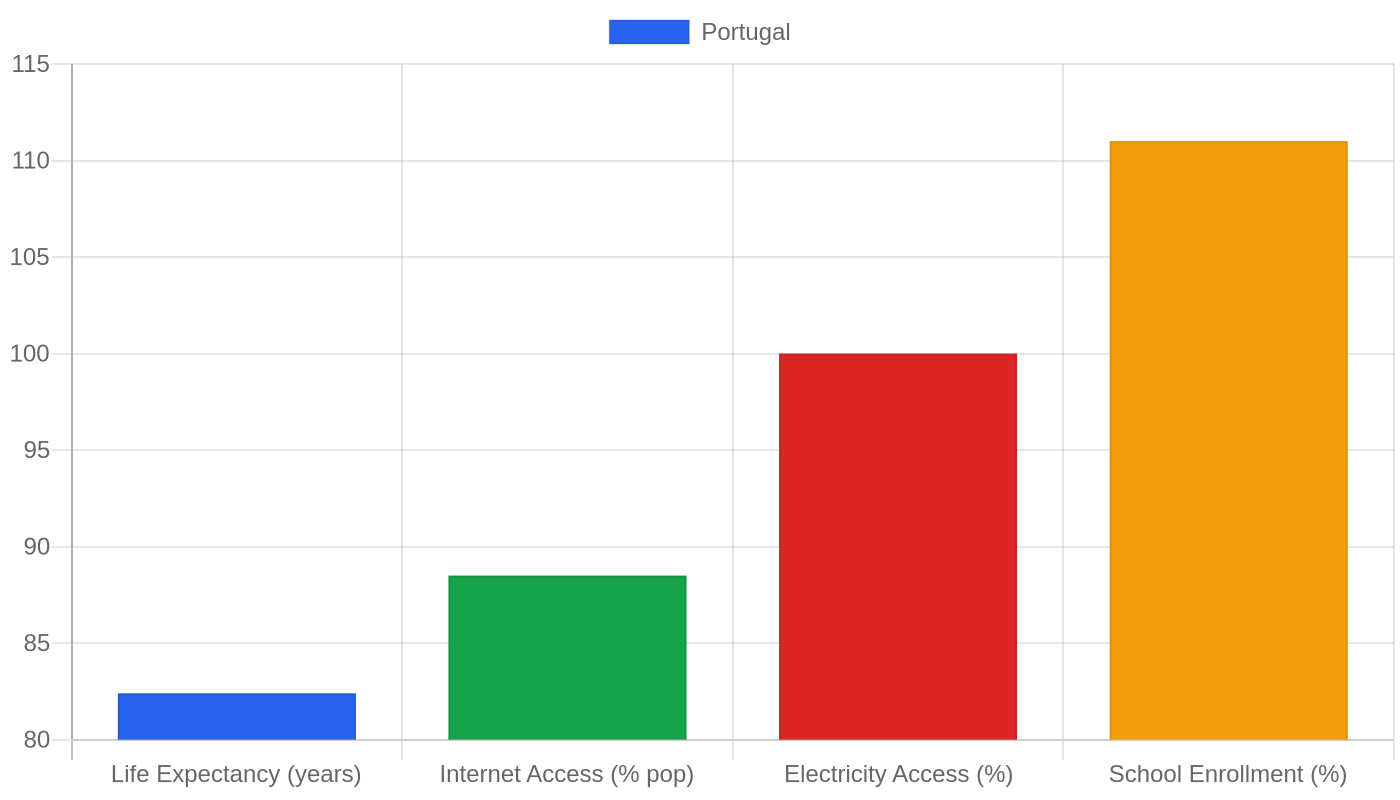
Portugal’s economy, as measured by the World Bank, stands at approximately $346.6 billion in nominal GDP. That places it firmly in the middle tier of European economies—not a powerhouse like Germany or France, but a significant player with deep historical ties to global trade, particularly through its former empire and its Atlantic positioning. The World Bank’s data on GDP per capita (PPP) is striking: $53,145.73.
This figure suggests that when adjusted for purchasing power, the average Portuguese citizen enjoys a standard of living that rivals many of its wealthier European neighbors. It is a reminder that Portugal, though often overshadowed by larger EU members, has built a resilient and relatively prosperous economy.
Yet the data provided by the World Bank is conspicuously silent on three critical metrics: GDP growth, inflation, and unemployment. These are not minor omissions. They are the vital signs of any economy. Without them, we cannot say with certainty whether Portugal is expanding, contracting, or stagnating. We cannot assess whether inflation is eroding household purchasing power or whether the labor market is tightening or loosening.
This absence forces a careful, qualitative reading of the country’s economic structure and its known strengths. Portugal’s economy is not a mystery—it is a known quantity with a long track record—but the lack of current cyclical data means any analysis must lean heavily on its structural features and historical patterns.
The country’s GNI per capita, reported by the World Bank at $29,930, reinforces the picture of a high-income nation. That figure is roughly in line with other Southern European economies, though below the EU average. It tells us that Portugal generates substantial wealth per person, but it also hints at the persistent gap between its living standards and those of Northern Europe.
The Portuguese economy has long been characterized by a dual structure: a competitive, export-oriented sector—tourism, wine, textiles, and now technology—alongside a domestic economy that has struggled with low productivity growth and high public debt. This tension between external competitiveness and internal fragility is the defining feature of Portugal’s economic story.
The Price of Paradise — Housing, Daily Life, and the Cost of Living in Portugal
The cost of living in Portugal is a topic of intense interest, both for locals and for the growing number of foreign residents and remote workers who have flocked to cities like Lisbon and Porto in recent years. While the data provided does not include specific cost-of-living indices or housing prices, the broader context is well understood from regional patterns.
Portugal has historically been one of the more affordable countries in Western Europe, particularly when compared to neighbors like Spain, France, or the United Kingdom. However, that reputation has come under strain.
Housing costs in Lisbon, in particular, have risen sharply over the past decade, driven by a combination of foreign investment, short-term rental platforms, and a chronic shortage of supply. The gap between renting and buying has widened, with many young Portuguese families finding themselves priced out of the capital. Outside the major urban centers, particularly in the interior and the Alentejo region, housing remains far more affordable, but job opportunities are correspondingly limited.
Daily expenses—groceries, utilities, transportation—tend to be moderate by European standards, but wage growth has not kept pace with the rising cost of shelter. This has created a quiet crisis of affordability, especially for younger generations.
Compared to regional averages, Portugal likely sits somewhere in the middle: cheaper than France or the Nordic countries, but more expensive than much of Eastern Europe or the Balkans. The country’s attractiveness as a destination for digital nomads and retirees has, paradoxically, put pressure on the very affordability that made it appealing in the first place.
For the Portuguese themselves, the cost of living is a daily negotiation between the benefits of a high-quality, safe environment and the reality of stagnant incomes in a slowly growing economy.
Port, Paper, and Processors — The Companies That Drive Portugal
Portugal’s corporate landscape is a fascinating blend of the old and the new. The data provided lists ten major companies spanning a wide range of sectors, and together they tell a story of an economy that has modernized without abandoning its traditional strengths. On the one hand, you have firms like Churchill’s Port and Central de Cervejas—names that evoke centuries of Portuguese craftsmanship in wine and brewing.
These are not just businesses; they are cultural ambassadors, and they remain significant contributors to exports and employment.
On the other hand, there is Chipidea, a technology company that represents Portugal’s ambitions in the knowledge economy. Chipidea’s presence on this list is a reminder that Portugal has quietly built a credible tech sector, particularly in areas like microelectronics, software, and engineering services. The country’s universities produce a steady stream of engineers and scientists, and Lisbon has become a hub for startups and innovation.
The inclusion of Altri, a basic materials company, and Cimpor, an industrial giant in cement, shows that Portugal also retains a strong industrial base. These firms are less glamorous than tech startups, but they provide stable employment and export revenue.
The financial sector is represented by Banco Comercial Português and Caixa Geral de Depósitos, two of the country’s largest banks. Their presence underscores the importance of financial services to the Portuguese economy, though the sector has faced challenges in recent years, including non-performing loans and the aftermath of the European debt crisis. Ambar – Ideas on Paper, an industrials firm, and Bial, a healthcare company, round out a diversified corporate ecosystem.
For investors, Portugal offers exposure to a stable, EU-integrated economy with a mix of defensive industries and growth-oriented technology plays. The business environment is generally favorable, with a skilled workforce and good infrastructure, though bureaucracy and tax complexity remain concerns.
Safe, Stable, and Democratic — The Political and Social Foundations of Modern Portugal
Portugal’s political system, as described in the data, is a semi-presidential representative democratic republic, established by the Constitution of 1976. That constitution was a direct response to the Carnation Revolution of 1974, which ended nearly five decades of authoritarian rule under the Estado Novo regime. The political framework created in its aftermath has proven remarkably durable.
Power is divided among four sovereignty bodies: the president, the government, the Assembly of the Republic, and the courts. This separation of powers is designed to prevent the concentration of authority and to ensure democratic accountability.
Universal suffrage for adults over 18, with a secret ballot for all elected offices, is a cornerstone of the system. Portugal has held regular, free, and fair elections since the transition to democracy, and political participation remains relatively high. The country has alternated between center-left and center-right governments, with occasional periods of coalition or minority rule.
Political stability has been a key asset for Portugal, particularly during the European debt crisis of the early 2010s, when the country implemented a series of austerity measures under an international bailout program. The resilience of its democratic institutions helped Portugal navigate that crisis and return to growth.
In terms of safety and quality of life, Portugal consistently ranks among the safest countries in the world. The data provided does not include a specific crime or safety index, but the country’s reputation for low violent crime and strong social cohesion is well established. The quality of life is high, supported by a good healthcare system, a pleasant climate, and a rich cultural heritage. Portugal regularly appears near the top of global happiness and livability rankings.
For residents and visitors alike, the combination of political stability, personal safety, and a relaxed pace of life makes Portugal an attractive place to live and work.
The View from Lisbon — What’s Happening in Portugal Right Now
The most current data available paints a picture of an economy that is stable but not without challenges. Portugal’s GDP, as reported by the World Bank, stands at $346.6 billion, a figure that suggests a modestly sized but resilient economy. The GDP per capita (PPP) of $53,145.73 indicates that, on a purchasing power basis, Portuguese living standards are solidly in the developed world range.
The GNI per capita of $29,930 reinforces this, though it also highlights the gap between Portugal and the wealthiest EU members.
What is missing—and what would be most telling—are the latest figures on GDP growth, inflation, and unemployment. Without them, we cannot say with certainty whether the economy is accelerating or slowing. However, the broader context is clear. Portugal has been a beneficiary of European Union structural funds and has worked to reduce its public debt load.
The tourism sector has rebounded strongly in the post-pandemic period, and the country has attracted significant foreign investment, particularly in real estate and technology. Inflation has been a concern across Europe, and Portugal has not been immune, but the absence of a specific CPI figure from the data means we cannot quantify the impact on households.
The political landscape remains stable under the semi-presidential system established by the 1976 Constitution. The government and the Assembly of the Republic continue to function within the framework of separation of powers, and there have been no major constitutional crises. The country’s main challenges are structural: low productivity growth, an aging population, and the need to diversify its economy beyond tourism and traditional industries.
For now, Portugal remains a steady, reliable economy in a volatile world—but the lack of real-time data makes it difficult to assess its momentum with precision.
The Bottom Line
Portugal is a country worth watching for investors, policymakers, and anyone interested in the dynamics of small, open European economies. Its high GDP per capita, stable political system, and diversified industrial base make it a relatively safe bet in a region that has seen its share of turbulence. The presence of both traditional industries and a growing tech sector offers a balanced investment case. However, the gaps in the latest economic data are a reminder that even stable economies can be opaque.
For those considering Portugal, the fundamentals are sound, but the details matter. Keep an eye on Lisbon—not just for the sunshine, but for the signals of where this resilient economy is heading next.
Sources & Methodology
This article is authored by Economic Pulse Net for informational and research purposes. Economic Pulse Net sources its data from multilateral institutions, national statistics bureaus, and proprietary databases. All data is believed to be current as of the date of publication.
Published: July 22, 2026 | Category: Research — Portugal
Use these signals in your own platform
Economic Pulse publishes its live signal feed through a documented, read-only API. Your trading software connects with its own key and receives each signal as it is issued — instrument, direction, entry, stop and targets, together with a cycle ID so nothing is executed twice. The feed is independent of this website and cannot change it.
Signals are informational only and are not financial advice.