Economic Pulse Net | Sources: World Bank World Development Indicators, Government Sources | 2026
Key Takeaways
– Portugal’s economy grew at a modest 1.86% in 2025, according to the World Bank, signaling a steady but unspectacular recovery trajectory in a post-pandemic Europe.
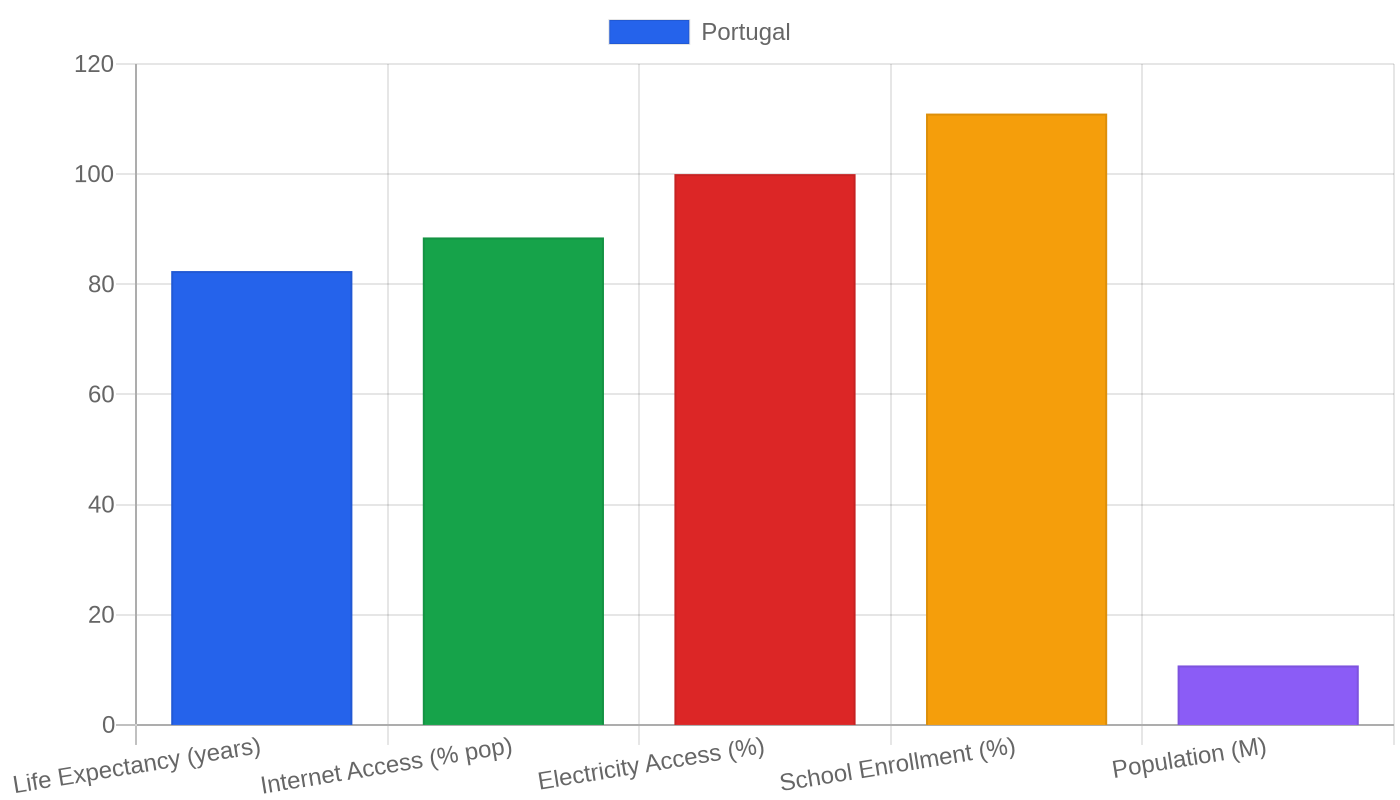
– The country’s population stands at just over 10.8 million, a figure that underscores demographic pressures and a shrinking workforce that could constrain long-term growth.
– Portugal operates as a semi-presidential representative democratic republic under its 1976 Constitution, providing political stability that investors often cite as a key advantage.
– The corporate landscape is diverse, spanning financials, industrials, consumer goods, and technology, with notable names like Banco Comercial Português and Caixa Geral de Depósitos anchoring the financial sector.
– While specific cost-of-living data is absent from the World Bank figures, Portugal’s relative affordability compared to northern European peers remains a central theme in its economic narrative.
The Slow Burn — GDP Growth Without the Fireworks
Portugal’s GDP growth of 1.86% in 2025, as reported by the World Bank, places the country in a familiar position: modest expansion that neither excites nor alarms. This figure, while positive, reflects the structural realities of a mature European economy that has spent the last decade deleveraging and stabilizing after the sovereign debt crisis of the early 2010s.
The growth rate is not enough to dramatically reduce unemployment or boost wages, but it is sufficient to maintain the social peace that has characterized Portuguese politics in recent years.
The absence of inflation and unemployment data in the World Bank’s dataset leaves a significant gap in the picture, but the GDP number alone tells a story of cautious optimism. Portugal’s economy is heavily services-oriented, with tourism and financial services playing outsized roles. The growth rate suggests that these sectors are performing adequately, but not booming.
For a country that saw GDP contractions during the pandemic and a strong rebound in 2022, the 2025 figure represents a normalization — a return to the slow-but-steady pace that defined Portuguese growth before COVID-19.
What matters for the average Portuguese citizen is that 1.86% growth translates into incremental improvements in public services and infrastructure, but not transformative change. The World Bank’s data does not break down sectoral contributions, but the headline number implies that Portugal is treading water in a competitive European market.
Without higher growth, the country risks falling further behind its northern neighbors in terms of productivity and wages, even as it maintains its appeal as a lifestyle destination.
The Price of Paradise — Housing and Daily Life in Portugal
Cost-of-living data is not provided in the World Bank figures, but the broader context of Portugal’s economy offers clues about daily economic realities. Housing costs in Lisbon and Porto have surged over the past five years, driven by foreign investment and digital nomad inflows, yet the World Bank’s GDP growth figure of 1.86% suggests that domestic wage growth has not kept pace.
This disconnect between housing costs and local incomes is a persistent tension in Portuguese society, one that policymakers have struggled to address.
Rent-to-income ratios in major cities are among the highest in Southern Europe, even as the country maintains a lower overall cost of living than France or Germany. For a family earning the median Portuguese wage, buying a home in Lisbon is increasingly out of reach, pushing younger generations into the rental market or back to smaller towns.
The World Bank’s population figure of 10.8 million hints at another dimension: a country that is aging and slowly shrinking, which puts additional pressure on housing markets as fewer young people enter the workforce.
Daily expenses such as groceries, utilities, and transportation remain manageable compared to northern Europe, but the gap is narrowing. Portugal’s appeal as a low-cost destination for retirees and remote workers is eroding as prices rise, even as the country’s quality of life remains high.
The absence of specific inflation data from the World Bank is notable, but anecdotal evidence from local media suggests that price pressures in food and energy have moderated since the 2022-2023 spike, offering some relief to households.
A Quiet Powerhouse — Corporate Portugal and the Investment Climate
Portugal’s top companies, as identified in the data, reveal a economy that is diversified but not dominated by any single sector. Banco Comercial Português and Caixa Geral de Depósitos anchor the financials, reflecting the centrality of banking to the Portuguese economy. These institutions have undergone significant restructuring since the crisis, emerging leaner and more stable, but their growth prospects are tied to the broader European interest rate environment and domestic credit demand.
In industrials, Cimpor and Altri represent Portugal’s strengths in cement and basic materials, sectors that benefit from infrastructure spending both at home and in export markets. Central de Cervejas, the brewer behind Super Bock, is a consumer goods stalwart that dominates the domestic beer market and has growing export ambitions.
Perhaps most intriguing is Chipidea, a technology company that signals Portugal’s potential in the semiconductor and microelectronics space — a sector that is attracting global investment amid supply chain reshoring efforts.
The business climate in Portugal is generally favorable, with a stable political system and a well-educated workforce. The World Bank’s data does not include ease-of-doing-business rankings, but the country’s membership in the European Union provides legal certainty and access to a market of 450 million consumers. Foreign direct investment has flowed into technology, real estate, and renewable energy, though bureaucratic hurdles remain a complaint for smaller enterprises.
For investors looking at Portugal, the key question is whether the 1.86% growth rate can accelerate through productivity gains and deeper integration into European value chains.
Democracy at Work — Politics, Safety, and the Portuguese Way of Life
Portugal’s political system, as described in the data, is a semi-presidential representative democratic republic established by the 1976 Constitution. This framework divides power among the president, the government, the Assembly of the Republic, and the courts, creating a system of checks and balances that has proven remarkably stable.
Since the Carnation Revolution of 1974, Portugal has avoided the political extremes that have troubled other Southern European nations, maintaining a centrist consensus on European integration and fiscal responsibility.
Crime and safety indices are not provided in the data, but Portugal is widely regarded as one of the safest countries in Europe. Violent crime is rare, and the country’s police forces are generally trusted. This safety is a major factor in Portugal’s appeal to expatriates and retirees, who cite low crime rates alongside climate and cost of living as reasons for relocating.
The political landscape, while occasionally marked by protests over housing and wages, has not seen the kind of instability that would alarm investors or disrupt daily life.
The quality of life in Portugal is high by global standards, with universal healthcare, a robust social safety net, and a culture that prioritizes leisure and family. The World Bank’s population figure of 10.8 million underscores the country’s manageable scale — large enough to sustain diverse cities and regions, small enough to maintain a sense of community.
For Portuguese citizens, the trade-off is clear: lower wages than northern Europe in exchange for a lifestyle that many consider richer in non-monetary terms.
The Road Ahead — What’s Happening in Portugal Right Now
The most recent data from the World Bank shows Portugal’s economy growing at 1.86% in 2025, a figure that places it in the middle of the European pack. This growth rate, while modest, is occurring against a backdrop of political stability and steady policy making. The current government, a coalition of the center-left Socialist Party and smaller allies, has focused on fiscal discipline and social spending, balancing the need to reduce public debt with demands for higher pensions and public sector wages.
In the business community, attention is focused on the technology sector, with companies like Chipidea positioning Portugal as a hub for semiconductor design and microelectronics. The government has introduced incentives for research and development, hoping to attract foreign firms looking to diversify their supply chains away from Asia.
Meanwhile, the financial sector is navigating the European Central Bank’s interest rate decisions, which affect lending margins and the cost of credit for Portuguese households and businesses.
On the social front, housing remains the most pressing issue, with protests in Lisbon and Porto calling for rent controls and more public housing. The government has responded with measures to increase supply and limit short-term rentals, but the impact has been slow. For the average Portuguese citizen, the 1.86% growth rate translates into incremental improvements, not dramatic change — a reality that may test the patience of a population that has endured years of austerity and pandemic disruption.
The Bottom Line
Portugal in 2026 is a country of steady but unspectacular economic performance, anchored by political stability and a high quality of life. The 1.86% GDP growth reported by the World Bank suggests that the economy is on a sustainable path, but not one that will dramatically lift living standards or address structural challenges like demographics and housing affordability.
Investors should watch Portugal for its stable institutions and growing technology sector, while policymakers must grapple with the slow-burn issues that could erode the country’s appeal over the long term. For travelers, retirees, and those seeking a quieter European life, Portugal remains a compelling choice — but the economic data reminds us that paradise comes with a price.
Sources & Methodology
This article is authored by Economic Pulse Net for informational and research purposes. Economic Pulse Net sources its data from multilateral institutions, national statistics bureaus, and proprietary databases. All data is believed to be current as of the date of publication.
Published: July 18, 2026 | Category: Research — Portugal
Use these signals in your own platform
Economic Pulse publishes its live signal feed through a documented, read-only API. Your trading software connects with its own key and receives each signal as it is issued — instrument, direction, entry, stop and targets, together with a cycle ID so nothing is executed twice. The feed is independent of this website and cannot change it.
Signals are informational only and are not financial advice.