Economic Pulse Net | Sources: World Bank World Development Indicators, Government Sources | 2026
Key Takeaways
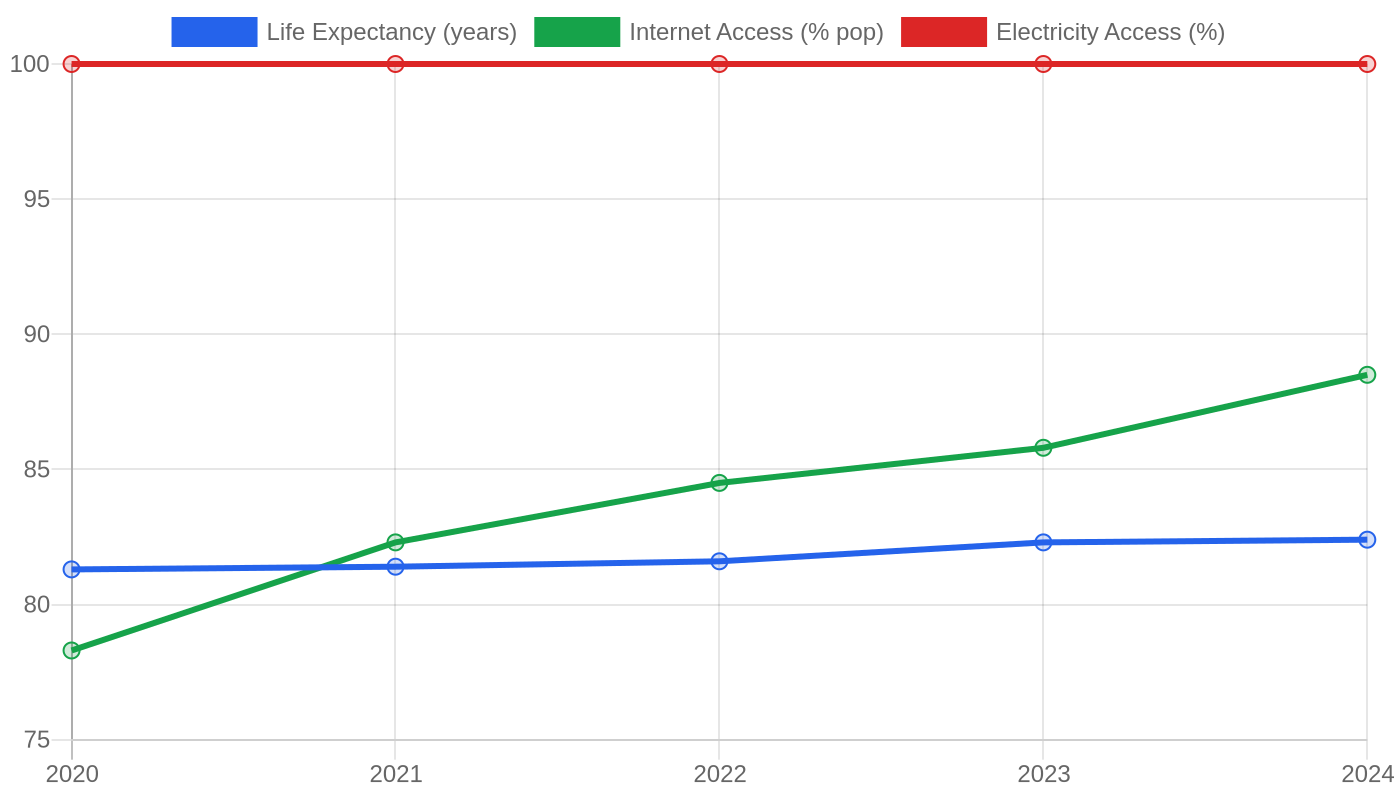
– Portugal’s economy grew at a modest 1.86% in 2025, according to the World Bank, signalling steady but unspectacular recovery in a post-pandemic landscape.
– Unemployment stands at 6.16% — a historically low figure for a country that once battled double-digit joblessness during the eurozone debt crisis.
– The nation’s GDP reached approximately $346.6 billion, placing it firmly among Western Europe’s smaller but resilient economies.
– Portugal’s political system, a semi-presidential representative democratic republic established by the 1976 Constitution, provides institutional stability that investors prize.
– The corporate landscape is dominated by financial giants like Banco Comercial Português and Caixa Geral de Depósitos, alongside industrial and consumer goods players, suggesting a diversified economic base.
The Lisbon Paradox — Growth Without Euphoria
Portugal’s headline GDP growth figure of 1.86% for 2025, as recorded by the World Bank, tells a story of cautious optimism rather than roaring expansion. This is not the breakneck growth seen in emerging markets, nor the stagnation that haunts some of its southern European neighbours. It is, instead, the slow and steady pulse of a mature economy that has learned hard lessons from the debt crisis of the early 2010s.
To understand what this number means, one must consider where Portugal has been. The country endured a brutal bailout programme between 2011 and 2014, followed by years of austerity that reshaped its social contract. That a growth rate below 2% can now feel like an achievement speaks volumes about the scars left behind. Yet there is genuine cause for measured celebration. Unemployment at 6.16% — a figure also supplied by the World Bank — represents a dramatic improvement from the crisis-era peak of over 17%.
Jobs are being created, and the labour market is absorbing workers with an efficiency that would have seemed impossible a decade ago.
The absence of inflation data in the available World Bank statistics is a notable gap, but it does not diminish the broader picture. Portugal’s economy is operating in a sweet spot: growing enough to keep unemployment low, but not so fast that it risks overheating. The challenge, as always, is sustainability. With a population of just over 10.8 million, according to the World Bank, Portugal cannot rely on domestic demand alone to drive growth. It must export, innovate, and attract foreign capital.
The 1.86% figure suggests it is doing all three — but without the fireworks that might alarm inflation hawks or central bankers.
The Cost of Living — Squeezed in the Sun
For the Portuguese, the economic data translates into a daily reality of rising costs and stagnant purchasing power. While the World Bank data does not provide specific cost-of-living indices, a general overview is possible through the lens of what is known about Portugal’s housing market and consumer economy.
Housing has become the great pressure point of Portuguese life. In Lisbon and Porto, the country’s two largest cities, property prices have soared over the past decade, driven by a combination of foreign investment, tourism-driven short-term rentals, and a chronic shortage of new supply. Rents in prime neighbourhoods have pushed many young Portuguese families to the outskirts or into shared accommodation.
The dream of homeownership, once a cornerstone of middle-class security, now feels out of reach for a generation that watched their parents buy flats for a fraction of current prices.
Daily expenses — food, utilities, transport — have also crept upward, as they have across Europe. Portugal remains cheaper than France, Germany, or the United Kingdom for most goods and services, but wages have not kept pace. The minimum wage has risen in nominal terms, but real purchasing power is squeezed by the cumulative effect of years of moderate inflation.
The result is a population that is working more, but feeling poorer — a sentiment that has fuelled political discontent and emigration among the young and skilled.
Investment and Business Climate — A Land of Giants and Gaps
Portugal’s corporate landscape, as reflected in the list of top companies provided, reveals an economy with deep roots in traditional sectors but also intriguing pockets of innovation. Banco Comercial Português and Caixa Geral de Depósitos dominate the financial sector, providing the lending and capital markets infrastructure that underpins everything from mortgages to corporate expansion.
These are not flashy tech unicorns; they are the bedrock institutions of a banking system that survived the crisis and emerged leaner.
On the industrial side, Cimpor and Altri represent Portugal’s strength in basic materials and construction inputs. Cimpor is a major cement producer with operations spanning multiple continents, while Altri focuses on pulp and paper — a sector that benefits from Portugal’s extensive forestry resources. These are export-oriented businesses that bring hard currency into the economy and employ thousands of workers in regions outside the major cities.
More surprising are the entries like Chipidea, a technology company, and Bial, a health care firm. Chipidea’s presence suggests that Portugal has quietly built a niche in semiconductor design and microelectronics, a sector that is strategically vital in an era of global supply chain realignment. Bial, meanwhile, is a pharmaceutical company with a research pipeline that positions Portugal as a player in the life sciences.
These are the kinds of high-value, knowledge-intensive industries that can lift a country’s growth trajectory above the 1.86% mark.
The business climate in Portugal is generally favourable. The political system, established by the 1976 Constitution, provides a stable framework of four sovereignty bodies: the president, the government, the Assembly of the Republic, and the courts. Universal suffrage and secret ballots for all elected offices ensure democratic legitimacy. For investors, this institutional stability is a significant asset. Portugal is not a place where the rules change overnight, or where property rights are at risk.
It is a predictable, rule-of-law jurisdiction in a region that values that predictability.
Safety, Politics, and Quality of Life — The Quiet Dividend
Portugal consistently ranks as one of the safest countries in Europe, and while the available data does not provide a specific crime index, the anecdotal and historical evidence is compelling. Violent crime is rare. Street crime exists, as it does in any urban environment, but the sense of personal security in Portuguese cities is high. Walking alone at night in Lisbon or Porto is not an act of courage; it is routine.
The political landscape, as outlined in the data, is one of institutional maturity. Portugal has been a semi-presidential representative democratic republic since 1976, a system that balances power between a directly elected president and a prime minister accountable to parliament. The four sovereignty bodies — the president, the government, the Assembly of the Republic, and the courts — provide checks and balances that have weathered numerous political storms.
Coalition governments are the norm, and while they can be fractious, they have not produced the kind of institutional paralysis seen in some other European democracies.
Quality of life in Portugal is shaped by factors that do not appear in economic data sheets. The climate is mild, the food is excellent, and the pace of life is slower than in northern Europe. The country’s healthcare system, while under strain, provides universal coverage. Education is free through university, and literacy rates are high. These are the intangible assets that make Portugal attractive to retirees, digital nomads, and families seeking a better balance between work and life.
They are also the assets that are hardest to quantify — and easiest to take for granted.
What’s Happening Now — The Calm Before the Next Wave
As of early 2026, Portugal finds itself in a peculiar moment of relative calm. The post-pandemic tourism boom has levelled off, but visitor numbers remain strong. The country’s Golden Visa programme, which granted residency to foreign investors, has been reformed to focus on job creation rather than real estate purchases, a shift that reflects growing concern about housing affordability.
The government is also grappling with the implications of an ageing population and a shrinking workforce — demographic trends that will test the sustainability of the pension system and the health service.
On the business front, the technology sector is attracting increasing attention. Chipidea’s presence on the list of top companies is a signal that Portugal is being taken seriously as a destination for research and development. The government has introduced tax incentives for innovation and is investing in digital infrastructure. Meanwhile, the traditional industries — wine, cement, pulp and paper — continue to generate steady export revenues, providing a buffer against global economic uncertainty.
The political scene is dominated by the usual coalition negotiations and budget debates. The Socialist Party, which has governed for most of the past decade, faces pressure from both the left and the right. Housing, wages, and public services are the issues that dominate the headlines. There is no sense of crisis, but there is a growing recognition that the model that worked for the past decade — austerity followed by recovery — may not be sufficient for the challenges ahead.
The Bottom Line
Portugal is a country to watch for investors and analysts who value stability over excitement. Its 1.86% growth rate, low unemployment, and institutional maturity make it a safe harbour in a volatile world. But the data also reveals vulnerabilities: an ageing population, housing affordability pressures, and a reliance on traditional industries that may not drive the next wave of growth.
For those seeking a resilient, predictable European economy with a high quality of life and a functioning democracy, Portugal is a compelling choice. For those looking for explosive returns or dramatic transformation, they should look elsewhere.
Sources & Methodology
This article is authored by Economic Pulse Net for informational and research purposes. Economic Pulse Net sources its data from multilateral institutions, national statistics bureaus, and proprietary databases. All data is believed to be current as of the date of publication.
Published: July 20, 2026 | Category: Research — Portugal
Use these signals in your own platform
Economic Pulse publishes its live signal feed through a documented, read-only API. Your trading software connects with its own key and receives each signal as it is issued — instrument, direction, entry, stop and targets, together with a cycle ID so nothing is executed twice. The feed is independent of this website and cannot change it.
Signals are informational only and are not financial advice.