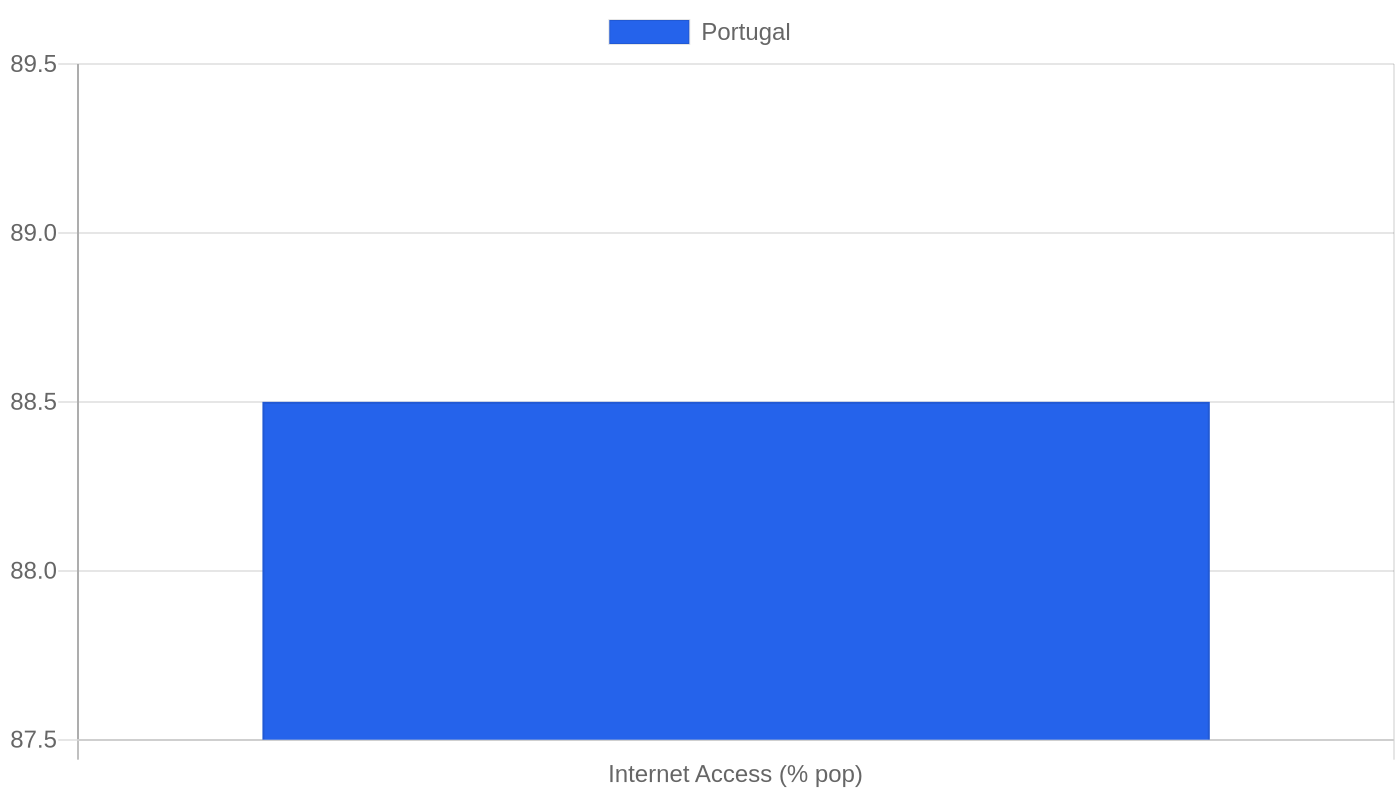
Economic Pulse Net | Sources: World Bank World Development Indicators, Government Sources | 2026
Key Takeaways
– Moderate Inflation: Portugal’s CPI stands at 2.34%, a figure that suggests the country has largely navigated the post-pandemic price shock better than many of its European peers.
– Resilient Labour Market: With unemployment at 6.16%, Portugal is operating near what economists consider full employment, a remarkable feat for a nation that faced a debt crisis just over a decade ago.
– Financial Sector Strength: The presence of major institutions like Banco Comercial Português and Caixa Geral de Depósitos signals a stabilised banking system that has moved beyond the bailout era.
– Political Continuity: As a semi-presidential representative democratic republic, Portugal’s constitutional framework provides institutional checks and balances that have underpinned policy consistency.
– Diversified Industrial Base: From wine-making heritage to cutting-edge technology, Portugal’s corporate landscape spans traditional and modern sectors.
The Economic Engine — Modest Prices, Steady Hands
The Portuguese economy is currently defined by a singular achievement: bringing inflation down to 2.34% without sacrificing labour market gains. This is no small feat. The World Bank’s latest data paints a picture of an economy that has absorbed global shocks—energy price volatility, supply chain disruptions, and tight monetary conditions across Europe—while maintaining social cohesion. The unemployment rate of 6.16% is particularly telling.
It reflects an economy where job creation has remained robust, and where the structural reforms implemented during the eurozone crisis have finally borne fruit.
What makes this inflation figure remarkable is the context. Portugal, as a small open economy, is inherently vulnerable to external price pressures. That it has managed to keep consumer price growth at this level suggests either prudent fiscal management or effective wage moderation—or, most likely, a combination of both. For Portuguese households, this means real purchasing power is being preserved. For businesses, it translates into predictable input costs, which encourages investment planning.
The labour market deserves special attention. At 6.16%, unemployment is not merely a statistic; it represents hundreds of thousands of Portuguese citizens engaged in productive work. This has knock-on effects across the economy: higher tax revenues for the state, reduced social welfare expenditures, and increased consumer confidence. The challenge now shifts from job creation to productivity enhancement—ensuring that the jobs being created are in high-value sectors that can sustain wage growth over the long term.
Housing and Daily Life — The Cost of Living Conundrum
Portugal has long been marketed as one of Western Europe’s more affordable destinations, but that narrative is becoming increasingly complex. While the World Bank data does not provide specific housing cost figures, the broader economic indicators suggest a country where daily expenses remain moderate relative to northern European neighbours.
The inflation rate of 2.34% implies that grocery bills, transportation costs, and utility payments are rising at a manageable pace—though any sustained price growth in essentials can disproportionately affect lower-income households.
The rental market in Lisbon and Porto has been under pressure for years, driven by tourism growth and digital nomad influxes. However, the 6.16% unemployment rate suggests that Portuguese workers are finding employment opportunities that allow them to navigate these costs. The tension between affordability and desirability remains one of the defining social issues of this era.
For young Portuguese, the choice between staying in regional towns with lower costs and moving to urban centres with better job prospects but higher rents is a daily calculation.
What the data does not show—but what any observer of the Portuguese economy knows—is that the country offers a quality of life that punches above its price tag. Healthcare, education, and public services remain accessible, mitigating some of the harsher edges of urban living costs. The key question for policymakers is whether wage growth can keep pace with housing costs in the coming years, particularly in the metropolitan areas that drive economic activity.
Business and Investment — A Corporate Landscape in Transition
Portugal’s top companies read like a microcosm of the nation’s economic evolution. On one hand, you have the traditional pillars: Cimpor in industrials, Central de Cervejas in consumer goods, and Churchill’s Port representing the storied wine-making heritage that has put Portugal on the global map. On the other, you have Chipidea in technology, signalling that Portugal is not content to rest on its historical laurels.
The financial sector remains robust, anchored by Banco Comercial Português and Caixa Geral de Depósitos. These institutions form the backbone of the economy, channelling savings into productive investment and providing the credit necessary for small and medium-sized enterprises to thrive. The presence of Bial in health care and Altri in basic materials demonstrates diversification across sectors, reducing the economy’s vulnerability to any single industry’s downturn.
For investors, Portugal offers a gateway to both European and Lusophone African markets. The country’s political stability, enshrined in its 1976 Constitution and its semi-presidential system, provides the kind of institutional predictability that long-term investors crave. The government’s commitment to maintaining a business-friendly environment, even amid global economic turbulence, has not gone unnoticed.
The challenge ahead lies in moving up the value chain—transitioning from assembly and tourism towards technology, pharmaceuticals, and advanced manufacturing.
Governance and Security — The Anchor of Portuguese Society
Portugal’s political system is a study in measured stability. As a semi-presidential representative democratic republic, it divides power among four sovereignty bodies: the president, the government, the Assembly of the Republic, and the courts. This constitutional architecture, ratified in 1976, has provided the framework for four decades of peaceful democratic governance.
Universal suffrage for adults over 18, with secret ballots for all elected offices, ensures that the government’s legitimacy rests on a solid democratic foundation.
This political continuity has direct economic consequences. It means that policy reversals are rare, contracts are honoured, and the rule of law is respected. For a country of Portugal’s size—positioned on the edge of Europe, historically looking outward to the Atlantic—this stability is a competitive advantage. It makes the country an attractive destination for foreign direct investment, particularly in sectors where long-term planning is essential.
The quality of life in Portugal extends beyond economic metrics. The country’s social fabric, its safety, and its community orientation contribute to a standard of living that many wealthier nations struggle to match. While the World Bank data does not provide specific crime indices, Portugal’s reputation as one of Europe’s safer countries is well established.
This combination of democratic health, social peace, and economic opportunity forms the bedrock upon which the country’s future prosperity will be built.
Current Affairs — Navigating the New Economic Reality
Right now, Portugal finds itself at a pivotal juncture. The inflation rate of 2.34% is not merely a statistical artefact; it represents the new equilibrium after years of volatility. The World Bank’s latest data suggests that the country has emerged from the inflationary spike that affected the entire European continent, and the focus now shifts to maintaining this stability while addressing structural challenges.
The labour market remains the bright spot. At 6.16% unemployment, Portugal is outperforming many of its European counterparts, and this is feeding through to consumer confidence and domestic demand. However, the government faces ongoing pressure to address housing affordability, particularly in urban centres where international demand has driven up prices. The tension between welcoming foreign investment and protecting local residents’ quality of life is a recurring theme in Portuguese political discourse.
There is also a generational shift occurring. Younger Portuguese, better educated and more globally connected than their predecessors, are demanding a modernised economy that offers opportunities beyond traditional sectors. The presence of technology companies like Chipidea in the corporate landscape suggests that this transition is already underway, but the pace must accelerate.
The country’s future competitiveness will depend on its ability to foster innovation, support entrepreneurship, and integrate digital transformation across all sectors of the economy.
The Bottom Line
Portugal in 2026 is a country that has learned the lessons of its past and is applying them to build a more resilient future. The combination of moderate inflation, low unemployment, and political stability makes it an attractive proposition for investors seeking a foothold in Southern Europe. For policymakers in other nations, Portugal offers a case study in how structural reform and social cohesion can coexist.
For the Portuguese themselves, the challenge is to ensure that the benefits of this stability are shared broadly across society. This is a country to watch—not for dramatic headlines, but for the quiet, persistent work of building sustainable prosperity.
Sources & Methodology
This article is authored by Economic Pulse Net for informational and research purposes. Economic Pulse Net sources its data from multilateral institutions, national statistics bureaus, and proprietary databases. All data is believed to be current as of the date of publication.
Published: August 11, 2026 | Category: Research — Portugal
Use these signals in your own platform
Economic Pulse publishes its live signal feed through a documented, read-only API. Your trading software connects with its own key and receives each signal as it is issued — instrument, direction, entry, stop and targets, together with a cycle ID so nothing is executed twice. The feed is independent of this website and cannot change it.
Signals are informational only and are not financial advice.