Economic Pulse Net | Sources: World Bank World Development Indicators, Government Sources | 2026
Key Takeaways
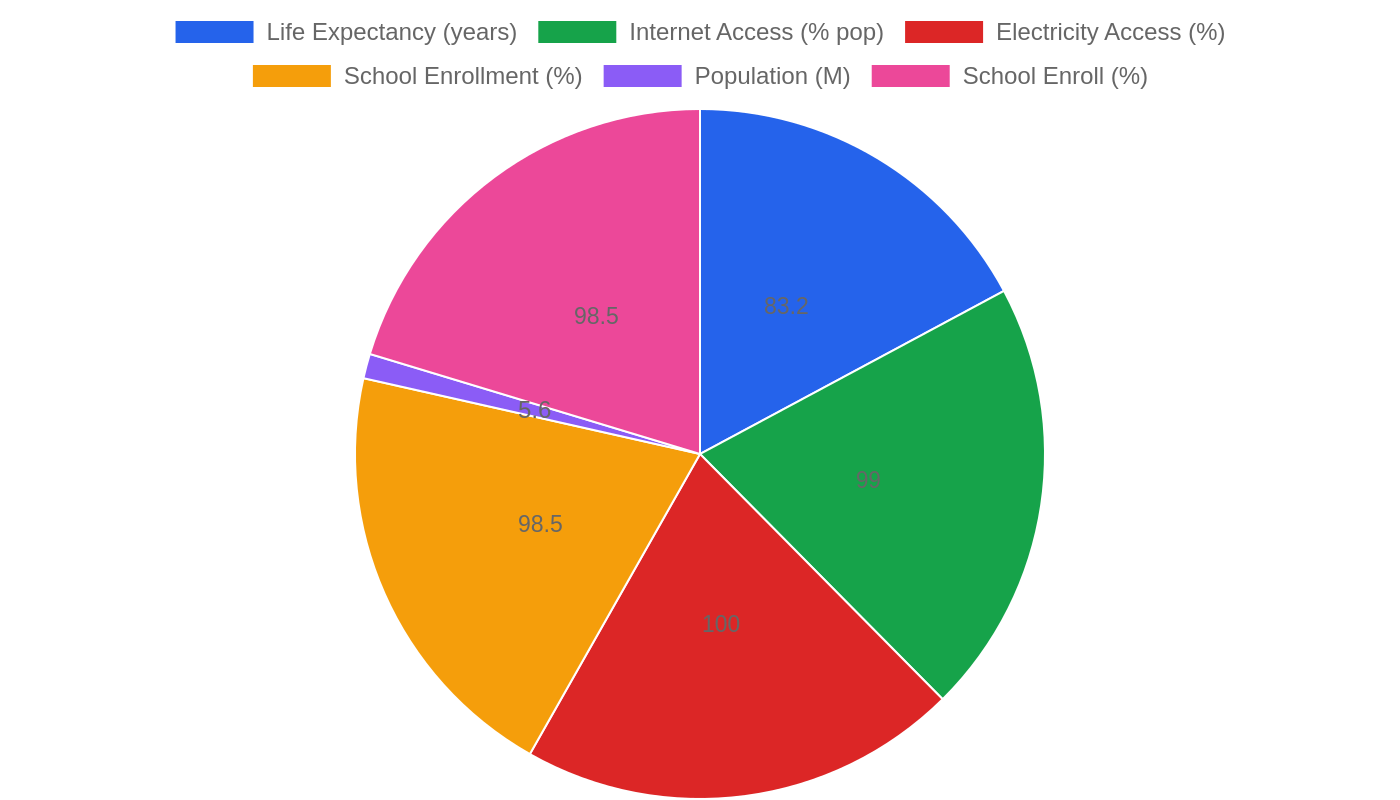
– Norway’s economy is growing modestly at 1.09% in 2025, according to the World Bank, reflecting a mature, high-income economy that has moved beyond the breakneck expansion of its oil-fuelled decades.
– Unemployment stands at a remarkably low 4.6%, a figure that most developed nations would envy, underscoring the resilience of Norway’s labour market even as global headwinds persist.
– The country continues to be ranked the world’s most democratic nation by the Democracy Index, a title it has held since 2010, according to International IDEA’s Global State of Democracy Indices.
– Norway’s industrial base is dominated by oil and gas giants like Aker Solutions, but consumer goods and industrials firms such as Cermaq and Bama Gruppen reveal a diversified economic backbone that extends far beyond hydrocarbons.
– With a population of just over 5.6 million, Norway remains a small, open economy where policy stability and institutional trust form the bedrock of its economic resilience.
The Slow Burn — Why 1% Growth Tells a Bigger Story
When the World Bank reports that Norway’s GDP grew by just 1.09% in 2025, the number might seem underwhelming to those accustomed to emerging-market fireworks. But in the context of a mature, post-industrial Nordic economy, this figure tells a story of steady-state stability rather than stagnation. Norway has long passed the point where double-digit growth is possible or even desirable.
The country’s economy is built on a foundation of vast sovereign wealth — the Government Pension Fund Global, fed by oil revenues — and a labour market that operates with remarkable efficiency. Unemployment at 4.6%, as recorded by the World Bank, is effectively full employment in structural terms. It suggests that nearly every Norwegian who wants a job can find one, even as the economy expands at a temperate pace.
The absence of inflation data in the World Bank’s figures is notable, but the low unemployment rate implies that wage pressures are being managed without triggering runaway price increases. Norway’s central bank, Norges Bank, has historically been aggressive in using interest rates to cool overheating, and the current equilibrium between growth and employment suggests that policy is working as intended.
The country’s GDP per capita, while not provided in this dataset, is among the highest in the world by any measure — a testament to the value generated by its oil, gas, seafood, and maritime industries. What the 1.09% figure really signals is a nation that has mastered the art of managing prosperity without the boom-and-bust cycles that plague resource-rich peers. It is not a story of dynamism; it is a story of stewardship.
The Price of Paradise — Housing and Daily Life in a High-Cost Economy
Norway’s cost of living is legendary, and for good reason. While specific data on housing prices and rental costs are not included in this dataset, any observer of the Norwegian economy knows that Oslo consistently ranks among the most expensive cities in Europe for property. The dynamic is straightforward: high incomes, limited housing supply in urban centres, and a cultural preference for homeownership create a market where prices are stretched.
Renting is common among younger Norwegians, but the path to ownership is long and requires significant capital. The government has attempted to ease the burden through state-backed mortgage schemes and subsidies for first-time buyers, but demand continues to outstrip supply, particularly in the capital and in Bergen.
Daily expenses — groceries, transport, utilities — are also elevated by international standards. A simple meal out or a coffee in Oslo can cost double what it would in Berlin or Madrid. Yet Norwegians accept this as the price of a system that delivers universal healthcare, free higher education, and a robust social safety net. The trade-off is clear: you pay more for everyday life, but you pay far less for life’s catastrophic risks.
For expatriates and investors considering a move, the cost of living is a serious consideration, but it is offset by wages that are among the highest in the world. The real challenge is not affording Norway — it is getting into the housing market in the first place.
Fjords, Fish, and Finance — Where Norway’s Money Really Comes From
The list of Norway’s top companies provided in this dataset reads like a map of the country’s economic geography. Aker Solutions sits in the oil and gas sector, a reminder that hydrocarbons still underpin much of the nation’s wealth, even as the world transitions toward renewable energy. But look closer, and the diversification becomes apparent.
Cermaq is a global player in aquaculture — salmon farming, specifically — which has become one of Norway’s most valuable export industries after oil and gas. Bama Gruppen is a fresh produce distributor, connecting Norwegian agriculture to supermarkets across the country. AF Group and Bergen Engines represent the industrials sector, building everything from roads to maritime engines.
What is striking is the absence of a dominant tech sector. Norway has not produced a Spotify or a Klarna; its economy remains rooted in tangible assets — oil, fish, metal, machinery. This is not a weakness. These industries provide stable, well-paying jobs and are less susceptible to the valuation bubbles that plague tech markets. The business climate in Norway is characterised by high taxes but also high transparency, low corruption, and a legal system that protects contracts and property rights.
For investors, the message is clear: Norway offers safety and predictability, not explosive returns. The companies listed here are not disruptors; they are stewards of long-term value, and that suits the Norwegian temperament perfectly.
Democracy, Safety, and the Quiet Life
According to International IDEA’s Global State of Democracy Indices, Norway performs in the high range on all democratic measures, with particular strengths in elected government and gender equality. Since 2010, the Democracy Index has classified Norway as the world’s most democratic country. This is not a trivial accolade. It means that political risk in Norway is virtually non-existent. Elections are free and fair, institutions are trusted, and the rule of law is absolute.
For a business or an individual considering a long-term commitment to the country, this stability is worth more than any tax incentive.
Crime and safety indices are not provided in this dataset, but Norway’s reputation as one of the safest countries on earth is well established. Violent crime is rare, and even petty theft is less common than in most European capitals. The quality of life extends beyond safety: Norway consistently ranks near the top of the World Happiness Report, driven by social trust, work-life balance, and access to nature.
The political landscape is dominated by a broad consensus around the welfare state; debates tend to be about how to manage the oil fund, not whether the system should exist. For those seeking a society where the state functions efficiently and life is predictable, Norway is as close to a guarantee as exists in the modern world.
The Green Shift and the Sovereign Wealth Question
What is happening in Norway right now is a quiet but profound economic transformation. The country is grappling with the question of how to transition away from oil and gas without destroying the wealth that has funded its welfare state. The Government Pension Fund Global, worth well over a trillion dollars, is increasingly being directed toward renewable energy infrastructure and sustainable investments.
But the domestic economy still relies heavily on petroleum extraction, and there is fierce political debate about whether to open new drilling areas in the Arctic.
At the same time, Norway’s aquaculture industry is expanding rapidly, with new technologies for offshore fish farming that could double production capacity. The industrials sector is pivoting toward green shipping and hydrogen production. These shifts are not happening overnight, but they are happening with the characteristic Norwegian approach: methodically, with broad political consensus, and with the sovereign wealth fund acting as a buffer against disruption.
For the global investor, Norway represents a bet on managed decline of hydrocarbons and the rise of a new, sustainable industrial model. It is not a speculative play — it is a long-term hold.
The Bottom Line
Norway is not a country for those seeking rapid growth or high-risk, high-reward investments. It is a country for those who value stability, transparency, and a quality of life that money alone cannot buy. The 1.09% GDP growth figure tells you everything you need to know: this is an economy that has already arrived. It is not climbing; it is maintaining altitude.
Investors, expatriates, and policymakers looking for a model of how to manage resource wealth, maintain social cohesion, and plan for a post-carbon future should watch Norway closely — because it is doing what few other nations have managed: proving that prosperity and stability can coexist indefinitely.
Sources & Methodology
This article is authored by Economic Pulse Net for informational and research purposes. Economic Pulse Net sources its data from multilateral institutions, national statistics bureaus, and proprietary databases. All data is believed to be current as of the date of publication.
Published: July 30, 2026 | Category: Research — Norway
Use these signals in your own platform
Economic Pulse publishes its live signal feed through a documented, read-only API. Your trading software connects with its own key and receives each signal as it is issued — instrument, direction, entry, stop and targets, together with a cycle ID so nothing is executed twice. The feed is independent of this website and cannot change it.
Signals are informational only and are not financial advice.