Economic Pulse Net | Sources: World Bank World Development Indicators, Government Sources | 2026
Key Takeaways
* Robust Economic Stability: Norway maintains a high GDP per capita (PPP) of over $104,000 and a GNI per capita near $97,310, reflecting one of the world’s wealthiest populations despite modest overall growth.
Democratic Gold Standard: Consistently ranked as the world’s most democratic country since 2010, Norway leads globally in elected government integrity and gender equality.
Industrial Diversification: Major corporate players like Aker ASA and Aker Solutions anchor key sectors including oil & gas, industrials, and consumer goods, signaling a resilient business environment.
Moderate Inflationary Pressure: With CPI inflation at approximately 3.04%, the economy faces typical post-pandemic price adjustments while maintaining low unemployment at 4.637%.
The Engine of a Wealthy Nation
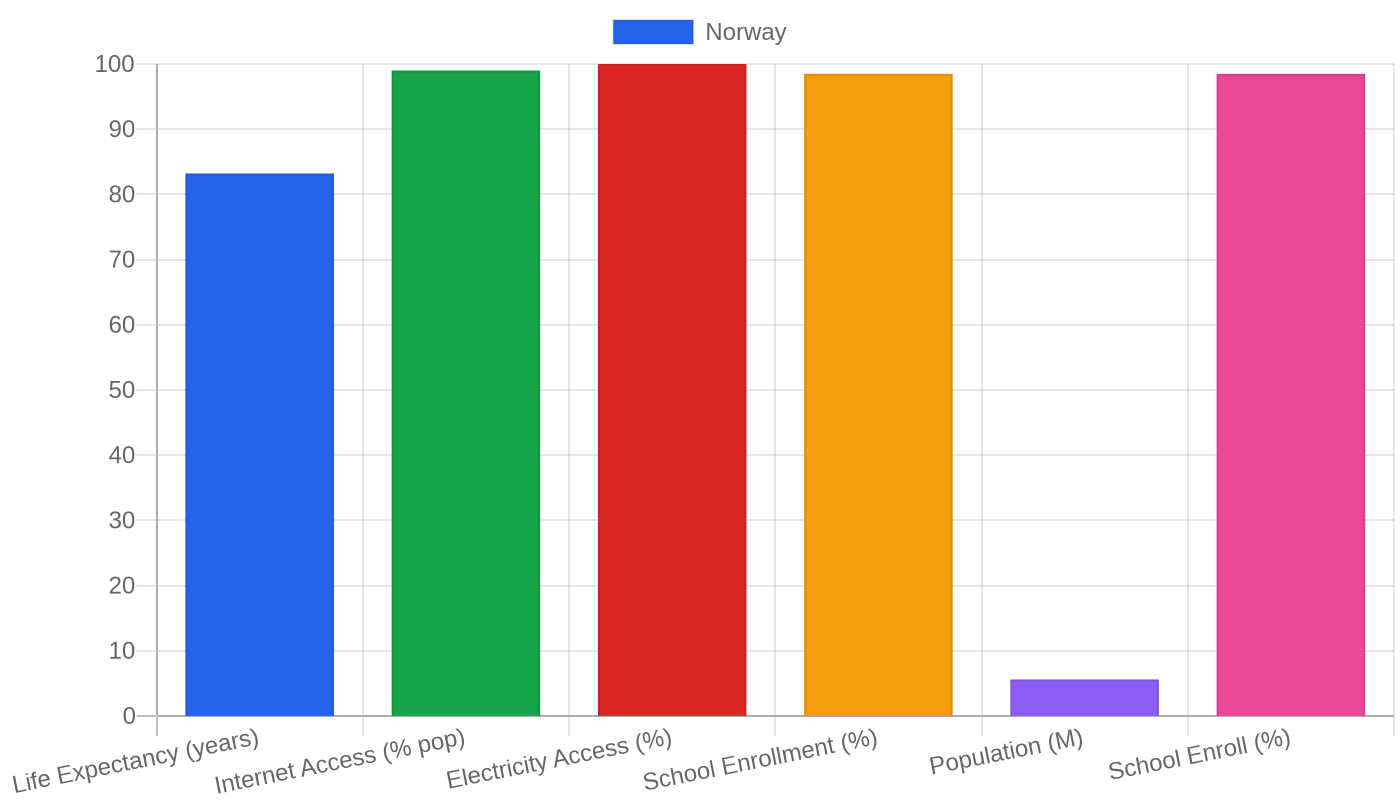
Norway’s economic landscape in 2025 is defined by a paradox of steady accumulation and cautious expansion. According to World Bank data, the nation’s Gross Domestic Product stands at roughly $530.7 billion USD, driven by a population of just over 5.6 million people. This demographic scale allows for an exceptionally high GDP per capita under Purchasing Power Parity (PPP), reaching $104,043.67, which underscores the immense individual wealth generated within the country.
However, the broader macroeconomic engine is running at a measured pace, with GDP growth recorded at 1.085% for 2025. This modest expansion suggests that while the economy is not contracting, it is prioritizing stability over rapid acceleration. Furthermore, the Consumer Price Index (CPI) has settled at 3.039%, indicating that inflationary pressures have normalized but remain present enough to influence consumer behavior.
Labor markets continue to be a strength, with unemployment holding steady at 4.637%, ensuring that the workforce remains largely engaged and productive. These figures collectively paint a picture of a mature, high-income economy that values sustainable growth over volatile spikes.
The Price of Nordic Living
While specific cost-of-living metrics are not explicitly detailed in the provided datasets, the underlying income figures provide a clear window into the Norwegian standard of living. With a GNI per capita of $97,310, residents possess significant purchasing power relative to global averages. This high income level typically correlates with elevated costs for housing, services, and daily essentials, creating a unique economic ecosystem where high wages offset high expenses.
For expatriates and investors, understanding this dynamic is crucial; the affordability index here is less about cheap goods and more about equitable access to high-quality services. The absence of extreme poverty or severe inflation volatility means that daily expenses, while likely higher than regional neighbors, are predictable and manageable for the average citizen.
Consequently, the cost of living serves as a filter that reinforces social equity, ensuring that even with high prices, the net disposable income for the majority remains robust.
Corporate Giants and Industrial Resilience
The business climate in Norway is anchored by a diverse array of top-tier companies that drive both domestic employment and international trade. Leading the pack is Aker ASA, a conglomerate that exemplifies the nation’s industrial breadth, alongside specialized entities like Aker BioMarine and Aker Floating Production. In the energy sector, Aker Solutions remains a critical player, leveraging Norway’s historical strengths in oil & gas while adapting to modern demands.
The industrials sector is further bolstered by firms such as AF Group, Bergen Engines, and Bertel O. Steen, which contribute to infrastructure and manufacturing capabilities. Meanwhile, the consumer goods market features notable brands like Bonheur, Bama Gruppen, and Arthur Soltvedt Møbelfabrikk, indicating a healthy domestic retail environment. This concentration of major corporations across multiple sectors suggests a resilient business ecosystem that is not overly reliant on a single industry.
Investors looking at Norway should note that these companies represent stable, established entities with deep roots in the local economy, providing a solid foundation for long-term commercial partnerships.
Safety, Politics, and Social Trust
Norway’s political landscape offers a compelling case study in democratic governance and social cohesion. According to International IDEA’s Global State of Democracy (GSoD) Indices and Democracy Tracker, the country performs in the high range on overall democratic measures, particularly excelling in elected government representation and gender equality.
Since 2010, Norway has been consistently classified as the world’s most democratic country by the Democracy Index, a testament to its institutional strength and rule of law. While specific crime and safety indices are listed as N/A in the current data, the strong emphasis on justice and democratic integrity implies a society with high levels of public trust and low social friction.
The combination of a developed state of justice and high democratic scores creates an environment where citizens feel secure and represented. This political stability is a non-negotiable asset for foreign investment and tourism, as it minimizes regulatory risk and ensures consistent policy implementation. Ultimately, the quality of life in Norway is deeply intertwined with its political success, offering a model of governance that prioritizes inclusivity and transparency.
Current Affairs and Policy Focus
In 2025, Norway’s economic narrative is centered on maintaining equilibrium amidst global uncertainties. The recent GDP growth figure of 1.085% indicates that policymakers are successfully navigating external shocks without resorting to aggressive stimulus measures. Simultaneously, the CPI reading of 3.039% shows that monetary authorities are keeping inflation in check, preventing it from eroding the high purchasing power enjoyed by citizens.
The labor market’s resilience, with unemployment at 4.637%, reflects effective job creation strategies aligned with the needs of key industries like oil & gas and industrials. As major corporations such as Aker ASA and Aker Solutions continue to innovate, they are likely driving technological advancements that will shape future economic policies.
The government’s focus on democratic integrity and gender equality, as highlighted by recent democracy indices, also influences social policies that support workforce participation. These concurrent trends suggest a country that is actively managing its resources and institutions to sustain its high standard of living in a changing global order.
The Bottom Line
Norway presents a compelling case for stakeholders seeking stability rather than high-risk, high-reward opportunities. Its combination of exceptional wealth indicators, democratic leadership, and diversified corporate base makes it a safe harbor for long-term investment. For businesses, the presence of strong industrial and consumer giants offers reliable partnership potential. For individuals, the high GNI and low unemployment promise a high quality of life supported by robust social structures.
Norway is not a country for speculative gains, but rather for those who value enduring prosperity and institutional reliability.
Sources & Methodology
This article is authored by Economic Pulse Net for informational and research purposes. Economic Pulse Net sources its data from multilateral institutions, national statistics bureaus, and proprietary databases. All data is believed to be current as of the date of publication.
Published: October 27, 2026 | Category: Research — Norway
Use these signals in your own platform
Economic Pulse publishes its live signal feed through a documented, read-only API. Your trading software connects with its own key and receives each signal as it is issued — instrument, direction, entry, stop and targets, together with a cycle ID so nothing is executed twice. The feed is independent of this website and cannot change it.
Signals are informational only and are not financial advice.