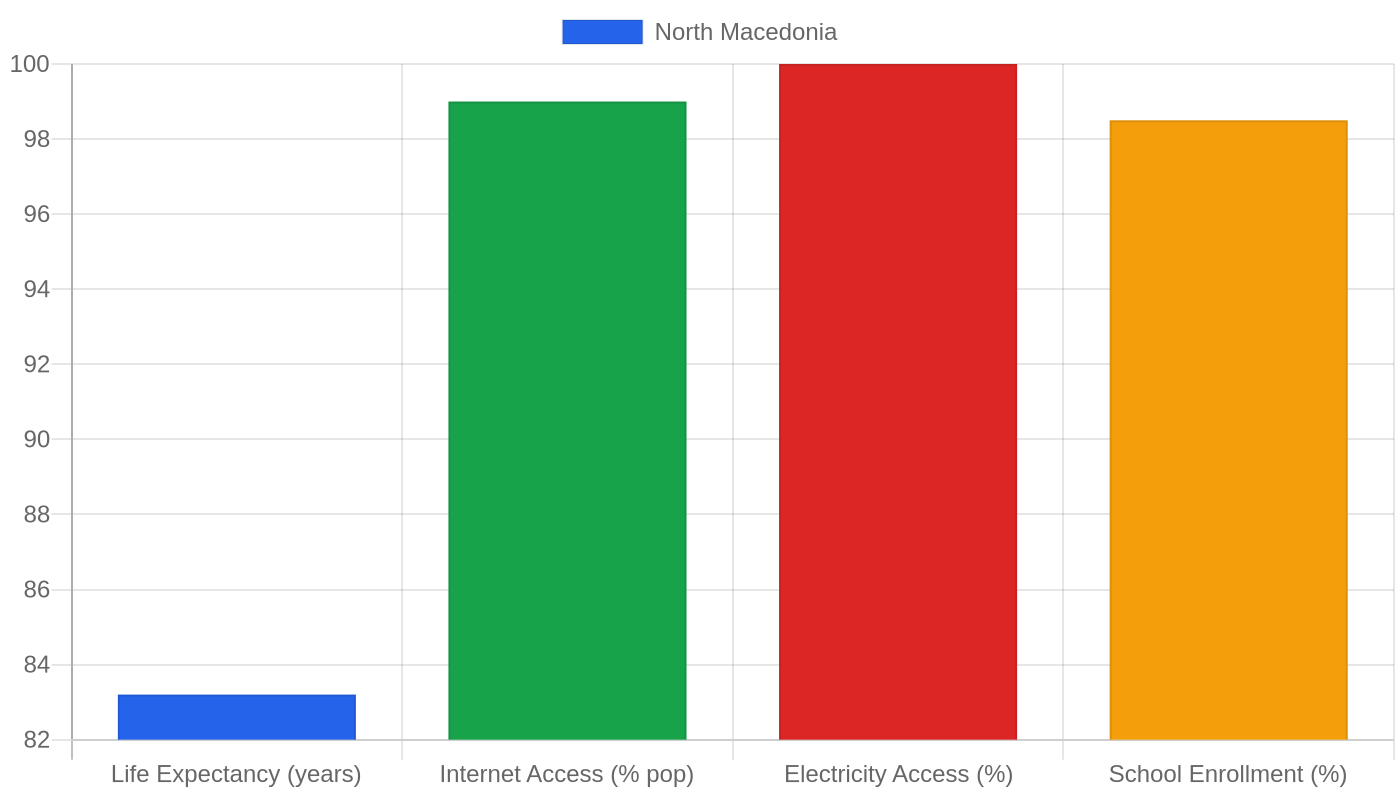
Economic Pulse Net | Sources: World Bank World Development Indicators, Government Sources | 2026
Key Takeaways
* Political Structure: Power is centralized in the Prime Minister and a coalition government within the unicameral Sobranie, while the President holds a largely ceremonial role.
Corporate Landscape: The economy is anchored by key players in utilities, finance, and basic materials, including Aktiva, Alkaloid, and EVN AD Skopje.
Data Transparency: Specific macroeconomic indicators such as GDP growth, inflation rates, and unemployment figures are currently listed as unavailable in the latest World Bank datasets.
Business Environment: Major domestic and international firms like Lukoil Macedonia and Komercijalna banka Skopje drive significant activity in energy and financial services.
Safety Profile: Current crime and safety indices for the region remain unreported, leaving a gap in quantifiable security metrics for investors and expatriates.
Economic Foundations and Industrial Pillars
North Macedonia’s economic narrative is defined not by volatile fluctuations, but by its structural composition and industrial base. While specific metrics for GDP growth, inflation, and unemployment are currently marked as N/A in the latest World Bank data, the underlying architecture of the economy remains clear through its primary industries and corporate leaders.
The presence of major entities like Aktiva in basic materials and FAS Sanos in industrials suggests a robust foundation in manufacturing and resource processing, sectors that typically provide steady employment and export revenue. Meanwhile, the dominance of utilities companies such as ESM and EVN AD Skopje indicates a critical focus on infrastructure stability, which is essential for attracting foreign direct investment.
In the healthcare sector, Alkaloid stands out as a significant player, highlighting the country’s capacity for specialized production beyond traditional commodities. Financial institutions like Alpha Bank and Komercijalna banka Skopje play a pivotal role in facilitating credit flow and supporting business expansion, ensuring that liquidity remains available for both local enterprises and international partners.
Although precise percentage changes in economic output are absent from current reports, the diversity of these top companies—from oil and gas with Lukoil Macedonia to construction via Eurovia DOOEL—points to a multifaceted economy capable of weathering sector-specific shocks. This industrial breadth provides a buffer against external volatility, even if aggregate national statistics are yet to be fully quantified in recent releases.
Cost of Living and Housing Dynamics
For residents and expatriates alike, understanding the cost of living in North Macedonia requires looking at the availability of consumer services and retail structures rather than just abstract price indices. With DON Market operating as a key player in consumer services, the daily expenses for groceries and household goods are likely shaped by competitive retail environments that serve the local population efficiently.
However, without specific CPI (Consumer Price Index) data or detailed housing cost breakdowns, it is difficult to make precise comparisons regarding rent versus buy ratios or overall affordability relative to regional averages. The absence of explicit cost-of-living metrics means that potential movers must rely on anecdotal evidence or localized market surveys rather than broad statistical benchmarks.
Nevertheless, the presence of established utility providers ensures that basic service costs are regulated, providing a degree of predictability in monthly overheads despite the lack of comprehensive inflation data. Investors and individuals should note that while general price trends are obscured by missing data points, the operational stability of major retailers and service providers offers a glimpse into the everyday economic rhythm of the nation.
Investment and Business Climate
The business environment in North Macedonia is characterized by the strength of its incumbent corporations and the strategic importance of its key sectors. Companies like Aktiva and Lukoil Macedonia underscore the significance of natural resources and energy, sectors that often attract long-term capital due to their tangible assets and consistent demand.
The financial sector, represented by Alpha Bank and Komercijalna banka Skopje, appears mature and integrated, suggesting that banking services are accessible and competitive for businesses seeking financing or transactional support. For those interested in infrastructure and real estate, Eurovia DOOEL’s involvement in construction highlights ongoing development projects that may offer opportunities for supply chain partnerships.
Additionally, the health care giant Alkaloid demonstrates the country’s ability to compete in specialized pharmaceutical markets, offering a niche avenue for biotech and medical-related investments. The industrial landscape, bolstered by FAS Sanos, further indicates a commitment to maintaining productive capacity in manufacturing. These established players form the backbone of the commercial ecosystem, creating a network of reliable partners for new entrants looking to establish a foothold in the Balkan region.
Safety, Politics, and Quality of Life
Navigating the political and social fabric of North Macedonia reveals a system where executive power is clearly delineated from ceremonial duties. The country operates as a parliamentary democracy, with the real political weight resting in the hands of the Prime Minister and a coalition government formed within the unicameral legislature, known as the Sobranie. This assembly, comprising 120 seats elected every four years, serves as the primary engine for legislative action and policy direction.
In contrast, the President’s role is predominantly symbolic, acting as the commander-in-chief of the armed forces but lacking the day-to-day executive authority found in presidential systems. An independent judicial branch, complete with a constitutional court, provides a check on governmental power, ensuring that legal disputes are resolved according to established constitutional frameworks.
Regarding personal security, current crime and safety indices are listed as N/A, meaning that quantitative assessments of public safety are not currently available for review. This data gap necessitates a reliance on qualitative reports and local insights when evaluating quality of life and security concerns for residents and visitors.
What’s Happening Now: Political Realignment and Institutional Focus
The current political atmosphere in North Macedonia is dominated by the dynamics of coalition governance and legislative activity within the Sobranie. With the Prime Minister holding substantial executive power, recent policy shifts and governmental priorities are likely driven by the negotiations and agreements among the coalition parties. The stability of this arrangement depends heavily on the cohesion of the 120-seat assembly, where every vote carries significant weight in shaping national direction.
While specific economic reforms or inflation trends are obscured by missing data, the institutional framework remains active, with the independent judiciary continuing to uphold constitutional standards. The ceremonial nature of the presidency ensures that political controversy is largely contained within the legislative and executive branches, providing a stable backdrop for administrative functions.
Observers should watch for developments in the coalition’s internal dynamics, as these will directly influence the pace of legislative reforms and regulatory changes. The focus remains on maintaining democratic continuity and effective governance amidst the complexities of modern statecraft.
The Bottom Line
North Macedonia presents a case study in structural resilience, where the absence of certain high-frequency economic data does not obscure the clarity of its industrial and political foundations. Investors and analysts should focus on the strength of its core corporations in utilities, finance, and materials, as these entities define the practical reality of the market. The political system offers a predictable, albeit complex, landscape centered on parliamentary coalitions and executive leadership.
For those willing to look past the statistical gaps, the country offers a stable entry point into the Balkan region, grounded in tangible industry and established governance.
Sources & Methodology
This article is authored by Economic Pulse Net for informational and research purposes. Economic Pulse Net sources its data from multilateral institutions, national statistics bureaus, and proprietary databases. All data is believed to be current as of the date of publication.
Published: October 13, 2026 | Category: Research — North Macedonia
Use these signals in your own platform
Economic Pulse publishes its live signal feed through a documented, read-only API. Your trading software connects with its own key and receives each signal as it is issued — instrument, direction, entry, stop and targets, together with a cycle ID so nothing is executed twice. The feed is independent of this website and cannot change it.
Signals are informational only and are not financial advice.