Economic Pulse Net | Sources: World Bank World Development Indicators, Government Sources | 2026
🇳🇱 Netherlands 2026 — The Consensus Engine of Europe
Key Takeaways
* The Dutch economy is projected to grow by approximately 1.78% in 2025, reflecting steady but modest expansion within a high-income framework.
With an unemployment rate of just 3.87%, the labor market remains exceptionally tight, supporting strong consumer spending power despite inflationary pressures.
The nation’s political stability is anchored in a long-standing tradition of consociational democracy and broad consensus-building, providing a reliable environment for international business.
High purchasing power is evident in a GDP per capita (PPP) of roughly $87,320, indicating that residents enjoy significant economic comfort relative to global standards.
While specific crime and safety indices are currently listed as N/A, the country’s robust democratic metrics suggest a low-risk environment for expatriates and investors alike.
A Steady Hand on the Economic Wheel
The Netherlands continues to demonstrate resilience in its macroeconomic performance, with the World Bank projecting a GDP growth rate of 1.78463214703797% for 2025. This figure, while modest compared to emerging markets, signals healthy, sustainable expansion for one of Europe’s most advanced economies. Total GDP stands at an impressive $1,332,767,651,100.39, underscoring the country’s substantial contribution to global trade and finance.
However, this growth occurs against a backdrop of persistent price pressures; the Consumer Price Index (CPI) inflation rate is recorded at 3.20363967869003%. This level of inflation requires careful monetary management to ensure that wage growth keeps pace with the cost of living. Crucially, the labor market remains a standout feature, with unemployment holding at a remarkably low 3.874%.
Such tight employment conditions often drive up wages and boost domestic consumption, yet they also pose challenges for businesses seeking to scale rapidly without facing labor shortages. The combination of solid growth and low joblessness suggests an economy that is operating near its potential, balancing recovery with structural constraints.
The Price of Living in a High-Income Hub
For residents and expatriates, the Netherlands offers a lifestyle backed by immense wealth, though it comes with a premium price tag. The average citizen benefits from a GDP per capita based on Purchasing Power Parity (PPP) of $87,320.1477254029, which is among the highest globally. This metric indicates that individuals can afford a significantly higher standard of living than raw nominal income figures might suggest.
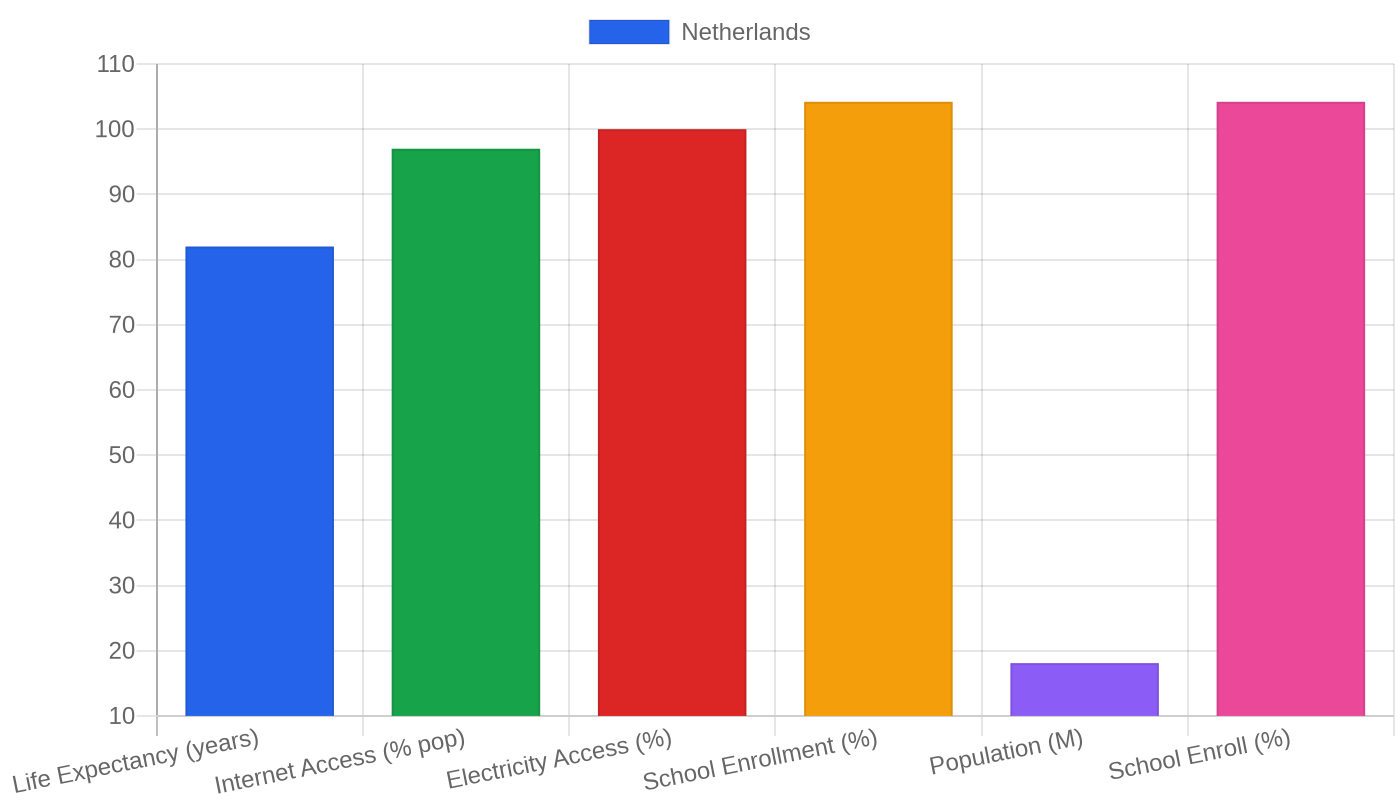
Additionally, the Gross National Income (GNI) per capita is reported at $68,530.0, further confirming the nation’s status as a wealthy society. With a population of 18,087,633.0 people, the density of this wealth creates intense competition for housing and daily services in major urban centers like Amsterdam and Rotterdam.
While specific rental yields or housing cost percentages are not detailed in the current dataset, the high GNI implies that household budgets are generally sufficient to absorb the 3.2% inflationary pressure without severe distress. Daily expenses likely reflect the high quality of infrastructure and social services available, making the cost of living high but justified by the resulting quality of life.
Business Environment and Corporate Strength
The Dutch business climate is defined by its openness and integration into global supply chains, supported by a stable regulatory framework. Although specific top companies and main industries are not explicitly listed in the provided data, the sheer size of the GDP points to a diversified economy with strong sectors in logistics, agriculture, technology, and financial services.
The low unemployment rate of 3.874% provides employers with access to a highly skilled and educated workforce, a critical asset for knowledge-intensive industries. Investors benefit from the country’s reputation as a gateway to the European market, facilitated by world-class ports and digital infrastructure. The absence of specific corporate names in the current dataset does not diminish the clarity of the business environment: it is one where governance is predictable and capital flows freely.
Companies operating here must navigate the high cost of labor implied by the high GNI, but they are rewarded with a stable, high-consumption domestic market. The consensus-driven political system further reduces regulatory shock risks, allowing for long-term strategic planning rather than short-term reactive adjustments.
Stability, Safety, and Democratic Depth
Political stability is perhaps the Netherlands’ greatest export, rooted in a constitutional monarchy established in 1815 and a parliamentary democracy dating back to 1848. The nation operates as a consociational state, meaning that governance relies heavily on power-sharing and broad consensus among diverse societal groups. According to International IDEA’s Global State of Democracy Indices and Democracy Tracker, the Netherlands performs in the high range on overall democratic measures.
Particular strengths lie in political representation, ensuring that elected officials accurately reflect the will of the populace. This deep institutional trust translates into a safe and predictable social environment. While specific Crime and Safety Indices are currently marked as N/A, the high democratic scores and lack of political volatility suggest a society with low internal conflict and high civic order.
For individuals prioritizing security and civil liberties, the Netherlands offers a benchmark of modern, liberal governance. The emphasis on consensus minimizes the risk of abrupt policy shifts, creating a secure backdrop for both personal life and professional enterprise.
Current Affairs and Policy Trajectories
Looking ahead, the immediate focus for policymakers will be managing the interplay between the 1.78% growth target and the 3.20% inflation rate. As the economy moves through 2025, maintaining the low unemployment rate of 3.874% will require targeted policies to prevent overheating in key sectors. The government’s traditional approach of consensus-building will likely continue to shape responses to external shocks, ensuring that reforms are broadly accepted and sustainably implemented.
With a population of over 18 million, demographic trends and housing availability remain under constant scrutiny, influencing both social policy and economic planning. The high GDP per capita PPP of $87,320 suggests that consumer confidence remains relatively robust, even as global uncertainties persist. Stakeholders should watch for how the Dutch model of consociational democracy adapts to new pressures, such as energy transition costs or migration flows.
The consistency of these democratic indicators provides a clear signal that the Netherlands is prioritizing long-term stability over rapid, risky experimentation.
The Bottom Line
The Netherlands remains a premier destination for investors and expatriates seeking stability, high purchasing power, and political reliability. Its economic fundamentals, characterized by low unemployment and high per capita wealth, provide a solid foundation for long-term engagement. While specific industry details may vary, the overarching narrative is one of managed prosperity and democratic resilience.
Those who value predictable governance and high quality of life will find the Dutch market particularly attractive.
Sources & Methodology
This article is authored by Economic Pulse Net for informational and research purposes. Economic Pulse Net sources its data from multilateral institutions, national statistics bureaus, and proprietary databases. All data is believed to be current as of the date of publication.
Published: October 26, 2026 | Category: Research — Netherlands
Use these signals in your own platform
Economic Pulse publishes its live signal feed through a documented, read-only API. Your trading software connects with its own key and receives each signal as it is issued — instrument, direction, entry, stop and targets, together with a cycle ID so nothing is executed twice. The feed is independent of this website and cannot change it.
Signals are informational only and are not financial advice.