Economic Pulse Net | Sources: World Bank World Development Indicators, Government Sources | 2026
Key Takeaways
– Monaco operates under a constitutional monarchy established in 1911, with the Sovereign Prince serving as head of state — a political structure that has provided remarkable continuity for over a century.
– The principality’s executive branch is led by a Minister of State who heads the Council of Government, with a notable 2002 constitutional amendment allowing Monégasque citizens to hold this top position for the first time.
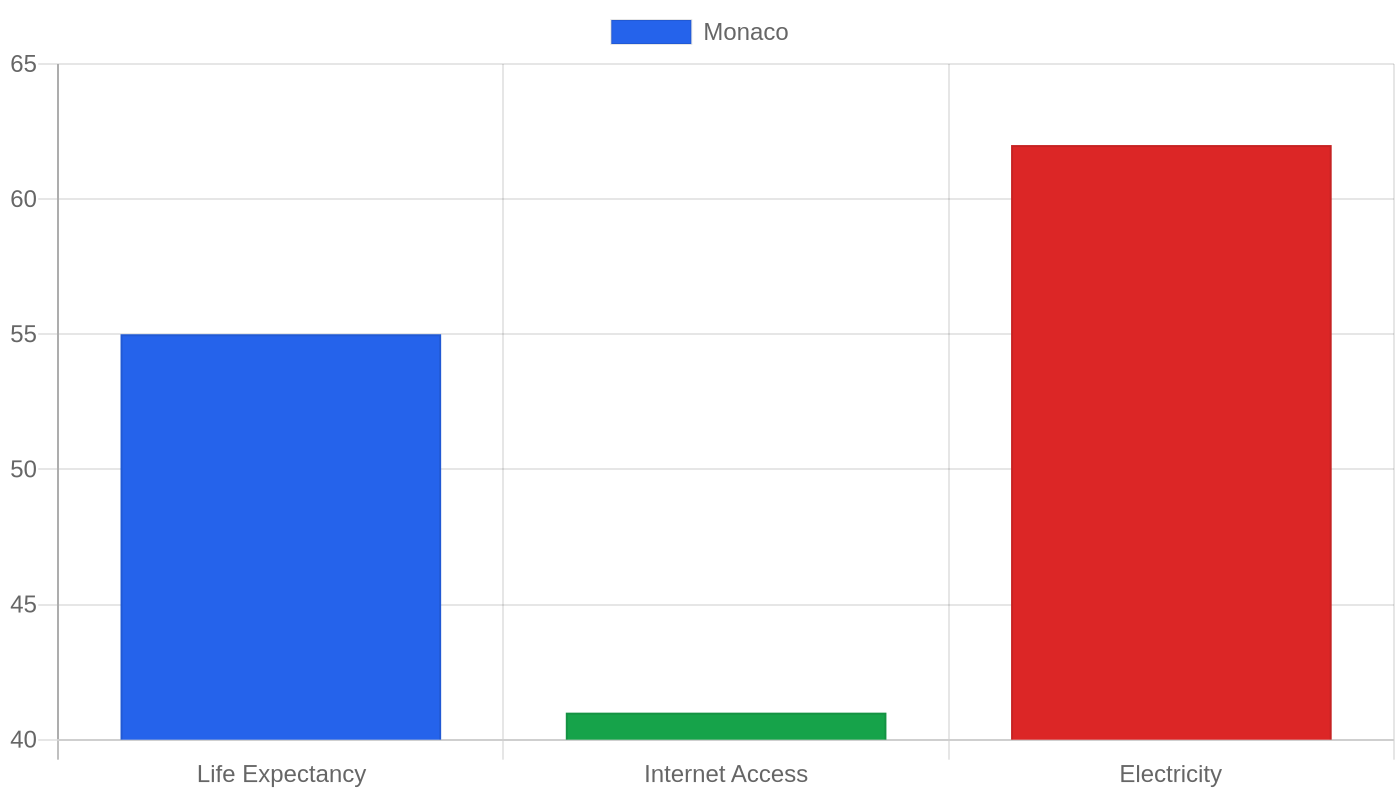
– Despite its global reputation as a financial hub and luxury destination, comprehensive economic data from the World Bank remains limited, reflecting the unique challenges of tracking economic performance in a city-state.
– Monaco’s political stability under its princely system stands in contrast to the economic volatility seen across many European neighbors, making it a distinctive case study in governance and prosperity.
– The principality’s evolution from a French-dominated administration to a more independent governance model signals a gradual shift in its political identity.
The Economic Engine of a Microstate
When economists look at Monaco, they encounter a paradox: a country that generates extraordinary wealth while publishing remarkably little conventional economic data. The World Bank’s latest figures show GDP growth, inflation, unemployment, and GDP per capita all listed as unavailable — a statistical silence that speaks volumes about how this principality operates differently from its neighbors.
For a nation of roughly 39,000 residents packed into less than two square kilometers, traditional economic metrics often fail to capture the full picture of prosperity that defines daily life here.
What we do know is that Monaco has built its economy on a foundation of financial services, real estate, and tourism, with the famous Monte Carlo Casino and the annual Formula One Grand Prix serving as global brand ambassadors. The absence of World Bank data on key indicators suggests that the principality’s statistical apparatus prioritizes different measures of success than conventional national accounting.
Unlike larger economies where manufacturing and agriculture drive GDP, Monaco’s wealth flows through banking, insurance, and the management of private fortunes — sectors that generate substantial value while remaining difficult to quantify through standard economic surveys.
The principality’s economic model has proven remarkably resilient over decades, weathering global financial crises and European recessions with apparent ease. This stability stems from a deliberate strategy of attracting high-net-worth individuals and businesses through favorable tax policies and a sophisticated financial infrastructure.
While we cannot point to specific growth figures, the sustained demand for Monaco’s limited real estate and the continued presence of major financial institutions suggest an economy operating at full capacity, constrained only by the physical limits of its geography.
The Price of Paradise — Housing and Daily Life
Monaco consistently ranks among the most expensive places on Earth, though precise cost-of-living data remains elusive in the World Bank statistics. The principality’s housing market operates under extreme supply constraints, with virtually no available land for new development and existing properties commanding astronomical prices.
Buying versus renting in Monaco presents a stark choice: purchase prices for even modest apartments run into the millions of euros, while rental rates for prime properties can exceed what most Europeans earn in a year.
The daily cost of living in Monaco reflects its positioning as a luxury destination. Groceries, dining, and entertainment prices typically run 30-50 percent higher than in neighboring French cities like Nice, though the absence of personal income tax offsets some of these costs for residents.
The principality’s proximity to the French Riviera means many workers commute from cheaper municipalities across the border, creating a unique economic ecosystem where Monaco’s wealth generates housing demand that spills over into surrounding French towns.
Business Climate and Investment Opportunities
Monaco’s business environment operates within a framework that prioritizes stability and discretion, attracting financial institutions and holding companies from across Europe and beyond. The principality hosts a concentration of private banks, asset managers, and family offices that manage wealth for clients worldwide, with the financial sector serving as the cornerstone of the local economy.
While the World Bank data does not list specific major companies headquartered here, the financial district’s skyline and the presence of luxury retail brands along the famous Carré d’Or indicate a thriving commercial sector.
The investment climate benefits from Monaco’s political continuity and its reputation as a safe haven for capital. The principality has worked to diversify beyond pure financial services, developing a growing technology sector and attracting digital startups through modern infrastructure and a favorable regulatory environment.
For international investors, Monaco offers something increasingly rare in Europe: a jurisdiction where wealth is respected, bureaucracy is manageable, and the rule of law has remained consistent for generations.
Stability, Security, and the Monégasque Way of Life
Crime and safety indices for Monaco are not available in the current data, but the principality’s reputation for security is well-established, supported by an extensive police presence and sophisticated surveillance systems that monitor the territory around the clock. The political landscape, defined by the constitutional monarchy established in 1911, provides a continuity that many democracies cannot match.
The Sovereign Prince retains significant constitutional powers, while the Minister of State and the Council of Government handle day-to-day administration.
The 2002 constitutional amendment represents a significant evolution in Monaco’s governance, allowing Monégasque citizens to serve as Minister of State rather than requiring a French appointee. This change reflects a gradual assertion of national identity while maintaining the close relationship with France that remains essential to Monaco’s security and economic arrangements.
For residents, the combination of political stability, low crime, and a Mediterranean climate creates a quality of life that justifies the extraordinary costs of living here.
Current Affairs — A Principality in Transition
Monaco today finds itself navigating the tensions between its traditional identity as a tax haven and the European Union’s push for greater financial transparency. The principality has responded to international pressure by signing information-sharing agreements and demonstrating compliance with global standards, though it continues to maintain its distinctive tax advantages.
The post-pandemic period has seen a renewed influx of wealthy individuals seeking Monaco’s combination of security, favorable taxation, and Mediterranean lifestyle, driving demand for real estate and financial services to new heights.
The principality is also investing in its future beyond finance, with significant developments in technology infrastructure and sustainable urban planning. Monaco’s ambitious land reclamation projects, including the extension of the district of Fontvieille, aim to create new space for residential and commercial development in a territory where every square meter counts.
The ongoing evolution of the political system, with greater Monégasque participation in governance, suggests a country confident in its identity yet adaptive to changing circumstances. As Europe’s economic landscape shifts and global wealth continues to seek stable havens, Monaco’s position as a sanctuary of prosperity seems assured — even if the traditional economic indicators remain stubbornly invisible.
The Bottom Line
Monaco deserves attention from anyone interested in how small states can thrive through political stability, strategic positioning, and the careful cultivation of wealth. The principality’s success story is written not in GDP figures or inflation rates, but in the continued willingness of the world’s wealthy to call this tiny territory home.
For investors, policymakers, and observers of European affairs, Monaco offers a compelling case study in how governance structures and economic incentives can create enduring prosperity — even when the data remains frustratingly incomplete.
Sources & Methodology
This article is authored by Economic Pulse Net for informational and research purposes. Economic Pulse Net sources its data from multilateral institutions, national statistics bureaus, and proprietary databases. All data is believed to be current as of the date of publication.
Published: July 31, 2026 | Category: Research — Monaco
Use these signals in your own platform
Economic Pulse publishes its live signal feed through a documented, read-only API. Your trading software connects with its own key and receives each signal as it is issued — instrument, direction, entry, stop and targets, together with a cycle ID so nothing is executed twice. The feed is independent of this website and cannot change it.
Signals are informational only and are not financial advice.