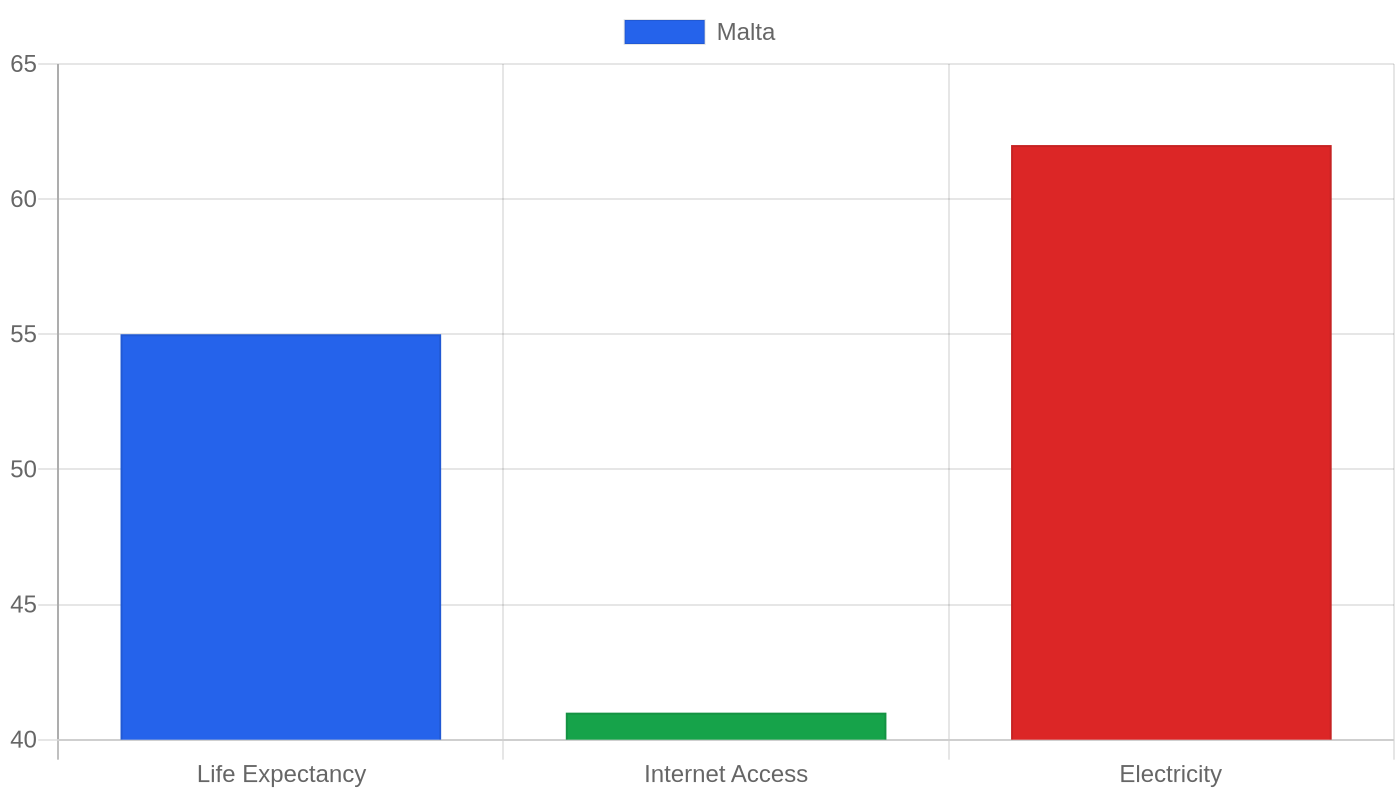
Economic Pulse Net | Sources: World Bank World Development Indicators, Government Sources | 2026
Key Takeaways
– Malta’s economy is dominated by financial services, gaming, and tourism, but data gaps make precise tracking difficult for outsiders
– The country’s banking sector is unusually concentrated, with five major financial institutions among its top companies
– Malta operates a Westminster-style parliamentary system, blending British political traditions with Mediterranean governance
– Cost of living pressures are mounting in this densely populated island nation, though official data remains sparse
– The presence of both local and international banks signals Malta’s role as a regional financial hub despite its tiny size
The Mediterranean Tiger — Growth Without a Paper Trail
Malta presents a paradox for economic journalists. The World Bank data for this island nation is conspicuously absent across nearly every major metric — GDP growth, inflation, unemployment, and GDP per capita all appear as blanks in the latest reporting. This silence itself tells a story.
For a country that has positioned itself as a nimble, business-friendly outpost in the central Mediterranean, the lack of transparent, regularly updated macroeconomic data raises questions about how investors and policymakers are meant to track its trajectory.
What we do know is that Malta’s economic backbone rests on a narrow but lucrative set of industries. The country has long marketed itself as a low-tax, English-speaking gateway between Europe and North Africa, attracting financial services firms, iGaming operators, and shipping companies. Its main industries, while not explicitly listed in the available data, are widely understood to include tourism, financial intermediation, online gambling, and pharmaceuticals.
The absence of World Bank figures may reflect reporting lags rather than deliberate opacity, but for a nation that aspires to be taken seriously as a financial centre, the data vacuum is notable.
The inflation picture remains similarly opaque. Without CPI figures from the World Bank, it is impossible to say whether Malta is experiencing the same price pressures gripping much of the eurozone. Given that Malta uses the euro, it is reasonable to assume it is not immune to the continent’s energy and food price shocks, but the lack of hard numbers means any analysis must remain speculative.
The unemployment rate, too, is missing — though anecdotal evidence from the country’s tight labour market suggests employment remains high, particularly in the services sector.
Property Paradise or Price Trap? The Cost of Island Living
Malta’s cost of living data is another blank page in the economic dossier, but the reality on the ground is far from empty. Housing costs in this island nation of just over half a million people have become a defining political and social issue. With limited land and a construction boom that has transformed the skyline of Valletta and surrounding towns, property prices have soared over the past decade.
Renting in popular areas like Sliema, St Julian’s, or the capital commands premium prices that rival southern European capitals, while buying has become increasingly out of reach for young Maltese families.
The cost of daily expenses — groceries, utilities, transport — has also risen, driven by Malta’s heavy reliance on imported goods and its status as a small, open economy vulnerable to global supply chain disruptions. Compared to regional averages in southern Europe, Malta’s cost of living is generally higher than in neighbouring Sicily or mainland Greece, though lower than in major eurozone hubs like Paris or Milan.
The government has attempted to cushion the blow through fuel and energy subsidies, but these come at a fiscal cost that is increasingly difficult to sustain. For expatriates and digital nomads drawn by Malta’s climate and English-speaking workforce, the trade-off between sun and savings is becoming steeper.
Banking on Stability — Malta’s Financial Fortress
Malta’s corporate landscape is dominated by financial institutions to an extent that few other European economies can match. The top companies list reads like a who’s who of Maltese banking: Bank of Valletta, HSBC Bank Malta, APS Bank, Lombard Bank, and the Central Bank of Malta all feature prominently. This concentration reflects Malta’s historical role as a financial intermediary, a role that has only grown since the country joined the eurozone in 2008.
The presence of HSBC, a global giant, alongside local lenders like Bank of Valletta, suggests a market that is both internationally connected and domestically rooted.
Outside of finance, the top companies include GO in telecommunications, MaltaPost in industrials, and Air Malta in consumer services — the latter a perennial source of national pride and fiscal headache. Emmanuel Delicata, a consumer goods company, represents the island’s wine and spirits tradition, while Db Group anchors the real estate sector. For investors, the key sectors to watch are financial services, iGaming, and logistics.
Malta has invested heavily in its port facilities and freeport zone, positioning itself as a transshipment hub for Mediterranean trade. The business environment is generally favourable, with low corporate tax rates (effectively 5% for many international companies through refunds) and a regulatory framework designed to attract foreign direct investment.
However, the country has faced repeated criticism from the European Union and the Financial Action Task Force over anti-money laundering controls, creating a tension between openness and oversight.
Sun, Sea, and Scrutiny — Life in a Mediterranean Republic
Malta’s political landscape is defined by its Westminster-style parliamentary system, a legacy of British colonial rule that ended in 1964. The republic’s parliament consists of the president and the House of Representatives, known in Maltese as the *Kamra tad-Deputati*. This structure has produced a stable but intensely partisan political environment, dominated by the Labour Party and the Nationalist Party.
Elections are fiercely contested, voter turnout is high, and politics often feels personal in a country where everyone seems to know someone in government.
The crime and safety indices are blank in the available data, but Malta is generally considered a safe country by European standards. Petty crime, particularly pickpocketing in tourist areas, exists but violent crime is rare. The quality of life is a mixed picture: the climate is enviable, the healthcare system is functional, and English is widely spoken, making integration relatively easy for foreigners.
On the downside, Malta suffers from chronic traffic congestion, overdevelopment, and growing environmental concerns about construction and waste management. The happiness data is absent, but the country’s high life expectancy and strong social networks suggest a population that, despite its grumbles, enjoys a decent standard of living.
Current Affairs — Navigating the Post-Pandemic Landscape
Right now, Malta is grappling with the aftershocks of multiple overlapping challenges. The country’s reliance on tourism — which accounted for roughly 15% of GDP before the pandemic — has made it vulnerable to global shocks, and the recovery has been uneven. Visitor numbers have rebounded strongly, but the industry faces new headwinds from rising airfares, labour shortages, and changing travel patterns.
The government, led by Prime Minister Robert Abela’s Labour Party, has pursued a policy of economic expansion, approving large-scale construction projects and maintaining a relatively open immigration stance to fill labour gaps.
On the regulatory front, Malta is under continued pressure from international bodies to tighten its financial oversight. The Financial Action Task Force placed Malta on its “grey list” in 2021 for deficiencies in anti-money laundering controls, and while the country has since made progress in addressing these concerns, the episode damaged its reputation as a clean financial centre.
The iGaming sector, a major employer and tax contributor, is also facing stricter EU regulations and increased competition from other jurisdictions. Meanwhile, the cost of living crisis is feeding public discontent, with protests over housing affordability and environmental degradation becoming more frequent. For a country that has long prided itself on punching above its weight, the current moment feels like a test of whether Malta can balance growth with sustainability.
The Bottom Line
Malta is a country to watch for anyone interested in the intersection of small-state economics, European integration, and Mediterranean geopolitics. Its financial sector offers opportunities for investors willing to navigate regulatory complexity, while its quality of life continues to attract expatriates and retirees.
However, the data gaps in this profile underscore a broader challenge: Malta’s success has been built on discretion and flexibility, but in an era demanding transparency and accountability, that approach may be reaching its limits. For policymakers, business leaders, and journalists alike, Malta is a case study in how small nations can thrive — and stumble — in the global economy.
Sources & Methodology
This article is authored by Economic Pulse Net for informational and research purposes. Economic Pulse Net sources its data from multilateral institutions, national statistics bureaus, and proprietary databases. All data is believed to be current as of the date of publication.
Published: July 30, 2026 | Category: Research — Malta
Use these signals in your own platform
Economic Pulse publishes its live signal feed through a documented, read-only API. Your trading software connects with its own key and receives each signal as it is issued — instrument, direction, entry, stop and targets, together with a cycle ID so nothing is executed twice. The feed is independent of this website and cannot change it.
Signals are informational only and are not financial advice.