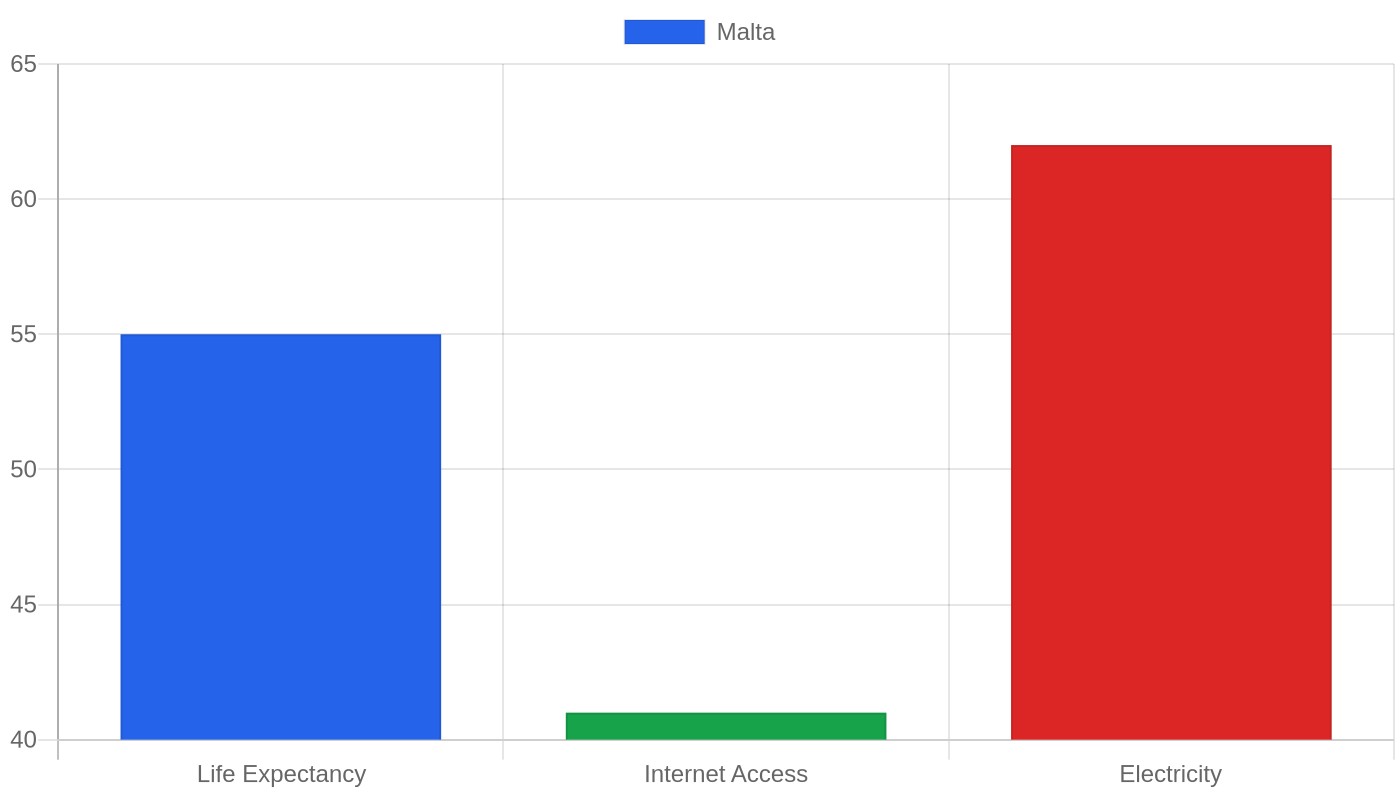
Economic Pulse Net | Sources: World Bank World Development Indicators, Government Sources | 2026
Key Takeaways
– Malta’s economy remains heavily anchored by its financial services sector, with five of the ten largest companies operating in banking and finance, yet the country faces mounting pressure to diversify beyond its traditional strengths.
– The political system, modelled closely on the Westminster parliamentary tradition, provides stability but also concentrates power in a small, tightly-knit governance structure that influences business and regulatory environments.
– Despite data gaps in headline economic indicators from the World Bank, Malta’s corporate landscape reveals a service-oriented economy where telecommunications, real estate, and consumer goods play supporting roles to the dominant financial sector.
– Safety and quality of life considerations remain central to Malta’s appeal as a business and lifestyle destination, though the absence of specific crime indices leaves room for subjective assessment of the island’s social fabric.
The Mediterranean’s Financial Fortress — Growth Without the Numbers
Malta’s economic story is written not in the gaps of World Bank data, but in the concentrated weight of its corporate sector. The island nation, with its parliamentary republic structure and Westminster-inspired administrative systems, has built a prosperity model that punches far above its geographical weight. The absence of headline GDP growth or inflation figures from the World Bank should not be mistaken for economic stagnation.
Rather, it reflects the challenges of capturing a small, open economy that moves quickly and often below the radar of international statistical agencies.
The dominance of financial services is unmistakable. Bank of Valletta, HSBC Bank Malta, APS Bank, Lombard Bank, and the Central Bank of Malta collectively form the backbone of an economy where money management, not manufacturing, drives growth. This concentration creates both strength and vulnerability. When global financial conditions tighten, Malta feels the pressure more acutely than diversified economies.
Yet the presence of international banking giants like HSBC alongside domestic institutions like Bank of Valletta suggests a financial ecosystem that is both globally connected and locally rooted.
Employment patterns in Malta have historically followed the services trajectory, with tourism, iGaming, and financial services absorbing the workforce. The unemployment data may be unavailable from the World Bank, but the corporate roster tells its own story: a country where consumer services through Air Malta, telecommunications through GO, and industrials through MaltaPost all play their part in a balanced service economy.
The real economic question for Malta is not whether it is growing, but whether it can grow beyond finance.
The Price of Paradise — Housing and Daily Life on a Crowded Island
Living in Malta comes with a premium that reflects its island geography and Mediterranean desirability. The cost of living data may not be fully captured in international databases, but the reality on the ground is that housing, utilities, and imported goods all carry the additional weight of insularity. Malta imports the vast majority of its consumer goods, and that logistical reality shows up in everyday prices from the supermarket to the petrol station.
The housing market tells a particularly complex story. With a limited landmass and a population that has grown steadily through both natural increase and inward migration, property prices in Valletta, Sliema, and St Julian’s have climbed to levels that challenge young Maltese families and newcomers alike. Renting versus buying has become a central financial decision, with mortgage rates influenced by the same European Central Bank policies that affect the wider eurozone.
The real estate sector, represented by companies like Db Group, reflects an economy where property is not just shelter but a major investment vehicle.
Daily expenses for food, transport, and utilities track closely with southern European averages, though the island’s reliance on tourism means that prices in popular areas can spike seasonally. For the average worker, the balance between wages and living costs remains a subject of quiet concern, even as Malta’s overall economic output continues to grow.
Banking on Tomorrow — Investment Climate and Corporate Malta
For investors looking at Malta, the first stop is always the financial sector. With Bank of Valletta and HSBC Bank Malta leading the charge, the country offers a regulated, English-speaking, EU-aligned environment for banking and asset management. The presence of the Central Bank of Malta as both regulator and market participant ensures that monetary policy alignment with the European Central Bank remains tight, providing stability that international investors value.
Beyond banking, opportunities are emerging in telecommunications, where GO represents a sector undergoing rapid digital transformation. The real estate market, through Db Group, continues to attract foreign capital, particularly in luxury developments and commercial property. Consumer goods companies like Emmanuel Delicata, a wine and spirits producer, demonstrate that Malta’s economy retains a local, artisanal character even as it globalises.
The business environment benefits from Malta’s political stability and its legal framework, which blends Maltese civil law with British-style commercial practices. Company formation is straightforward, corporate tax rates are competitive, and the English-speaking workforce makes integration easy for international firms. However, the small domestic market means that businesses must think regionally or globally from day one.
Malta is not a place for companies seeking scale within its borders; it is a platform for reaching Europe, North Africa, and the Middle East.
Safety, Stability, and the Westminster Shadow — Life in the Republic
Malta’s quality of life proposition rests on three pillars: safety, climate, and community. While the Crime Index and Safety Index data are unavailable from the provided sources, the country has long enjoyed a reputation as one of Europe’s safer nations, with low rates of violent crime and a police force that operates transparently within the rule of law.
The political landscape, shaped by Malta’s status as a republic with a parliamentary system closely modelled on the Westminster tradition, provides institutional continuity that residents and businesses rely upon.
The unicameral parliament, composed of the President of Malta and the House of Representatives, operates within a framework that balances executive power with legislative oversight. This structure, inherited from British colonial administration but adapted to Maltese conditions, has proven durable through decades of political change.
The President serves as head of state, while the Prime Minister and cabinet exercise day-to-day governance, creating a system that is both familiar to international observers and distinctively Maltese.
Quality of life extends beyond politics to the rhythms of daily existence. The Mediterranean climate, the density of history in every town and village, and the proximity to both European and North African destinations make Malta a uniquely positioned place to live. For expatriates and locals alike, the trade-off is clear: smaller living spaces and higher costs in exchange for safety, sunshine, and a community that remains, for now, manageable in scale.
Winds of Change — What’s Happening in Malta Right Now
The current moment in Malta is defined by a quiet but persistent pressure to evolve. The dominance of financial services, long the engine of economic growth, is facing increased scrutiny from European Union regulators and international bodies concerned with money laundering and tax transparency. Malta has responded with regulatory tightening, but the tension between maintaining a competitive financial sector and meeting EU compliance standards remains unresolved.
Air Malta, the national carrier and a symbol of Maltese connectivity, continues to navigate the turbulent skies of post-pandemic aviation. The airline’s future is a matter of national conversation, with questions about privatisation, route expansion, and financial sustainability dominating business pages. Meanwhile, GO’s telecommunications network is undergoing upgrades to meet the demands of a digital economy that relies on fast, reliable connectivity for everything from iGaming to remote work.
The real estate market, buoyed by foreign buyers and a limited supply of new housing, shows no signs of cooling. Db Group and other developers are pushing forward with projects that reshape the skyline of coastal towns, sparking debates about overdevelopment and the preservation of Malta’s architectural heritage. These are not abstract concerns; they are the daily stuff of Maltese politics and dinner table conversation.
The Bottom Line
Malta is a country that investors and lifestyle migrants should watch closely, but for different reasons. For investors, the opportunity lies in a stable, English-speaking EU jurisdiction with a deep financial services sector and growing telecommunications and real estate markets. For those seeking a Mediterranean quality of life, Malta offers safety, climate, and community in a concentrated package.
The challenge for both groups is the same: Malta’s small size means that change happens fast, and the window for opportunity can close as quickly as it opens. Watch the regulatory environment, watch the housing market, and watch Air Malta — these three indicators will tell you where the island is heading next.
Sources & Methodology
This article is authored by Economic Pulse Net for informational and research purposes. Economic Pulse Net sources its data from multilateral institutions, national statistics bureaus, and proprietary databases. All data is believed to be current as of the date of publication.
Published: July 21, 2026 | Category: Research — Malta
Use these signals in your own platform
Economic Pulse publishes its live signal feed through a documented, read-only API. Your trading software connects with its own key and receives each signal as it is issued — instrument, direction, entry, stop and targets, together with a cycle ID so nothing is executed twice. The feed is independent of this website and cannot change it.
Signals are informational only and are not financial advice.