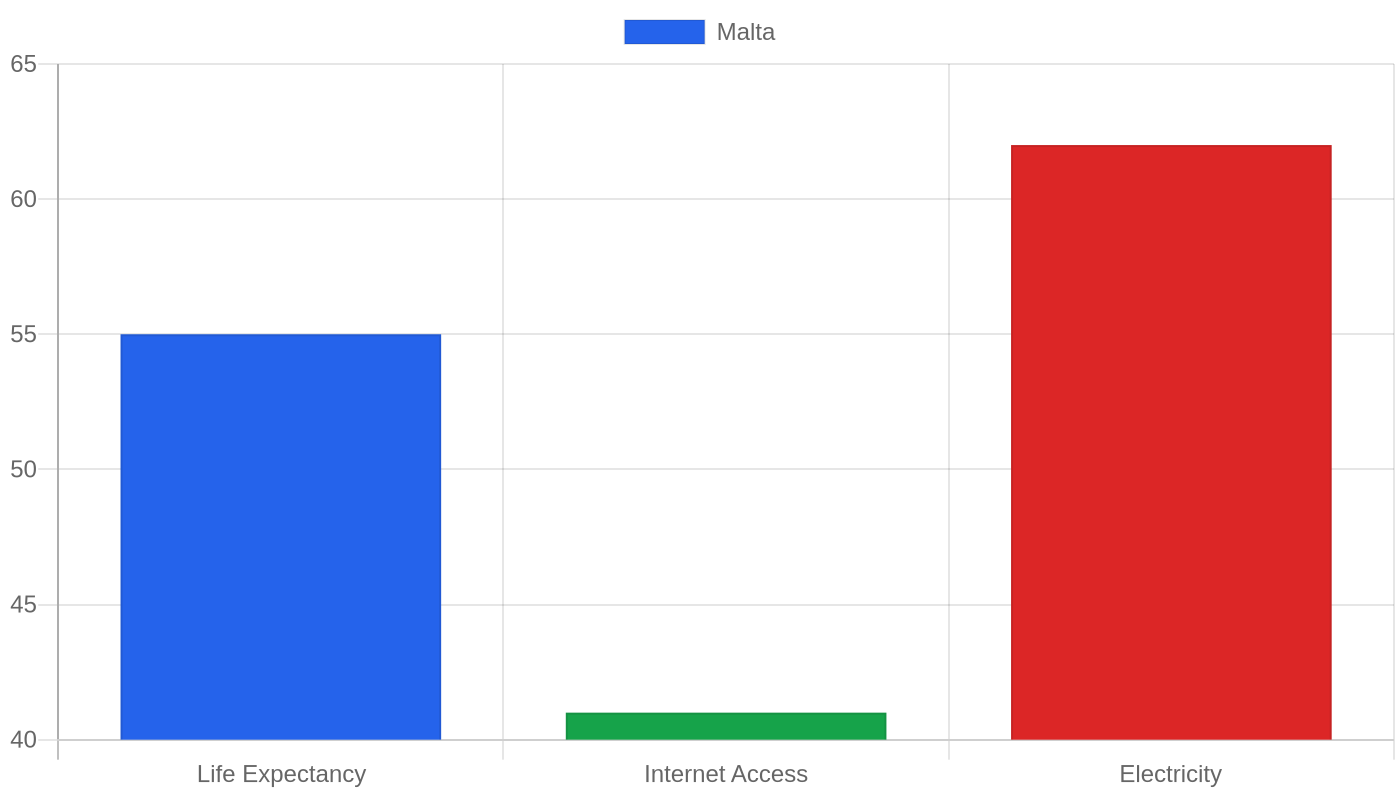
Economic Pulse Net | Sources: World Bank World Development Indicators, Government Sources | 2026
Malta is often described as a Mediterranean crossroads — a tiny archipelago where European, North African, and Middle Eastern influences have collided for centuries. But today, this republic of roughly half a million people is carving out a very different identity: that of a nimble, services-driven economy punching far above its weight.
With a financial sector anchored by homegrown banking giants, a strategic position at the heart of the Mediterranean, and a political system modelled on Westminster, Malta is a case study in how small states can leverage stability and location to attract capital. Yet the same openness that fuels its success also raises questions about resilience, cost pressures, and long-term sustainability.
Key Takeaways
– Financial services dominate: Malta’s corporate landscape is overwhelmingly financial, with major players like Bank of Valletta, HSBC Bank Malta, and APS Bank shaping the economic core.
– A Westminster-style republic: The country’s parliamentary system and public administration are explicitly modelled on the UK’s Westminster system, providing political continuity and institutional familiarity for investors.
– Consumer services and real estate are rising: Beyond banking, companies like Air Malta, GO, and Db Group highlight a diversified services economy that includes aviation, telecoms, and property.
– A small, open economy with concentrated strengths: Malta’s growth story is driven by a handful of sectors rather than broad-based industrial expansion — a source of both agility and vulnerability.
– Liveability and safety are central to its pitch: While specific crime and safety indices are not available, Malta’s appeal has long rested on its quality of life and Mediterranean lifestyle.
Economic Engines: A Services Powerhouse in Miniature
The latest World Bank data for Malta does not include specific figures for GDP growth, inflation, or unemployment — a reminder that small states often lag in statistical reporting. But the absence of fresh numbers should not obscure the broader picture. Malta’s economy is a services-driven machine, with a corporate roster that reads like a who’s who of financial and consumer industries.
The Central Bank of Malta anchors the monetary framework, while commercial lenders such as Bank of Valletta, HSBC Bank Malta, Lombard Bank, and APS Bank form the backbone of the financial sector. This concentration is not accidental; Malta has deliberately positioned itself as a banking and insurance hub within the European Union, leveraging its English-speaking workforce and regulatory alignment with EU standards.
Beyond finance, the presence of GO in telecommunications and Air Malta in consumer services signals a broader push into digital infrastructure and tourism-related connectivity. The industrial sector is comparatively thin — MaltaPost represents the industrials category, but the economy is not built on manufacturing. This is a post-industrial services economy, one that exports financial products, tourism experiences, and digital connectivity rather than goods.
The absence of hard data from the World Bank makes precise analysis difficult, but the structural signals are clear: Malta’s economic identity is financial, consumer-oriented, and deeply integrated into European and Mediterranean trade networks. The real question is not whether Malta is growing, but whether its concentrated model can withstand external shocks — from tourism downturns to shifts in global banking regulation.
The Cost of Living: Mediterranean Lifestyle, European Price Tag
Malta’s cost of living has become a topic of quiet anxiety among locals and expatriates alike. The country’s appeal as a sun-drenched, English-speaking base for remote workers and financial firms has driven demand for housing and daily goods, pushing prices upward in recent years.
While the data provided does not include specific cost-of-living indices, the structural pressures are evident from the corporate landscape: a thriving real estate sector represented by Db Group suggests active property markets, and the dominance of consumer services companies indicates that domestic spending is a significant economic driver.
Renting in Malta’s prime areas — Valletta, Sliema, St Julian’s — has become increasingly competitive, with demand from foreign professionals and digital nomads colliding with limited housing supply. Buying property, meanwhile, is often seen as a safer long-term bet in a country with constrained land availability and steady population interest.
Daily expenses for food, utilities, and transport are broadly in line with southern European averages, though imported goods carry a premium given the island’s reliance on external supply chains. For those earning in euros and working in the financial sector, Malta remains affordable; for those on local wages, the gap between income and outgoings is tightening.
The broader regional comparison is telling: Malta offers a higher baseline cost than its North African neighbours but a lower one than most northern European capitals — a middle ground that is increasingly rare in the EU.
Investment and Business Climate: Banking on Stability
For investors, Malta’s pitch is straightforward: a stable, English-speaking, EU-member jurisdiction with a financial sector that punches far above its size. The top companies list is a testament to this — the financial sector alone accounts for six of the eleven major firms identified, including the Central Bank of Malta, Bank of Valletta, HSBC Bank Malta, APS Bank, and Lombard Bank.
This is not a diversified industrial economy; it is a specialised financial hub with supporting services in telecoms, aviation, and real estate.
The business environment benefits from the Westminster-style administrative system, which offers a familiar legal and regulatory framework for British and Commonwealth investors. Malta’s corporate tax system, while not detailed in the data, has historically been a draw for holding companies and financial services firms.
The presence of GO in telecommunications points to ongoing investment in digital infrastructure, while Air Malta’s continued operation — despite years of financial turbulence — suggests that the government views national connectivity as strategically important. Sectors to watch include fintech, iGaming, and blockchain-based services, all of which have found a welcoming regulatory home in Malta in recent years.
The risk, however, is concentration: a financial-sector downturn or a regulatory crackdown at the EU level could disproportionately impact the Maltese economy. Investors are betting on stability, but they are also exposed to the very concentration that makes Malta’s model so efficient.
Safety, Politics, and Quality of Life: The Mediterranean Balance
Malta’s political landscape is defined by its unique constitutional setup — a republic whose parliamentary system and public administration are explicitly modelled on the Westminster system. This hybrid of republican headship and parliamentary governance provides a degree of institutional continuity that investors and residents alike tend to find reassuring.
The parliament is composed of the president and the House of Representatives, a structure that mirrors the British model while adapting it to Maltese circumstances.
Crime and safety indices are not currently available in the provided data, but Malta’s reputation as a low-crime, family-friendly destination has long been a cornerstone of its appeal. The country’s quality of life is rooted in its Mediterranean setting — mild winters, hot summers, and a coastline that supports a robust tourism industry.
For expatriates, the combination of English as an official language, EU membership, and a relatively relaxed pace of life makes Malta an attractive alternative to larger, more expensive European hubs. The political system, while occasionally polarised between its two dominant parties, has remained stable within the EU framework.
This is not a country in political crisis; it is a small state managing the tensions of growth, immigration, and European integration with a degree of pragmatism that larger nations often lack.
What’s Happening Now: A Nation at a Crossroads
Malta in 2026 is a country navigating the tension between its ambitions and its constraints. The financial sector, long the engine of economic growth, faces increasing scrutiny from EU regulators and international bodies concerned about money laundering and corporate transparency. The government has responded with a series of reforms aimed at tightening oversight, but the balance between maintaining a business-friendly environment and meeting Brussels’ expectations remains delicate.
At the same time, the cost-of-living pressures noted earlier are becoming a political issue, with local wages struggling to keep pace with the influx of higher-earning foreign professionals.
The real estate market, represented by firms like Db Group, continues to boom — but this is a double-edged sword. Property development is driving economic activity and government revenue, yet it is also reshaping Malta’s landscape, raising concerns about overdevelopment and the loss of the very character that attracts visitors and investors in the first place.
Air Malta’s ongoing restructuring is another live issue; the national carrier’s viability is a matter of both economic and symbolic importance, tied to Malta’s connectivity and its ability to project itself as a hub between Europe and North Africa. Meanwhile, the telecommunications sector, anchored by GO, is investing in fibre and 5G infrastructure, positioning Malta as a digitally connected node in the Mediterranean.
These are not the headlines of a country in crisis — they are the stories of a small nation managing the complexities of success.
The Bottom Line
Malta is a country to watch for investors, remote workers, and anyone interested in how small states navigate the pressures of globalisation. Its financial sector offers stability and expertise, but that very concentration is also its greatest vulnerability. The cost of living is rising, the political system is stable yet occasionally fractious, and the quality of life remains a powerful draw.
For those willing to look past the absence of hard statistical data, Malta’s trajectory is clear: a services-driven economy, a Mediterranean lifestyle, and a government betting on openness and connectivity. The question is whether that bet will continue to pay off in a world of tighter regulation, higher costs, and shifting global trade patterns. For now, the answer seems to be a cautious, qualified yes.
Sources & Methodology
This article is authored by Economic Pulse Net for informational and research purposes. Economic Pulse Net sources its data from multilateral institutions, national statistics bureaus, and proprietary databases. All data is believed to be current as of the date of publication.
Published: August 12, 2026 | Category: Research — Malta
Use these signals in your own platform
Economic Pulse publishes its live signal feed through a documented, read-only API. Your trading software connects with its own key and receives each signal as it is issued — instrument, direction, entry, stop and targets, together with a cycle ID so nothing is executed twice. The feed is independent of this website and cannot change it.
Signals are informational only and are not financial advice.