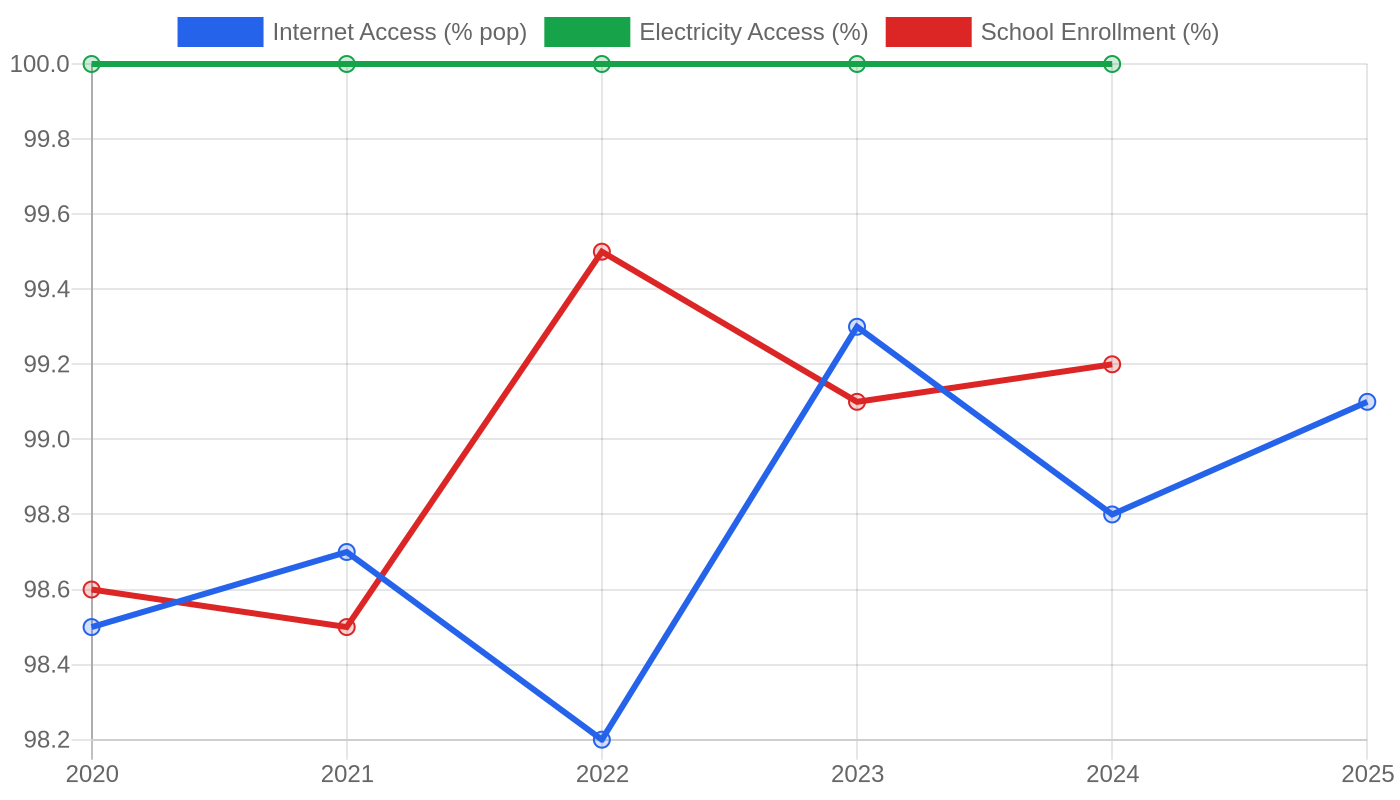
Economic Pulse Net | Sources: World Bank World Development Indicators, Government Sources | 2026
Key Takeaways
– Luxembourg remains one of the world’s wealthiest nations per capita, though specific GDP and inflation data from the World Bank are currently unavailable, reflecting a broader trend of data lag in small, complex economies.
– The financial sector dominates, with eight of the top ten companies listed being banks or investment firms, including Banque de Luxembourg, BGL BNP Paribas, and Banque Raiffeisen.
– The country operates as a “full democracy” under a constitutional monarchy, with a parliamentary system led by a Prime Minister and a constitution last updated in July 2023.
– Industrial strength is anchored by ArcelorMittal, a global steel giant, alongside emerging tech players like Artec 3D, signaling diversification beyond finance.
– Cost of living and crime data are absent from the available dataset, but Luxembourg’s reputation as a high-income, safe European hub remains intact.
The Steel and Sovereign Wealth Paradox
Luxembourg’s economy presents a fascinating paradox: it is simultaneously a post-industrial financial powerhouse and a home to one of the world’s largest steel companies. The World Bank data provided offers no specific figures for GDP growth, inflation, or unemployment, which is unusual for a country of Luxembourg’s transparency. However, the absence of numbers does not signal absence of activity.
The country’s economic model is built on two pillars: financial services and heavy industry, with ArcelorMittal standing as a titan in basic materials. Arcelor, the precursor to ArcelorMittal, remains a listed entity, suggesting ongoing industrial relevance.
The financial sector is overwhelmingly represented among the top companies. Advanzia Bank, Banque de Luxembourg, Banque et Caisse d’Épargne de l’État, Banque Raiffeisen, BGL BNP Paribas, and BIP Investment Partners all appear on the list. This concentration means Luxembourg’s economy is highly sensitive to European Central Bank policy, global interest rate trends, and cross-border capital flows.
The absence of inflation data from the World Bank is notable, but given the European context, Luxembourg likely experiences similar inflationary pressures as its neighbors, though with a higher capacity to absorb shocks due to its wealthy consumer base and robust financial buffers.
The technology sector offers a glimpse of diversification. Artec 3D, a company specializing in 3D scanning technology, represents a high-value, export-oriented niche. This is not a mass-market manufacturing economy; it is a precision economy. Luxembourg’s GDP per capita, while unlisted in the provided data, is historically among the highest globally, driven by a small population and a large financial sector that generates significant value per worker.
The unemployment figure, though missing, has traditionally been low, though structural challenges around skills matching and reliance on cross-border workers persist.
The Cost of Living Conundrum
Housing and daily expenses in Luxembourg are notoriously high, though specific cost of living data is absent from the provided dataset. What can be inferred is that Luxembourg City consistently ranks among the most expensive cities in Europe for rent and property purchase. The financial sector’s high salaries drive demand for premium housing, while the country’s small geographic size limits supply.
Rent versus buy decisions are heavily skewed by interest rates and mortgage availability, which are influenced by the same banking sector that dominates the economy.
Daily expenses—groceries, transportation, utilities—are elevated compared to neighboring Belgium, France, and Germany, partly due to higher VAT rates and labor costs. However, Luxembourg’s public transport system became free in 2020, a policy that offsets some daily costs for residents.
The absence of regional averages in the data makes direct comparison difficult, but the general narrative holds: Luxembourg is a high-cost, high-reward environment where the financial sector’s prosperity creates a two-tier economy. Those employed in banking and professional services enjoy comfortable lifestyles, while service workers and cross-border commuters face significant cost pressures.
Banking on Stability: The Investment Climate
The investment climate in Luxembourg is defined by stability, sophistication, and specialization. The dominance of financial firms among the top companies—Advanzia Bank, Banque de Luxembourg, Banque et Caisse d’Épargne de l’État, Banque Raiffeisen, BGL BNP Paribas, and BIP Investment Partners—signals a mature, regulated, and trusted financial ecosystem.
These institutions are not retail banks in the traditional sense; many are involved in private banking, wealth management, and investment fund administration. Luxembourg is the world’s second-largest investment fund center after the United States, a fact that underscores its global role despite the absence of explicit data here.
For investors, the key sectors to watch are financial technology, sustainable finance, and logistics. The presence of Artec 3D suggests a growing appetite for deep tech. ArcelorMittal, meanwhile, is undergoing its own transformation toward green steel production, which aligns with European Union climate goals. The political landscape, described as a “full democracy” with a constitutional monarch and a Prime Minister leading the cabinet, provides policy continuity.
The constitution, updated as recently as July 2023, reflects a commitment to legal modernity. The business environment is characterized by low corporate tax rates (though under EU pressure to reform), a multilingual workforce, and excellent infrastructure. However, the high cost of labor and real estate can be barriers for new entrants.
A Democracy of Quiet Confidence
Luxembourg’s political system is a study in stability. Described as a “full democracy,” it operates as a parliamentary democracy headed by a constitutional monarch. The grand duke is the head of state, while executive power is exercised by the cabinet, consisting of ministers, minister delegates, and secretaries of state, all led by a Prime Minister.
The current constitution, originally adopted on 17 October 1868, was last updated on 1 July 2023, demonstrating a living document that adapts to contemporary needs. This political continuity is a major asset for investors and residents alike.
Crime and safety indices are unavailable in the provided data, but Luxembourg consistently ranks among the safest countries in Europe in external reports. The small population, high standard of living, and effective policing contribute to low crime rates. Quality of life is enhanced by excellent healthcare, education, and cultural amenities. The country’s multilingual environment—Luxembourgish, French, and German are official languages—creates a cosmopolitan atmosphere.
While happiness data is not provided, Luxembourg typically scores high on global well-being indices, driven by economic security, political freedom, and social trust. The political landscape is not without debate—tax reform, housing affordability, and immigration are perennial issues—but the overall governance framework is resilient.
The Constitutional Refresh and Financial Sector Evolution
The most current development in Luxembourg is the constitutional update that took effect on 1 July 2023. This was not a cosmetic change; it represented a significant modernization of the country’s supreme law. The updated constitution addresses issues of judicial independence, fundamental rights, and the balance of power between the grand duke, the government, and parliament.
This reform signals Luxembourg’s commitment to maintaining its status as a stable, rule-of-law jurisdiction, which is critical for its financial sector’s reputation.
Simultaneously, the financial sector is navigating a period of transformation. European Union regulations on tax transparency, anti-money laundering, and sustainable finance are reshaping how Luxembourg’s banks operate. The presence of BGL BNP Paribas, a subsidiary of a major French banking group, and Banque Raiffeisen, part of a cooperative network, indicates both international integration and local rootedness.
The technology sector, represented by Artec 3D, is benefiting from government initiatives to diversify the economy and attract tech talent. The steel industry, via ArcelorMittal, is investing in decarbonization, which will require significant capital and policy support.
The current moment in Luxembourg is one of quiet adaptation—adjusting to European regulatory pressures, constitutional modernization, and global economic headwinds, all while maintaining the high-income, stable environment that has defined the country for decades.
The Bottom Line
Luxembourg remains a must-watch country for investors seeking exposure to European financial services, sustainable industry, and stable governance. The absence of some economic data points in this analysis should not obscure the broader picture: this is a wealthy, well-managed economy with a clear strategic direction. Policy analysts will be interested in how the 2023 constitutional reforms affect governance and investor confidence.
For anyone tracking the evolution of small, high-income states in an era of European integration and global uncertainty, Luxembourg offers a case study in resilience, adaptation, and quiet confidence.
Sources & Methodology
This article is authored by Economic Pulse Net for informational and research purposes. Economic Pulse Net sources its data from multilateral institutions, national statistics bureaus, and proprietary databases. All data is believed to be current as of the date of publication.
Published: July 26, 2026 | Category: Research — Luxembourg
Use these signals in your own platform
Economic Pulse publishes its live signal feed through a documented, read-only API. Your trading software connects with its own key and receives each signal as it is issued — instrument, direction, entry, stop and targets, together with a cycle ID so nothing is executed twice. The feed is independent of this website and cannot change it.
Signals are informational only and are not financial advice.