Economic Pulse Net | Sources: World Bank World Development Indicators, Government Sources | 2026
Key Takeaways
– Lithuania has maintained unbroken democratic governance since restoring independence in 1990, making it one of the most politically stable nations in the post-Soviet space.
– The country’s economy is anchored by industrials and consumer services, with major firms like Avia Solutions Group and Apranga driving growth in aviation and retail.
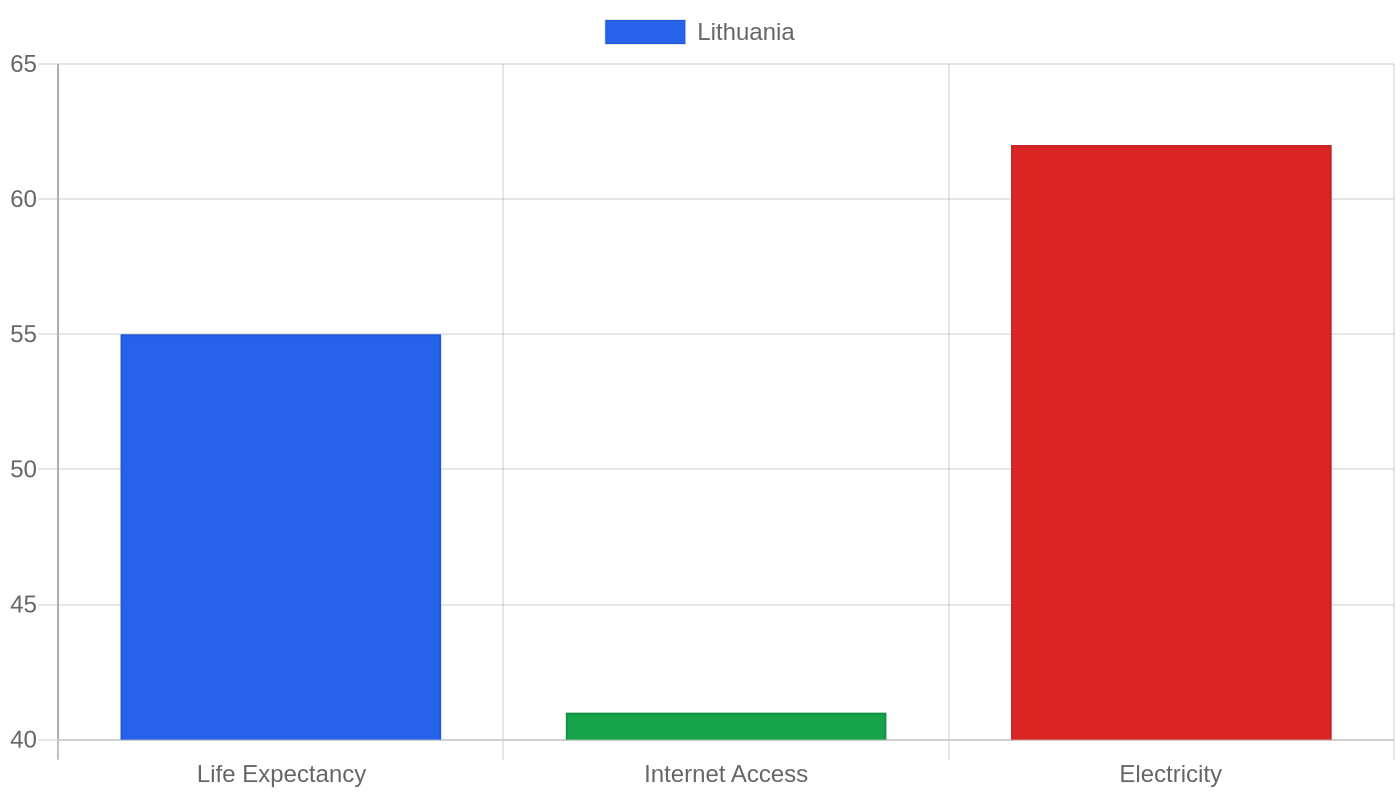
– Despite incomplete macroeconomic data from the World Bank, Lithuania’s trajectory suggests a resilient economy navigating regional pressures without the safety net of larger Western neighbours.
– Top companies span utilities, shipbuilding, food and beverage, and basic materials — indicating a diversified industrial base rather than single-sector dependency.
The Economy Beyond the Numbers
The World Bank data on Lithuania arrives with frustrating gaps. No GDP growth figure. No inflation rate. No unemployment percentage. No GDP per capita. For a journalist accustomed to leading with statistics, this absence is both a challenge and an invitation. Because what the numbers fail to tell us, the structure of the economy reveals clearly enough.
Lithuania’s industrial backbone is unmistakable. The list of top companies reads like a map of a nation that refused to be defined by its Soviet past. Achema, in basic materials, represents the heavy industrial capacity that still powers much of the Baltic region. Amber Grid, the state-controlled natural gas transmission operator, speaks to Lithuania’s strategic position as an energy transit hub — and its long campaign to reduce dependence on Russian supplies.
Then there is Avia Solutions Group, the global aviation services giant, and Avion Express, the ACMI leasing specialist. These are not small players serving a small market. They are firms with international reach, headquartered in Vilnius because the business environment allows it.
The industrials sector dominates. BLRT Western Shipyard in Klaipėda, Aviavilsa, and Baltik vairas in consumer goods — these are companies that make things, move things, and employ people. When the World Bank eventually updates its numbers, the story will likely be one of moderate growth constrained by European headwinds, but the underlying resilience comes from this industrial diversity. Lithuania does not rely on a single export commodity. It builds ships, processes food, transmits energy, and leases aircraft.
That breadth matters when global demand shifts.
The Cost of Living — A Baltic Balancing Act
Housing costs in Lithuania have been climbing steadily, particularly in Vilnius, where the post-independence generation is now entering its prime earning and buying years. The dynamic is familiar across the region: urbanisation concentrates demand, supply struggles to keep pace, and prices rise faster than wages. Rent versus buy calculations increasingly favour ownership for those who can secure financing, though mortgage rates remain sensitive to broader European monetary conditions.
Daily expenses — food, transport, utilities — sit noticeably below Western European averages but above those in neighbouring Latvia and well above Belarus. The gap between Vilnius and the rest of the country is significant. In the capital, a coffee costs what it costs in Berlin. In the countryside, it costs half that. This internal disparity creates a dual economy: one part integrated into European service-sector norms, the other still operating on post-Soviet price logic.
For the Lithuanian middle class, the squeeze is real but manageable. For younger workers entering the market, the pressure is mounting.
Investment and Business Climate — Where the Action Is
The corporate landscape in Lithuania is defined by a striking mix of legacy industries and modern services. Apranga, the retail giant, dominates consumer services with a network of fashion stores across the Baltics. Aurela, another consumer services firm, operates in the same space. These companies benefit from Lithuania’s position as a regional retail hub, drawing customers from Latvia, Estonia, and even parts of Poland.
But the real story is in industrials. Avia Solutions Group is a global player in aircraft maintenance, leasing, and crew services — a business that requires skilled labour, regulatory sophistication, and capital access. That it flourishes in Lithuania says something about the country’s business climate: corporate tax rates are competitive, the workforce is well-educated, and the legal framework is European-standard.
For investors looking at the Baltics, Lithuania offers the largest domestic market of the three, a coastline with port infrastructure in Klaipėda, and a government that has consistently prioritised foreign direct investment.
The sectors to watch are aviation services, renewable energy (Amber Grid’s gas infrastructure is increasingly being adapted for hydrogen and biomethane), and advanced manufacturing. The shipbuilding capacity at BLRT Western Shipyard is no Soviet relic; it is a modern operation servicing European and North Sea clients.
Safety, Politics, and Quality of Life — Democracy’s Long Run
Since Lithuania declared the restoration of its independence on 11 March 1990, it has maintained strong democratic traditions. The first independent general elections on 25 October 1992 saw 56.75% of voters support the new constitution. That moment was not a one-off. It set a pattern. Lithuania has held regular, competitive elections ever since, with peaceful transfers of power and a vibrant civil society.
The political system is a semi-presidential republic, and debates over the role of the president have been a recurring feature of Lithuanian politics since the early 1990s. A separate referendum on 23 May 1992 saw 41% of voters support restoring the presidency — a sign, even then, of the careful balancing act between parliamentary and executive power that continues today. The current landscape is stable, though not without tension.
Lithuania has been a vocal critic of Russian aggression, a strong supporter of Ukraine, and a reliable NATO ally. That geopolitical posture has domestic costs — energy security, defence spending, and the management of a large ethnic Russian minority — but it has also given Lithuania a clarity of purpose that some larger European nations lack.
Crime rates are low by regional standards. Vilnius is a safe city. The quality of life metrics — healthcare access, education, environmental quality — place Lithuania in the upper tier of post-communist states. The country ranks well on press freedom and internet access. It is not a perfect democracy, but it is an unmistakably real one.
What’s Happening Now — The Energy Endgame and the Industrial Pivot
Right now, Lithuania is in the middle of a strategic transformation that will define its next decade. The country completed its synchronisation with the European continental electricity grid in early 2025, finally severing the last major energy link to the post-Soviet system. This was not a technical footnote. It was a geopolitical declaration. For a nation that lived through Russian gas cut-offs and electricity blackmail, full integration into the European energy market is existential.
On the corporate side, Avia Solutions Group continues to expand its global footprint, with recent moves into Southeast Asian and African markets. The company’s growth trajectory suggests that Lithuania is producing not just regional champions but genuinely international firms.
Meanwhile, Apranga and Aurela are navigating a retail environment disrupted by e-commerce and changing consumer habits — pressures that are hitting the entire Baltic retail sector but that these companies have so far managed with reasonable success.
The political conversation in Vilnius is increasingly about demographics and labour shortages. The population is ageing, emigration to Western Europe continues at a modest but persistent rate, and the economy needs workers. Immigration policy is being quietly liberalised, particularly for skilled workers from Ukraine, Belarus, and further afield. This is a slow-burn issue, but it will shape Lithuania’s economic capacity for years to come.
The Bottom Line
Lithuania is not a headline economy. It does not make the front pages of the financial press. But for investors and businesses looking for a stable, democratic, European-integrated market with a diversified industrial base and a government that takes sovereignty seriously, it deserves attention. The country has done the hard work — energy independence, democratic consolidation, corporate development — that many of its peers have not.
Watch Lithuania for its industrials, its aviation sector, and its quiet determination to be more than a small Baltic state. It is already something larger.
Sources & Methodology
This article is authored by Economic Pulse Net for informational and research purposes. Economic Pulse Net sources its data from multilateral institutions, national statistics bureaus, and proprietary databases. All data is believed to be current as of the date of publication.
Published: July 27, 2026 | Category: Research — Lithuania
Use these signals in your own platform
Economic Pulse publishes its live signal feed through a documented, read-only API. Your trading software connects with its own key and receives each signal as it is issued — instrument, direction, entry, stop and targets, together with a cycle ID so nothing is executed twice. The feed is independent of this website and cannot change it.
Signals are informational only and are not financial advice.