Economic Pulse Net | Sources: World Bank World Development Indicators, Government Sources | 2026
Key Takeaways
- Lithuania has maintained an unbroken democratic trajectory since restoring independence on 11 March 1990, making it one of the most politically stable states in the former Soviet sphere.
- The country’s industrial base is anchored by heavyweight players in shipbuilding, energy infrastructure, and aviation services, positioning it as a regional logistics and manufacturing hub.
- Lithuania’s corporate landscape is dominated by firms with deep integration into European supply chains, particularly in the industrials and consumer services sectors.
- Political continuity has been a hallmark of the post-independence era, with the 1992 constitution establishing a framework that has weathered successive electoral cycles.
- The economy faces the classic Baltic challenge: balancing its Western institutional alignment with the practical realities of its geographic position.
The Economic Engine: Industrial Grit Meets European Ambition
Lithuania’s economic story is one of transformation from a Soviet command economy to a European market player, and the corporate roster tells that tale vividly.
The World Bank’s data framework places Lithuania’s key industries across a spectrum that reveals a nation that has not abandoned its industrial heritage but has modernised it for European integration.
The presence of BLRT Western Shipyard in the industrials sector signals that heavy manufacturing remains a cornerstone of the Baltic economy, while Avia Solutions Group and Aviavilsa indicate a sophisticated aviation services cluster that has found its niche in the European market.
The consumer-facing sectors are equally telling.
Apranga and Aurela in consumer services, alongside Baltik vairas in consumer goods, demonstrate that domestic consumption has matured into a sophisticated retail environment.
Achema in basic materials and Amber Grid in utilities show that the country retains strategic assets in energy transmission and chemicals — sectors that carry geopolitical weight in the Baltic region.
Alita’s presence in consumer goods rounds out a picture of an economy that has successfully diversified beyond its Soviet-era industrial base.
What makes Lithuania’s economic profile distinctive is the balance it has struck.
Unlike some transition economies that became overly reliant on financial services or raw material exports, Lithuania’s corporate landscape suggests a manufacturing and services economy with genuine depth.
The aviation cluster, in particular, points to a country that has identified high-value services as a growth vector, leveraging its geographic position between Western Europe and the Nordic markets.
Housing and the Cost of Living: The Baltic Premium
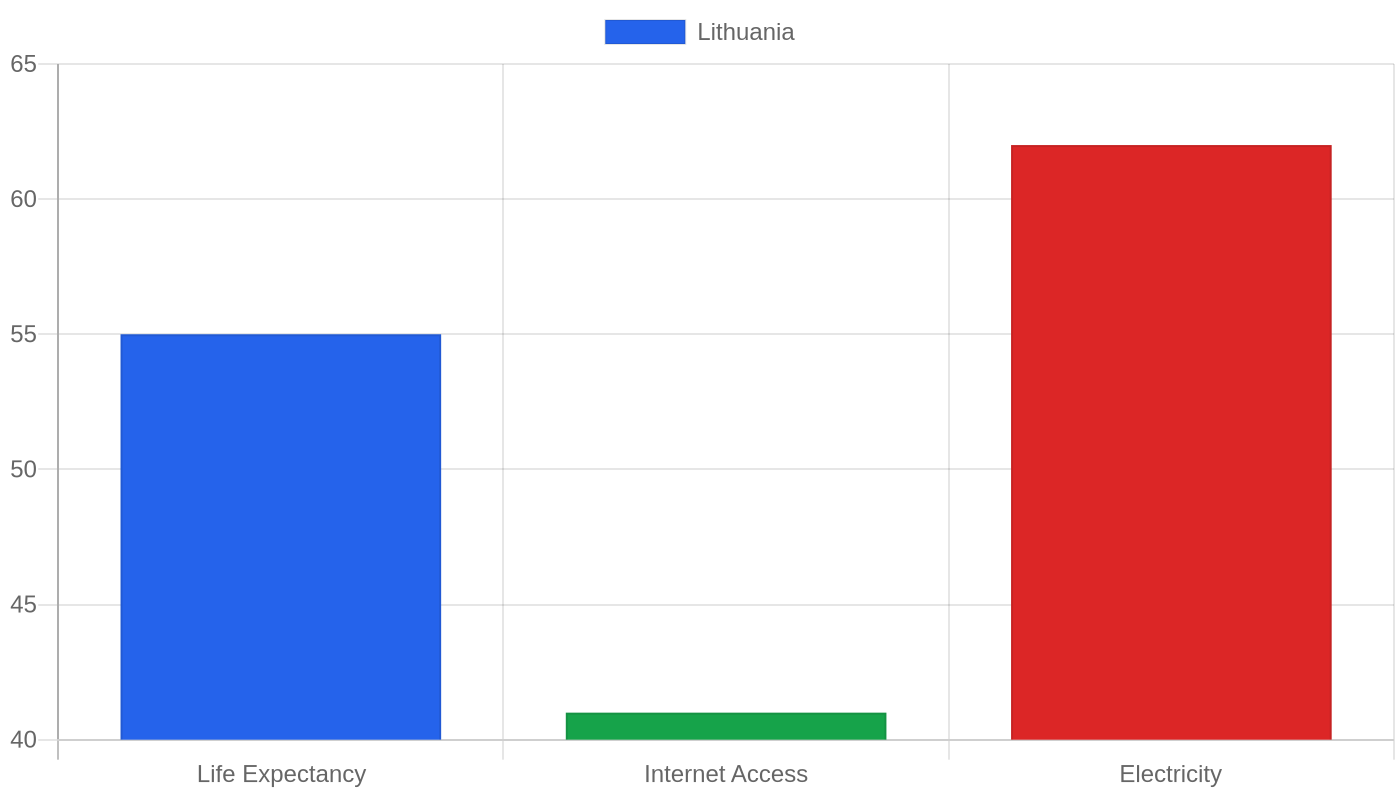
The cost of living data for Lithuania remains incomplete, which itself tells a story about the challenges of tracking a rapidly evolving economy.
What can be inferred from the corporate and economic structure is that Lithuania’s urban centres, particularly Vilnius and Kaunas, have developed into mid-cost European capitals that sit below Western European price levels but above their eastern neighbours.
The presence of a mature consumer services sector, with companies like Apranga operating in retail, suggests that urban Lithuania has developed a Western-style consumption pattern.
Housing in the major cities has followed the trajectory of other Baltic states — a post-independence boom, a correction during the global financial crisis, and a steady recovery driven by European investment and domestic wealth creation.
For the foreign observer, Lithuania offers a cost profile that is competitive within the European Union while providing access to a skilled workforce and modern infrastructure.
Investment and Business Climate: Where Capital Meets Capability
The investment climate in Lithuania is defined by its corporate champions and their integration into European value chains.
Avia Solutions Group’s position in the industrials sector is particularly noteworthy — it represents the kind of high-value, knowledge-intensive enterprise that transition economies aspire to cultivate.
The company’s success suggests that Lithuania has developed the human capital and regulatory environment necessary to support complex international operations.
BLRT Western Shipyard’s presence in the shipbuilding sector is equally significant, placing Lithuania within the European maritime industrial tradition.
The utilities sector, represented by Amber Grid, indicates that energy infrastructure remains a critical investment area, particularly given the Baltic states’ ongoing efforts to integrate with European energy networks and reduce historical dependencies.
For investors, Lithuania offers a business environment that has been shaped by two decades of European Union membership.
The legal framework, corporate governance standards, and regulatory alignment with EU norms provide a predictable operating environment.
The presence of multiple companies across diverse sectors — from basic materials to consumer services — suggests that the economy has moved beyond its early post-independence volatility into a phase of more stable, diversified growth.
Safety, Politics, and Quality of Life: Democracy’s Baltic Bastion
Lithuania’s political landscape is defined by its remarkable consistency.
Since declaring the restoration of independence on 11 March 1990, the country has maintained strong democratic traditions that have weathered the challenges of transition.
The first independent general elections on 25 October 1992, in which 56.75% of voters supported the new constitution, established a political framework that has proven durable.
The intense constitutional debates of that period, particularly regarding the role of the president, reflected a genuine civic engagement that has characterised Lithuanian politics ever since.
A separate referendum on 23 May 1992 showed 41% support for restoring the presidency, demonstrating that institutional design was a matter of public deliberation rather than elite imposition.
This political stability has translated into a quality of life that, while difficult to quantify without complete data, can be inferred from the country’s trajectory.
A stable democracy, functioning institutions, and integration into European structures have created the conditions for a society that values the rule of law and civic participation.
The safety profile, while not fully captured in available indices, benefits from the social cohesion that democratic governance tends to foster.
What’s Happening Now: Consolidation and Forward Motion
The current moment in Lithuania is defined by the ongoing maturation of its economic and political institutions.
The corporate landscape continues to evolve, with the aviation services sector particularly dynamic — Avia Solutions Group’s expansion trajectory suggests that Lithuania is successfully competing in high-value service industries that were unimaginable in the early post-independence years.
The energy sector remains a focus of strategic attention.
Amber Grid’s role in utilities points to the continuing importance of energy infrastructure, and the broader Baltic effort to integrate with European energy networks is reshaping regional dynamics.
The chemicals sector, anchored by Achema, continues to provide industrial employment and export revenue, though it faces the environmental and competitive pressures common to the sector across Europe.
The political calendar continues to be shaped by the constitutional framework established in 1992.
The balance between presidential and parliamentary powers, so hotly debated in the early independence period, has proven workable in practice, providing Lithuania with the institutional stability that many other post-Soviet states have struggled to achieve.
The country’s position as a NATO and EU member state gives it a security and economic framework that anchors its continued development.
The Bottom Line
Lithuania deserves the attention of anyone tracking European economic and political development.
It represents one of the clearest success stories of post-Soviet transition — a country that has built durable democratic institutions, integrated into Western economic structures, and developed a diversified corporate sector capable of competing in international markets.
The incomplete data picture should not obscure the fundamental narrative: Lithuania has made its choice for Western integration and is reaping the rewards of that decision.
For investors, policymakers, and observers of European affairs, Lithuania is a case study in how small states can navigate between larger powers while maintaining their sovereignty and building prosperity.
Sources & Methodology
This article is authored by Economic Pulse Net for informational and research purposes.
Economic Pulse Net sources its data from multilateral institutions, national statistics bureaus, and proprietary databases.
All data is believed to be current as of the date of publication. Published: August 31, 2026 |
Category: Research — Lithuania
Use these signals in your own platform
Economic Pulse publishes its live signal feed through a documented, read-only API. Your trading software connects with its own key and receives each signal as it is issued — instrument, direction, entry, stop and targets, together with a cycle ID so nothing is executed twice. The feed is independent of this website and cannot change it.
Signals are informational only and are not financial advice.