Economic Pulse Net | Sources: World Bank World Development Indicators, Government Sources | 2026
Key Takeaways
* Stagnant but Stable: With GDP growth hovering at just 0.54% in 2025, Italy is experiencing near-zero expansion, yet it remains the third-largest economy in the Eurozone by nominal terms.
High Purchasing Power: Despite sluggish growth, the average Italian enjoys significant economic resilience, with a GDP per capita (PPP) of over $62,800, indicating high living standards relative to global averages.
Labor Market Tightness: Unemployment has fallen to 6.39%, suggesting a tighter labor market that could eventually drive wage pressures or attract foreign talent despite the slow macroeconomic backdrop.
Industrial Heritage: The country’s economic engine continues to rely on established industrial and utility giants, from A2A in energy to aerospace leaders like AgustaWestland, rather than emerging tech sectors.
Economic Stagnation Amidst High Living Standards
Italy’s economic trajectory in 2025 presents a paradox of modest growth coupled with substantial wealth distribution. According to World Bank data, the nation’s GDP grew by only 0.539583636778445% this year, a figure that underscores the persistent structural challenges facing Europe’s third-largest economy. However, looking solely at headline growth misses the nuance of the Italian model; the GDP per capita based on purchasing power parity (PPP) stands at an impressive $62,802.51.
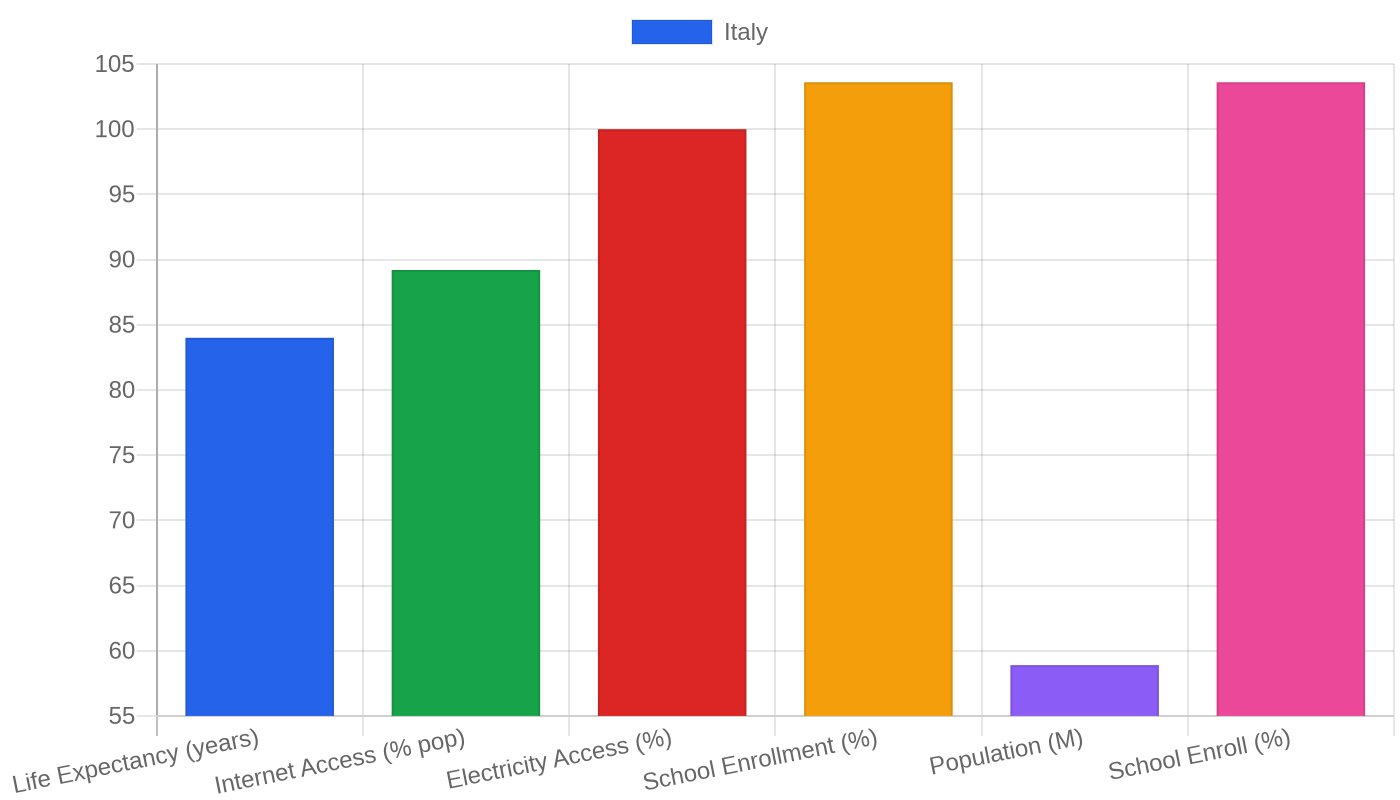
This metric suggests that while the overall pie is not expanding rapidly, the slice available to each citizen remains large, driven by a population of 58,915,656 people who benefit from a robust social safety net and high-value services. Inflation, measured by the Consumer Price Index (CPI), has settled at 1.5316735709312%, which is well within the European Central Bank’s comfort zone, providing a stable environment for consumers and businesses alike.
This price stability is crucial for a country where consumer confidence can easily be swayed by energy costs and import prices. Furthermore, the unemployment rate of 6.391% indicates that the labor market is functioning efficiently, keeping more citizens economically active and contributing to the total GDP of $2.55 trillion USD. These figures collectively paint a picture of a mature economy that is no longer chasing hyper-growth but is instead focusing on maintaining stability and high per-capita welfare.
Cost of Living and Housing Dynamics
The cost of living in Italy varies significantly by region, but the underlying data points to a high-income society where daily expenses are balanced against strong wages. With a Gross National Income (GNI) per capita of $42,080.0, residents have considerable disposable income compared to many other European nations, allowing them to absorb higher costs in major urban centers like Milan and Rome without severe financial strain.
While specific housing indices are not provided in the current dataset, the high PPP-adjusted GDP per capita implies that housing costs, whether through rent or mortgage payments, are sustainable for the median earner. Daily expenses, including food and utilities, are likely moderated by the low inflation rate of 1.53%, which preserves the purchasing power of household budgets.
For expatriates or investors, this means that while initial setup costs may be high, the ongoing operational costs for individuals remain manageable due to the strong baseline income levels. The interplay between high GNI and controlled inflation creates a resilient consumer base, ensuring that domestic demand remains steady even when broader economic growth is sluggish.
Investment and Business Climate
Italy’s business landscape is dominated by legacy industries and state-influenced utilities, offering stability over disruptive innovation. Key players such as A2A in the utilities sector and Agip in oil and gas form the backbone of the nation’s infrastructure, ensuring reliable energy supplies for both domestic consumption and industrial output.
In the consumer goods and industrials space, companies like Abarth, AGV, and ALAN cater to both local tastes and international markets, leveraging Italy’s reputation for quality manufacturing. The aerospace sector remains a critical pillar, with firms like AgustaWestland and Alenia Aermacchi driving high-value exports and technological advancement. Even smaller entities like Air Dolomiti and Air One contribute to the service economy, facilitating connectivity that is vital for tourism and trade.
For investors, these sectors offer defensive characteristics; they are less volatile than tech startups and provide consistent cash flows. The presence of such entrenched corporate structures suggests that new entrants must partner with or complement existing giants rather than compete directly in core infrastructure or heavy industry.
Safety, Politics, and Quality of Life
Political stability in Italy is anchored by its long-standing democratic framework, having operated as a unitary parliamentary republic since the abolition of the monarchy in 1946. The head of state, President Sergio Mattarella, has served since 2015, elected for a seven-year term by Parliament and regional voters, providing a layer of continuity amidst shifting political coalitions.
The constitution, forged by anti-fascist forces, ensures a written democratic foundation that protects civil liberties and judicial independence. Regarding personal security, current data does not provide specific Crime or Safety Indices, leaving a gap in quantifiable metrics for short-term visitors or expats. However, the historical context of the nation’s liberation from Nazi and Fascist forces highlights a deep societal commitment to democratic values and rule of law.
This institutional resilience contributes to an overall sense of order, even if specific crime statistics are unavailable. For residents, the combination of political maturity and cultural richness offers a high quality of life, supported by the economic stability outlined in previous sections.
What’s Happening Now: Policy and Outlook
As Italy navigates the post-pandemic recovery phase, the focus has shifted from rapid expansion to sustainable consolidation. The low GDP growth rate of 0.54% reflects a deliberate pause, allowing the government to address structural inefficiencies without overheating the economy. With inflation firmly under control at 1.53%, policymakers are likely prioritizing investment in green energy and digital transformation within the utilities and industrial sectors.
Companies like A2A are probably at the forefront of this transition, adapting traditional energy models to meet EU sustainability targets. Meanwhile, the tight labor market, evidenced by the 6.39% unemployment rate, may force businesses to invest in automation or upskilling to maintain productivity. The political landscape, led by President Mattarella’s enduring tenure, provides a steady hand for implementing long-term reforms without the disruption of frequent electoral cycles.
Stakeholders should watch for policy shifts aimed at boosting small and medium-sized enterprises (SMEs), which are the true engine of Italian employment. The coming years will likely see a continued emphasis on preserving the high standard of living indicated by the $62,800 PPP figure, even if absolute growth numbers remain modest.
The Bottom Line
Italy is a country to watch for investors seeking stability and high-quality assets rather than explosive growth. Its strong per-capita income and controlled inflation make it a safe harbor for capital preservation. Businesses should focus on partnering with established industrial leaders in energy, aerospace, and manufacturing. Ultimately, Italy’s economic narrative is one of resilience, proving that a mature economy can thrive even without double-digit growth rates.
Sources & Methodology
This article is authored by Economic Pulse Net for informational and research purposes. Economic Pulse Net sources its data from multilateral institutions, national statistics bureaus, and proprietary databases. All data is believed to be current as of the date of publication.
Published: October 24, 2026 | Category: Research — Italy
Use these signals in your own platform
Economic Pulse publishes its live signal feed through a documented, read-only API. Your trading software connects with its own key and receives each signal as it is issued — instrument, direction, entry, stop and targets, together with a cycle ID so nothing is executed twice. The feed is independent of this website and cannot change it.
Signals are informational only and are not financial advice.