Economic Pulse Net | Sources: World Bank World Development Indicators, Government Sources | 2026
Key Takeaways
* Modest Growth Trajectory: Italy’s economy is projected to expand by just 0.54% in 2025, reflecting a period of cautious recovery rather than explosive growth.
Strong Consumer Power: With a GDP per capita (PPP) exceeding $62,800 and a GNI per capita of $42,080, Italian citizens maintain high purchasing power relative to global standards.
Low Inflation Environment: Consumer prices are rising at a manageable rate of approximately 1.53%, offering stability for households and businesses alike.
Tight Labor Market: Unemployment sits at a relatively low 6.39%, indicating a resilient labor market despite broader economic headwinds.
Established Corporate Base: The nation hosts a diverse array of major players in utilities, aerospace, and consumer goods, anchoring its industrial output.
Economic Pulse: Navigating Slow but Steady Waters
Italy’s economic landscape in 2025 is defined by resilience rather than rapid expansion. According to World Bank data, the country’s GDP growth is projected at a modest 0.539583636778445%, signaling a slow but positive trajectory for one of Europe’s largest economies. This figure, while subdued compared to emerging markets, reflects the structural challenges faced by mature European economies as they navigate post-pandemic adjustments and energy transitions.
However, the underlying strength of the economy is evident in its total output; with a GDP of $2,551,556,954,100.35 USD, Italy remains a significant global player, contributing substantially to international trade and finance.
The health of the average Italian citizen tells a different story than the aggregate growth numbers might suggest. The GDP per capita based on Purchasing Power Parity (PPP) stands at an impressive $62,802.51, which indicates that when adjusted for local costs and price levels, Italians enjoy a standard of living comparable to or exceeding many advanced economies. Furthermore, the Gross National Income (GNI) per capita is recorded at $42,080, underscoring the robust income generation within the country.
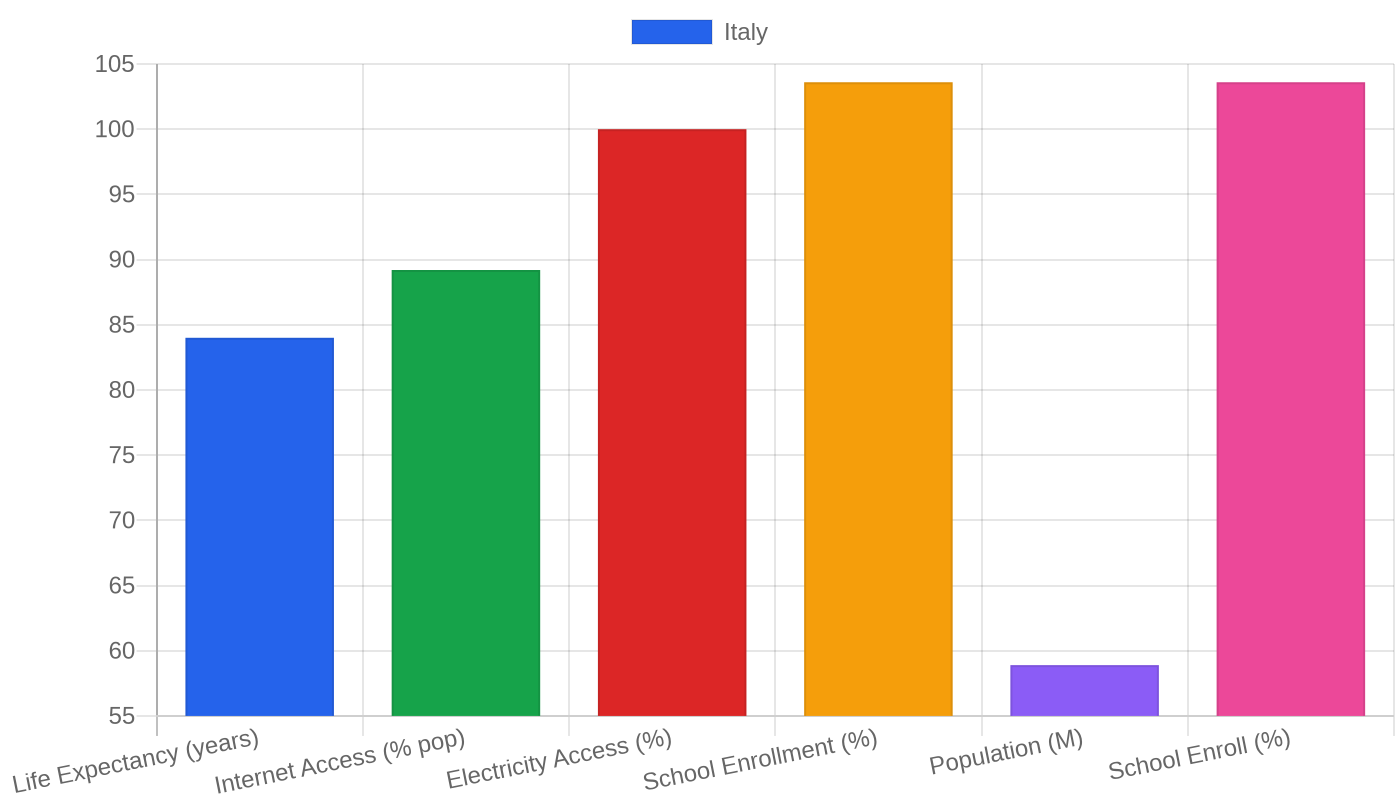
These figures are particularly notable given the population base of 58,915,656 people, suggesting that wealth distribution, while always a topic of political debate, supports a broad middle class capable of sustaining domestic consumption.
Inflation has also come under control, providing a stable environment for both consumers and investors. The Consumer Price Index (CPI) inflation rate is reported at 1.5316735709312%, a level that central banks typically view as healthy and sustainable. This low inflationary pressure reduces the cost of borrowing and preserves the real value of savings, encouraging long-term investment planning. For businesses, predictable pricing environments allow for better margin management and strategic forecasting.
Consequently, while headline growth may be slow, the quality of economic activity—measured by income levels and price stability—remains high.
Cost of Living: The Premium of Quality
Living in Italy offers a unique blend of cultural richness and economic accessibility, though specific housing metrics require careful interpretation. While detailed rent-to-buy ratios are not explicitly provided in the current dataset, the high GDP per capita (PPP) of over $62,800 suggests that the cost of living, while present, is well-supported by household incomes.
This implies that daily expenses, from groceries to utilities, are manageable for the average resident, allowing for a lifestyle that prioritizes leisure and culture alongside financial security.
For expatriates and domestic residents alike, the balance between earnings and expenditures appears favorable. The GNI per capita of $42,080 serves as a strong benchmark for what households can expect to earn annually on average. When juxtaposed with the low inflation rate of 1.53%, it becomes clear that wage growth is likely outpacing or keeping pace with price increases, preventing erosion of living standards.
This dynamic is crucial in a country where regional disparities often exist; however, the national averages indicate a baseline of comfort that exceeds many other European nations.
Furthermore, the structure of the Italian economy, heavily reliant on services and high-value manufacturing, supports a cost of living that rewards skilled labor. Whether in Milan’s financial district or Rome’s administrative hubs, professionals benefit from an economic ecosystem where high productivity translates into tangible purchasing power.
While luxury goods and tourism-heavy areas may command premium prices, the general economic indicators suggest that Italy remains an affordable destination for those earning global-standard wages. The absence of hyperinflation ensures that long-term residents can plan for retirement and education without the fear of sudden economic shocks eroding their assets.
Investment & Business Climate: Anchors of Industry
Italy’s business environment is anchored by a diverse portfolio of established companies across critical sectors. The presence of major entities like A2A in utilities and Agip in oil and gas highlights the nation’s focus on energy infrastructure and resource management. These corporations play pivotal roles in maintaining national stability and driving technological upgrades in traditional industries.
Meanwhile, the industrial sector is bolstered by giants such as Alenia Aermacchi and AgustaWestland, which dominate the aerospace and defense markets, showcasing Italy’s capability in high-tech manufacturing.
Consumer goods and services also form a vital pillar of the economic landscape. Brands like Abarth, AGV, and ALAN represent Italy’s global influence in automotive design and safety equipment, leveraging the country’s reputation for style and engineering excellence. In the service sector, airlines such as Air Dolomiti and Air One facilitate both domestic connectivity and international tourism, a key revenue stream for the nation.
Additionally, Aermacchi contributes to the broader industrial complex, illustrating the interconnected nature of Italy’s manufacturing base.
For investors, these companies offer exposure to sectors that are less volatile than pure tech startups but provide steady returns through established market positions. The diversification across utilities, aerospace, consumer goods, and services reduces systemic risk, making the Italian market attractive for conservative capital allocation. Moreover, the low unemployment rate of 6.391% ensures a ready supply of labor for these industries, supporting operational continuity.
As Italy continues to integrate into European supply chains, these legacy firms serve as gateways for foreign partners seeking reliable, high-quality production capabilities.
Safety, Politics & Quality of Life: A Stable Republic
Italy operates as a unitary parliamentary republic, a system established since 1946 following the abolition of the monarchy. This democratic framework provides a stable political backdrop for economic activities, ensuring that policy shifts occur through constitutional processes rather than upheaval. Sergio Mattarella, serving as President since 2015, acts as the head of state, elected for a seven-year term by Parliament and regional voters.
His role, while largely ceremonial, embodies the continuity of the state and the protection of the written democratic constitution forged by anti-fascist forces during World War II.
This historical context imbues the political landscape with a deep sense of institutional resilience. The constitution, resulting from a Constituent Assembly representing various anti-fascist groups, guarantees civil liberties and checks on power, fostering an environment where businesses can operate with legal certainty.
Although specific crime indices are listed as N/A in the current data, the political stability and strong rule of law implied by this governance structure generally contribute to a safe societal environment. Citizens and investors alike benefit from a system where disputes are resolved through established judicial channels.
Quality of life in Italy is further enhanced by its cultural heritage and social structures, which are supported by the aforementioned economic strengths. The combination of high personal income and low inflation allows for greater discretionary spending on health, education, and leisure. While the data does not provide explicit happiness scores, the economic indicators suggest a population that is financially secure enough to prioritize well-being.
The political maturity of the nation, having evolved significantly since the mid-20th century, provides a reassuring foundation for long-term residency and investment.
What’s Happening Now: Policy and Performance Trends
Currently, Italy is navigating a phase of economic consolidation where policy efforts are focused on maintaining price stability while encouraging modest growth. The projected GDP growth of 0.54% for 2025 suggests that policymakers are balancing stimulus measures with fiscal responsibility, avoiding overheating risks associated with higher inflation.
With CPI inflation holding at 1.53%, the central bank and government appear successful in managing monetary conditions, keeping costs predictable for businesses and consumers.
Recent trends indicate a continued emphasis on strengthening key industrial sectors. Companies like A2A and Agip are likely expanding their operations to meet evolving energy demands, aligning with broader European goals for energy security. Simultaneously, the aerospace industry, represented by Alenia Aermacchi and AgustaWestland, is benefiting from increased global demand for defense and commercial aviation solutions.
This shift towards high-value manufacturing complements the traditional strengths in consumer goods, creating a more resilient economic mix.
The labor market remains a bright spot, with unemployment at 6.391%. This relatively low figure suggests that job creation initiatives are effective, possibly driven by investments in technology and services. As the population of nearly 59 million engages in this growing economy, there is a noticeable trend towards skill development and adaptability.
Businesses are increasingly looking to leverage Italy’s creative industries and industrial expertise to compete globally, turning historical advantages into modern competitive edges.
The Bottom Line
Italy presents a compelling case for investors and observers seeking stability in a mature market. With high per capita incomes and controlled inflation, the country offers a safe harbor for capital preservation and steady, albeit slow, growth. The robust corporate landscape, featuring leaders in utilities, aerospace, and consumer goods, provides ample opportunities for engagement across multiple sectors.
For those who value political stability and high quality of life alongside moderate economic returns, Italy remains a top-tier destination in the European arena.
Sources & Methodology
This article is authored by Economic Pulse Net for informational and research purposes. Economic Pulse Net sources its data from multilateral institutions, national statistics bureaus, and proprietary databases. All data is believed to be current as of the date of publication.
Published: October 16, 2026 | Category: Research — Italy
Use these signals in your own platform
Economic Pulse publishes its live signal feed through a documented, read-only API. Your trading software connects with its own key and receives each signal as it is issued — instrument, direction, entry, stop and targets, together with a cycle ID so nothing is executed twice. The feed is independent of this website and cannot change it.
Signals are informational only and are not financial advice.