Economic Pulse Net | Sources: World Bank World Development Indicators, Government Sources | 2026
Ireland presents one of the most paradoxical pictures in the developed world. By one measure, it is extraordinarily wealthy — with GDP per capita (PPP) of $155,089, a figure that towers over nearly every other nation on Earth. By another, it is a country grappling with a severe housing crisis, infrastructure strain, and a cost-of-living squeeze that feels anything but prosperous.
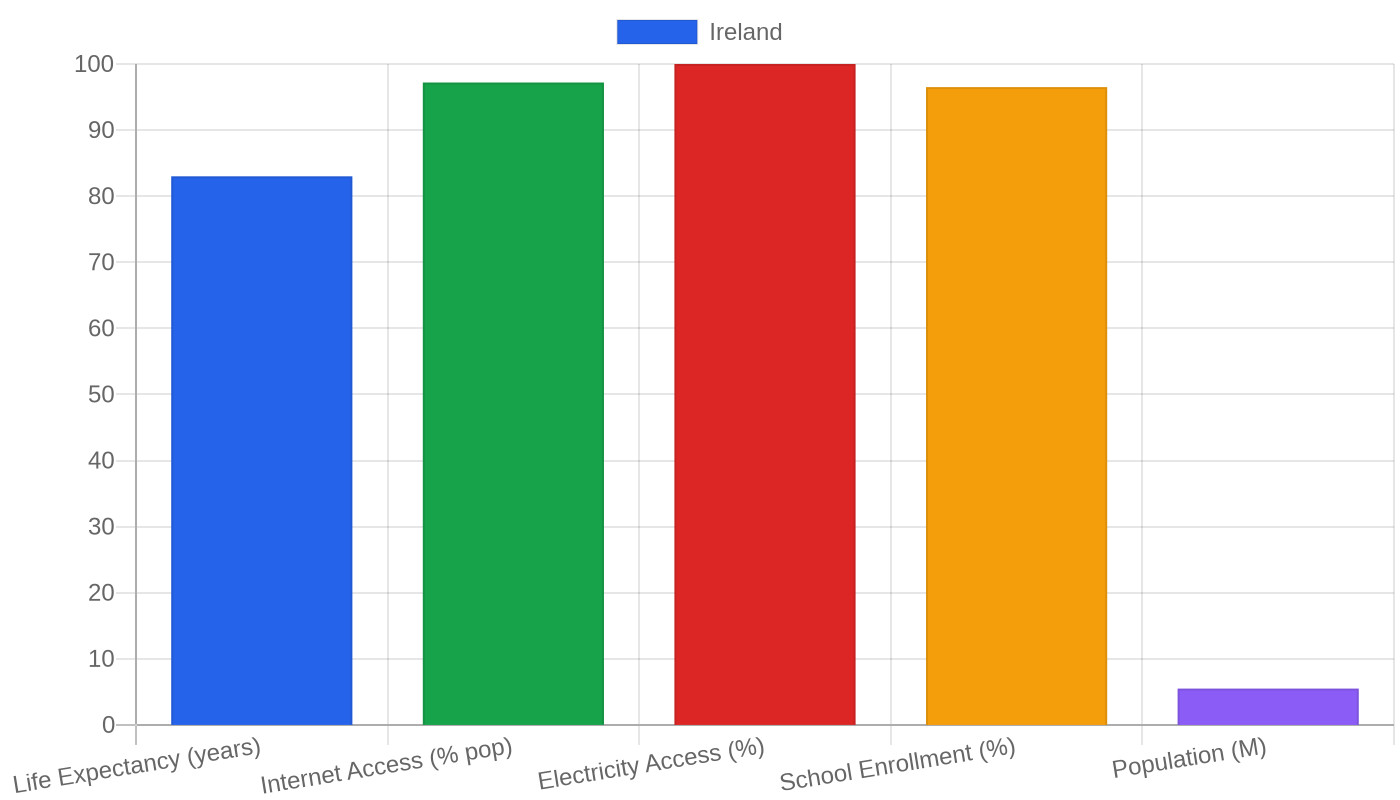
This is the story of Ireland’s split personality: a global hub for multinational capital that is struggling to translate that paper wealth into tangible quality of life for its 5.48 million citizens.
As the island’s political landscape remains defined by the unique partition between the Republic and Northern Ireland—with the open border and Common Travel Area facilitating free movement of people, goods, services and capital—the economic machine keeps humming, even as the social contract shows signs of wear.
Key Takeaways
– Astronomical GDP per capita: At $155,089 (PPP) according to World Bank data, Ireland’s headline wealth figure is among the highest globally, though this is heavily inflated by the presence of multinational corporate entities.
– A tale of two Irelands: The Republic and Northern Ireland share an open border and a Common Travel Area, but their economic realities are distinct, with the Republic’s economy dwarfing its UK-linked neighbor.
– Services and finance dominate: From Aer Lingus to Allied Irish Banks, the top companies are overwhelmingly in consumer services, industrials, and financials, reflecting a post-industrial economy.
– Population pressure: With a population of 5,484,367, Ireland is growing rapidly, intensifying demand for housing and public services.
– Structural challenges remain: Despite the headline wealth, the cost of living and housing availability are the defining domestic political issues.
The Wealth Illusion: GDP, Inflation, and the Multinational Factor
The World Bank’s latest data presents a fascinating statistical anomaly. While the GDP growth rate, inflation CPI, and unemployment figures are currently listed as N/A—a frustrating gap in the data—the GDP per capita (PPP) figure of $155,089.41 tells a compelling story. This number is not merely high; it is stratospheric, placing Ireland far above the average for the European Union. However, any serious economic journalist must immediately caveat this figure.
The “leprechaun economics” phenomenon—where multinational corporations book massive intellectual property and contract manufacturing profits in Ireland for tax purposes—means that a significant portion of this GDP is not actually circulating in the domestic economy. It is a measure of what is produced *within* the borders, not necessarily what is owned by or benefits the residents.
This distortion is critical to understanding the country’s economic health. While the GDP per capita suggests a nation of millionaires, the reality for the average worker is far more grounded. The GNI per capita—which excludes the profits of foreign multinationals—is a far more accurate measure of living standards, and while the data provided does not list it, the gap between GDP and GNI is known to be enormous.
The industries driving this growth are knowledge-intensive and capital-heavy: technology, pharmaceuticals, and financial services. The reliance on a handful of large foreign firms makes Ireland’s tax base vulnerable to global shifts in corporate tax policy. When the World Bank data is updated, we expect to see strong headline growth figures, but the underlying domestic economy—small businesses, construction, and domestic services—operates in a different, more modest lane.
The Housing Paradox: Prosperity Without Shelter
The most acute symptom of Ireland’s economic paradox is its housing market. With a population of 5.48 million and rising, the demand for housing has far outstripped supply for over a decade. The cost of living is heavily skewed by shelter costs; rent in Dublin is among the highest in the Eurozone, and homeownership rates are falling, particularly among the young.
The data provided does not offer specific rent indices, but the qualitative reality is visible in the political discourse and the strain on the construction sector.
The “rent vs. buy” calculation has become brutally simple: in most urban centers, it is now cheaper to buy than rent on a monthly basis, but the barrier is the deposit. High prices have made the property ladder inaccessible for many, leading to a surge in long-term renting and a generation living with insecurity. This is not a cyclical downturn but a structural shortage.
The government’s attempts to increase supply have been hampered by construction costs, planning delays, and infrastructure bottlenecks. The cost of groceries, energy, and services also remains elevated, eroding the high nominal wages that tech and finance jobs offer. For those not in the multinational sector—nurses, teachers, hospitality workers—the cost of living crisis is acute, creating a two-tier society where the headline GDP figures feel utterly disconnected from the daily reality of the rental market.
Investment & Business Climate: A Hub of Giants
For investors, Ireland remains an exceptionally attractive proposition. The top companies list provided reads like a who’s who of European and global business: Accenture, the global consulting giant, AerCap, the world’s largest aircraft leasing company, and Allied Irish Banks, a pillar of the domestic financial system. The presence of Aer Lingus, along with regional carriers like Aer Lingus Regional and ground transport providers like Aircoach, highlights the country’s role as a transatlantic gateway.
The business environment is characterized by a highly educated, English-speaking workforce, a common law legal system, and a pro-business regulatory framework that has successfully attracted foreign direct investment for decades.
The industrial makeup is bifurcated. On one hand, you have the “Industrials” sector—represented by Accenture and AerCap—which thrives on global trade and aviation. On the other, you have the “Consumer services” and “Utilities” sectors, represented by Abrakebabra, Airtricity, and An Post, which are deeply embedded in the domestic economy.
This split means that while the corporate tax base is booming, the domestic business climate is facing headwinds from high commercial rents and labor shortages. The presence of Airtricity as a top utility underscores the growing importance of renewable energy, a sector where Ireland has vast untapped offshore wind potential. The country is essentially a tax-efficient bridge between the American market and the European Union, a position that remains highly lucrative despite global pressure on corporate tax rates.
Safety, Politics & Quality of Life: Divided Island, Shared Space
The political landscape of Ireland is unique in Europe. The island is divided between the Republic—an independent state—and Northern Ireland, which remains part of the United Kingdom. The open border and the Common Travel Area, as noted in the data, facilitate free movement of people, goods, services, and capital, creating a unique economic zone that transcends political boundaries.
This arrangement, enshrined in post-Brexit agreements, is crucial for the economies on both sides of the border, allowing for seamless trade and labor mobility. For the Republic, this means a complex relationship with its nearest neighbor, balancing EU membership with the practicalities of the island’s shared economy.
In terms of safety and quality of life, the data provided does not include a specific Crime Index or Safety Index, but qualitative assessments suggest a relatively safe society by global standards, though urban areas face issues with drug-related crime and anti-social behavior. The quality of life is a mixed bag: access to green spaces and a strong community culture are positives, but the infrastructure—particularly public transport and healthcare—is under significant strain.
The political consensus in the Republic has shifted toward addressing these domestic deficits, with a focus on housing and public services. The peace process in Northern Ireland has held, and the economic integration across the border continues to be a stabilizing force, making the “island economy” a reality even as the political map remains divided.
What’s Happening Now: The Tectonic Shifts of 2026
Right now, Ireland is at a critical inflection point. The economy is facing the challenge of transitioning from a reliance on volatile corporate tax receipts to a more sustainable domestic model. There is intense political and social pressure to use the country’s fiscal surplus to address the chronic housing shortage and upgrade creaking infrastructure.
The government is under the microscope regarding how it spends the windfall from corporate taxes, with debates raging over the creation of a sovereign wealth fund versus immediate public spending. Domestically, the cost-of-living crisis remains the number one issue for voters, as inflation, while cooling, has left price levels permanently higher.
The business community is closely watching the implementation of the global minimum corporate tax rate, which threatens to erode Ireland’s competitive advantage. However, the country is pivoting, leveraging its stability and talent pool to attract investment in new sectors like renewable energy and data centers. The industrial presence of Airtricity in the top companies list signals a push toward green energy, but this is being hampered by grid capacity issues.
The political debate is also increasingly focused on migration and the strain on public services, a direct consequence of the population growth to 5.48 million. The relationship between Dublin and Brussels remains strong, but there is a growing tension between the need to maintain the open border with Northern Ireland and the EU’s external trade policies.
The next few quarters will be defined by whether Ireland can manage its success—a challenge that, while enviable, is proving to be just as difficult as managing decline.
The Bottom Line
Ireland is a must-watch for anyone interested in the future of the globalized economy. It is the ultimate test case for how a small, open economy can maintain its sovereignty and social cohesion in the face of massive capital inflows and external corporate influence. Investors should watch it for its continued—if evolving—tax advantages and its role as a gateway to the EU. Policy analysts should watch it for its innovative—and sometimes controversial—approaches to housing and industrial policy.
For the casual observer, it is a warning that a high GDP per capita does not automatically equate to a high standard of living for all. Ireland is a country that has successfully won the global game of attracting capital; its next challenge is to ensure that its citizens feel the victory.
Sources & Methodology
This article is authored by Economic Pulse Net for informational and research purposes. Economic Pulse Net sources its data from multilateral institutions, national statistics bureaus, and proprietary databases. All data is believed to be current as of the date of publication.
Published: August 15, 2026 | Category: Research — Ireland
Use these signals in your own platform
Economic Pulse publishes its live signal feed through a documented, read-only API. Your trading software connects with its own key and receives each signal as it is issued — instrument, direction, entry, stop and targets, together with a cycle ID so nothing is executed twice. The feed is independent of this website and cannot change it.
Signals are informational only and are not financial advice.