Economic Pulse Net | Sources: World Bank World Development Indicators, Government Sources | 2026
Key Takeaways
* Explosive Economic Expansion: Ireland is experiencing unprecedented GDP growth of over 12% in 2025, driven by a massive $721 billion economy and high-income status.
Stable Macro Fundamentals: Despite rapid growth, inflation remains controlled at roughly 2.2%, while unemployment sits at a healthy 4.6%.
Corporate Hub Status: The economy is anchored by global giants in services, industrials, and utilities, including Accenture, AerCap, and Allied Irish Banks.
Unique Geopolitical Context: The island’s division between the Republic of Ireland and Northern Ireland creates a complex but open-border economic zone within the Common Travel Area.
High Cost Environment: With a GNI per capita of $87,360 and significant PPP wealth, the cost of living is structurally higher than regional averages, reflecting a premium economy.
A Economy on Fire: Dissecting the Growth Engine
Ireland’s economic trajectory for 2025 is nothing short of spectacular, characterized by a GDP growth rate of 12.3375990291434%, according to World Bank data. This explosive expansion pushes the total Gross Domestic Product to an impressive $721,701,359,046.31 USD, positioning the nation as a heavyweight in the European economic landscape.
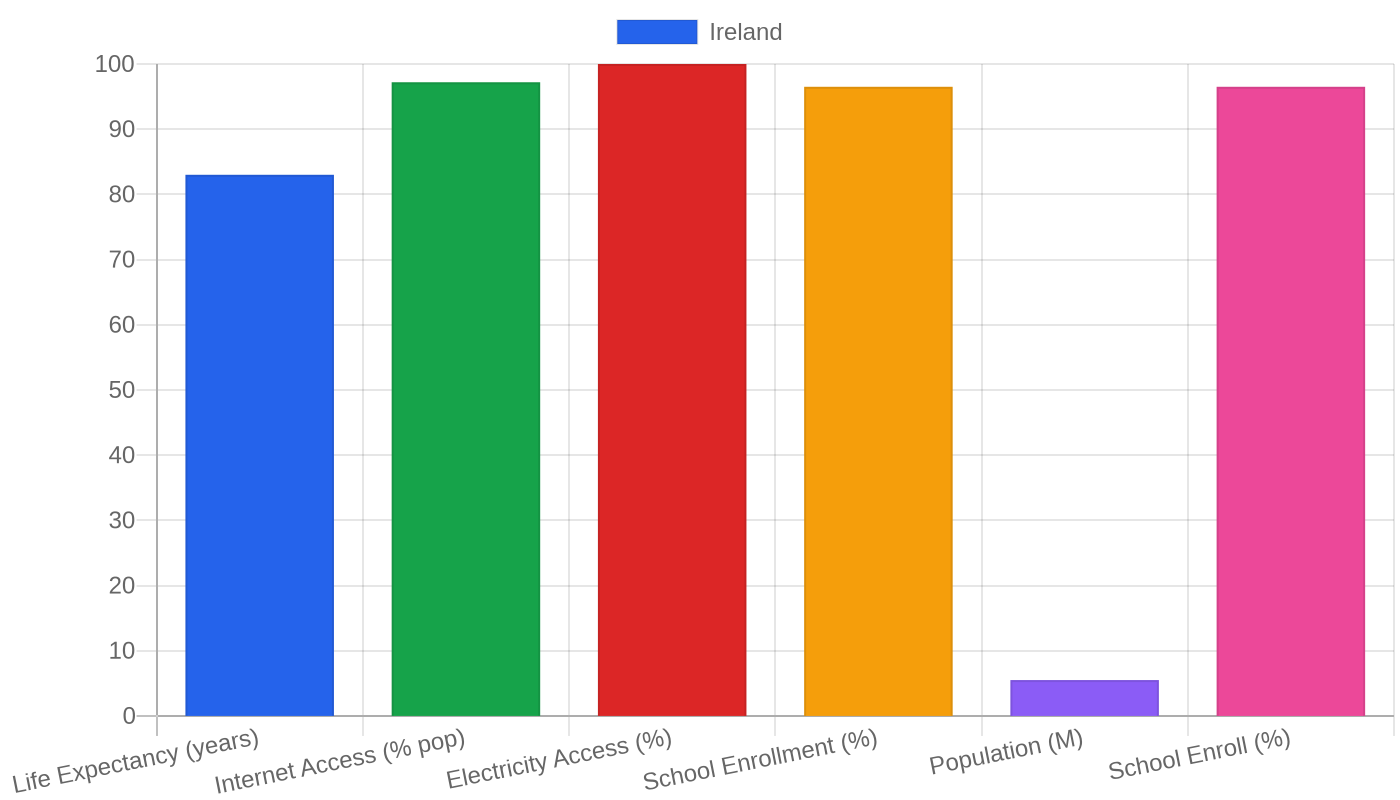
What makes these figures particularly striking is not just the volume of growth, but the underlying productivity; with a population of 5,484,367, the sheer output per head is substantial. The country boasts a GDP per capita (PPP) of $155,089.41, indicating that the average resident benefits from a standard of living significantly above global norms.
Furthermore, the Gross National Income (GNI) per capita stands at $87,360, underscoring the robustness of national earnings despite potential multinational profit repatriations. Crucially, this hyper-growth has not come at the expense of price stability; the Consumer Price Index (CPI) inflation rate is held steady at 2.21044788475857%, suggesting that demand is being met with supply without triggering runaway costs.
Additionally, the labor market remains tight yet stable, with an unemployment rate of 4.632%, allowing businesses to operate with minimal friction in hiring skilled workers. These metrics collectively paint a picture of a mature, high-efficiency economy that is currently outperforming many of its peers in both scale and sustainability.
Living Costs and the Premium of Prosperity
The economic success reflected in Ireland’s GDP figures inevitably translates into a higher cost of living environment for residents and expatriates alike. While specific housing indices are not detailed in the current dataset, the high GNI per capita of $87,360 and the PPP-adjusted GDP per capita of $155,089 suggest that daily expenses, rent, and property values are priced at a premium relative to lower-income economies.
In such a high-income jurisdiction, the baseline for consumer goods and services is naturally elevated, requiring households to manage budgets with a focus on value rather than mere affordability. For investors and business owners, this means that wage expectations and operational costs will be aligned with Western European standards, if not higher. However, the low inflation rate of approximately 2.2% provides some relief, preventing the erosion of purchasing power that often accompanies rapid economic booms.
Consequently, while the barrier to entry for lifestyle consumption is high, the overall economic health ensures that income levels generally keep pace with or exceed these costs, maintaining a positive net financial position for the majority of the workforce.
Corporate Powerhouses and Investment Climate
Ireland’s business landscape is dominated by a diverse array of major corporations that serve as pillars of the national economy, ranging from technology services to aviation and finance. Prominent entities include Accenture, which anchors the industrials sector with global consulting prowess, and AerCap, a leader in aircraft leasing that highlights the country’s strength in specialized industrial finance.
The consumer services sector is equally vibrant, featuring major players like Aer Lingus and its regional counterpart, alongside transport providers such as Aircoach and The Airporter, which facilitate both domestic connectivity and tourism. Financial stability is supported by Allied Irish Banks, ensuring that capital flows remain secure for domestic and international transactions.
Energy infrastructure is managed by Airtricity, providing the essential utility backbone required for industrial and residential operations. Other key contributors include An Post, which handles critical logistics and postal services, and Abrakebabra, representing the broader consumer service ecosystem.
This concentration of top-tier companies indicates a favorable investment climate where regulatory frameworks likely support large-scale corporate operations, making Ireland an attractive destination for foreign direct investment seeking a gateway to European markets.
Safety, Politics, and Quality of Life
Navigating the social and political fabric of Ireland requires an understanding of its unique geographical and historical context. The island is politically divided, with the Republic of Ireland operating as an independent state and Northern Ireland remaining a constituent country of the United Kingdom. Despite this division, the two jurisdictions share an open border and are part of the Common Travel Area, which guarantees free movement of people, goods, services, and capital across the internal boundary.
This arrangement fosters a unified economic zone that mitigates the traditional risks associated with hard borders, enhancing trade efficiency and social cohesion. Regarding personal security, specific crime and safety indices are listed as N/A in the current data set; however, the general stability implied by the strong economic indicators and open trade policies suggests a society focused on integration rather than isolation.
The absence of explicit conflict markers in the economic data reinforces the notion that daily life is governed by routine civic order and legal frameworks that protect both local citizens and international residents.
Current Affairs and Policy Shifts
The freshest developments in Ireland center on the interplay between its booming economic metrics and the logistical realities of managing a high-growth environment. With GDP expanding by more than 12% in 2025, policymakers and business leaders are likely focused on sustaining this momentum while keeping inflation anchored near the 2.2% target.
The presence of major multinationals like Accenture and AerCap suggests that ongoing reforms may be geared toward maintaining tax competitiveness and regulatory agility to attract continued corporate headquarters. Meanwhile, the operational resilience of sectors like aviation (Aer Lingus) and utilities (Airtricity) points to active investments in infrastructure to support population growth and industrial output.
The seamless flow of goods and services across the open border with Northern Ireland remains a critical policy achievement, ensuring that supply chains are not disrupted by geopolitical tensions. As the year progresses, attention will likely turn to how the government manages the distribution of wealth generated by this high GDP, given the disparity between GDP per capita and GNI per capita, to ensure broad-based prosperity.
The Bottom Line
Ireland presents a compelling case for investors and economists alike, offering a rare combination of double-digit GDP growth and controlled inflation. The presence of global industry leaders and a highly educated workforce supports a business environment that is both dynamic and stable. While the cost of living reflects the nation’s high-income status, the underlying economic fundamentals provide a strong buffer against volatility.
For stakeholders looking for exposure to a resilient, high-growth European market with deep corporate ties, Ireland is a priority destination worth monitoring closely.
Sources & Methodology
This article is authored by Economic Pulse Net for informational and research purposes. Economic Pulse Net sources its data from multilateral institutions, national statistics bureaus, and proprietary databases. All data is believed to be current as of the date of publication.
Published: October 01, 2026 | Category: Research — Ireland
Use these signals in your own platform
Economic Pulse publishes its live signal feed through a documented, read-only API. Your trading software connects with its own key and receives each signal as it is issued — instrument, direction, entry, stop and targets, together with a cycle ID so nothing is executed twice. The feed is independent of this website and cannot change it.
Signals are informational only and are not financial advice.