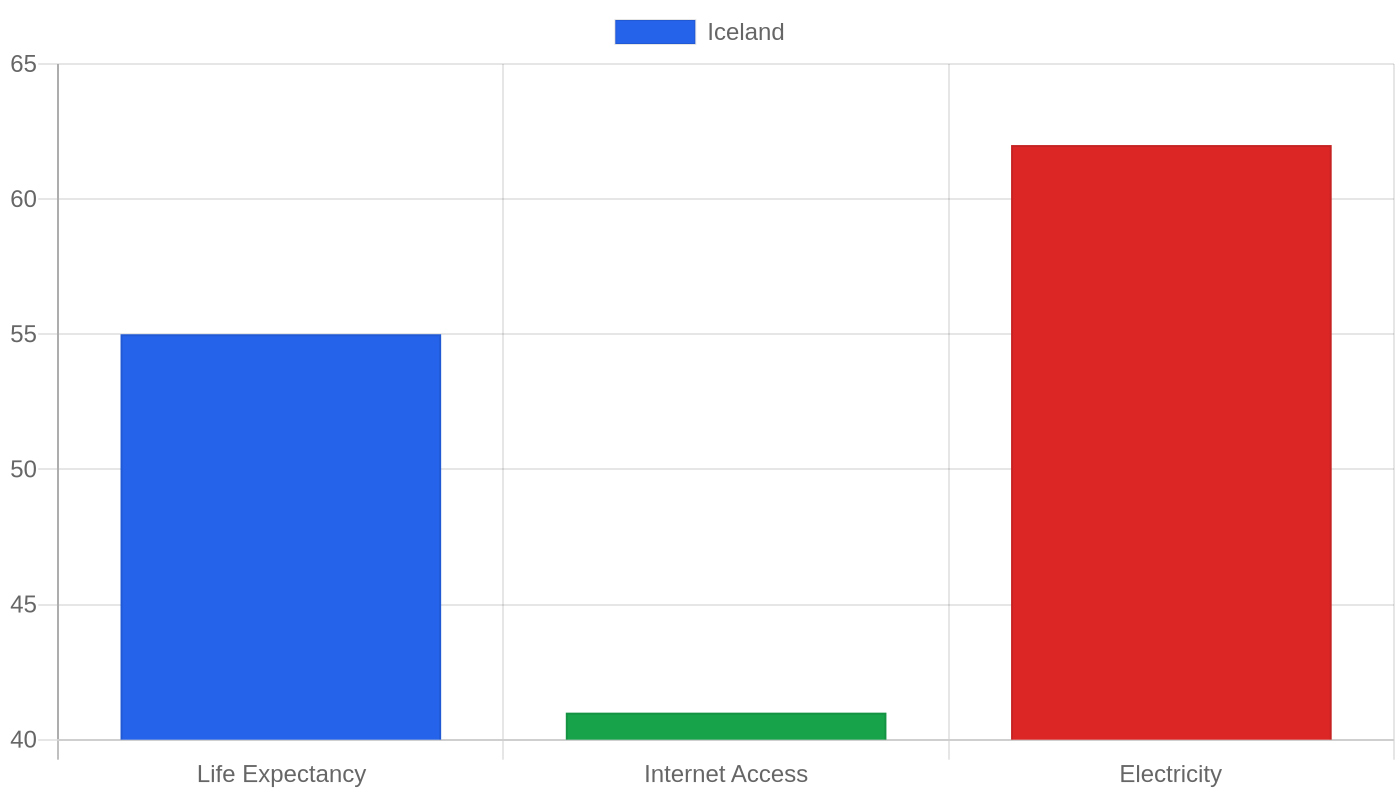
Economic Pulse Net | Sources: World Bank World Development Indicators, Government Sources | 2026
Key Takeaways
– Iceland’s economy, historically reliant on aluminium smelting and the fishing industry, is undergoing a significant structural shift toward high-tech, knowledge-based sectors, with companies like deCODE genetics and CCP Games leading the charge.
– The nation’s political system, a parliamentary representative democratic republic with a multi-party framework, emphasizes proportional representation, creating a consensus-driven approach to governance that impacts economic policy.
– Iceland’s unique state-owned enterprises, such as the ÁTVR alcohol monopoly, highlight a distinct Nordic model where the state plays a significant role in certain markets.
– Despite the lack of current headline macroeconomic figures, the composition of Iceland’s top companies reveals a dynamic business environment where innovation in carbon capture, software, and specialized vehicles coexists with traditional retail and media.
– The country’s small, open economy makes it highly sensitive to global commodity prices and exchange rate fluctuations, while its political stability and high safety standards provide a resilient foundation for business.
The Great Diversification: Beyond Fish and Aluminium
While the World Bank’s latest data set does not provide specific figures for Iceland’s GDP growth, inflation, or unemployment, the country’s economic narrative is far from opaque. For decades, the Icelandic economy was a textbook case of resource dependence, leaning heavily on the North Atlantic cod fisheries and an abundance of geothermal and hydroelectric energy that powered heavy industry, particularly aluminium smelting.
However, the most telling indicator of Iceland’s current trajectory lies not in the quarterly statistics, but in the roster of its most prominent companies. The presence of deCODE genetics (Íslensk erfðagreining ehf) signals a mature biotech sector that has put Iceland on the global map for genomic research, leveraging the nation’s isolated gene pool for breakthroughs in disease understanding.
This pivot towards a knowledge economy is reinforced by the success of CCP Games (CCP hf), the developer behind the iconic EVE Online, which has proven that a company based in Reykjavik can compete on the global stage in the competitive video game industry. Alongside these tech flagships, **Carbon Recycling International** represents a forward-thinking approach to environmental economics, turning CO2 emissions into methanol and positioning Iceland as a testbed for the circular economy.
This is not merely a story of replacing old industries with new; it is a layering of complex, high-value sectors onto the traditional base. The fishing industry remains the backbone of export revenues, but the future growth is clearly being driven by intellectual capital, software engineering, and green technology, a diversification that makes the economy more resilient to the boom-and-bust cycles of commodity prices.
The Nordic Price Tag: Navigating a High-Cost Reality
Any discussion of Iceland’s economic landscape must confront the reality of its cost of living, which is notoriously among the highest in Europe. While specific index figures are not provided in the current data, the composition of the top companies list offers indirect evidence of this.
The presence of Bónus, a discount supermarket chain, as one of the nation’s leading firms underscores a crucial dynamic: even in a country with high average wages, price sensitivity is a major consumer concern, and the retail sector is fiercely competitive. The high cost of goods is a direct consequence of the country’s geographic isolation and small population, which limits economies of scale and necessitates a heavy reliance on imports for everything from foodstuffs to manufactured goods.
This high-cost environment presents a unique challenge for the workforce. While salaries are generally robust to compensate for the expense, the gap between the cost of housing and daily necessities versus net income remains a persistent political and social issue. The state-owned ÁTVR (Áfengis- og tóbaksverslun ríkisins) monopoly on alcohol sales is a classic example of a Nordic fiscal policy aimed at curbing consumption while simultaneously generating significant state revenue through high excise taxes.
For the average resident, this means that everyday life requires careful budgeting, and the cost of a night out or a simple grocery shop can be a shock to foreign visitors. This economic reality creates a unique consumer culture where efficiency and value for money are paramount, a fact that is clearly reflected in the market dominance of discount retailers.
Where Innovation Meets the Elements: The Business Climate
The Icelandic business climate is defined by a small, agile domestic market that forces companies to look outward for growth. The presence of Advania (Advania ehf) as a leading IT services company demonstrates a mature digital infrastructure and a domestic capacity for high-level tech support, which is crucial for attracting foreign investment.
Meanwhile, **Arctic Trucks** (Arctic Trucks Ísland ehf) has carved out a global niche by modifying vehicles for extreme off-road conditions, a business born directly out of the necessity of navigating Iceland’s harsh terrain. This ability to turn geographical challenges into global export products is a hallmark of Icelandic entrepreneurship.
The media landscape, represented by **365** (365 – miðlar ehf), shows a consolidated but vibrant domestic media market, while **Dagsbrún** (Dagsbrún ehf) and **Air Iceland** (Flugfélag Íslands ehf) highlight the importance of logistics, transport, and internal connectivity.
For investors, the absence of a large domestic consumer base means that the most attractive opportunities lie in sectors where Iceland has a unique competitive advantage: renewable energy, data centers, biotechnology, and tourism-related services. The government’s political structure, a parliamentary representative democratic republic with a multi-party system, fosters a collaborative political environment, though it can also lead to slower policy implementation.
However, this consensus-driven approach provides a high degree of political stability, which is a significant asset for long-term investors. The focus on proportional representation ensures that a variety of voices are heard in the Althing (parliament), which helps maintain social cohesion and support for the welfare state, a key component of the business environment’s social license to operate.
Safety, Stability, and the Social Contract
Iceland consistently ranks as one of the safest and most peaceful countries on Earth, a reputation that is integral to its quality of life and its appeal as a destination for both tourists and skilled expatriates. While the specific Crime and Safety Indices are not filled in the current data, the country’s political description as a “parliamentary representative democratic republic” with a “multi-party system” points to a mature, stable governance structure.
The president serves as the head of state, while the prime minister is the head of government, a division of powers that ensures a balance between ceremonial leadership and executive action. This political framework, combined with a strong social safety net, contributes to a society with low levels of social tension and high levels of trust in public institutions.
This high level of social trust is the invisible currency of the Icelandic economy. It lowers transaction costs for businesses, reduces the need for extensive legal oversight, and creates an environment where innovation can flourish without fear of excessive bureaucratic friction. The quality of life is intrinsically linked to the natural environment, with the population enjoying clean air, abundant geothermal pools, and unspoiled wilderness.
While the cost of living is high, the return on that investment is a society that is safe, educated, and politically engaged. This unique social contract makes Iceland an attractive hub for research and development, as it can draw top-tier talent from around the world who are willing to trade a lower absolute salary for a significantly higher quality of life.
The Road Ahead: Navigating a Post-Pandemic World
Right now, Iceland is in a period of recalibration, finding its footing in a post-pandemic world where the travel boom has subsided. The current data does not provide a live snapshot of inflation or unemployment, but the composition of the top companies suggests where the economy is heading. The continued prominence of Carbon Recycling International is particularly telling, as it aligns with the global push for ESG (Environmental, Social, and Governance) investing and the European Union’s Green Deal.
Iceland is positioning itself not just as a country that uses renewable energy, but as a leader in the technology that makes the green transition possible for others. This is a strategic pivot from being a consumer of green energy to an exporter of green solutions.
The business landscape is also adapting to the new realities of remote work and digital nomadism. With Advania providing world-class IT infrastructure, the country is well-placed to attract a new class of remote workers who are looking for a safe, unique, and connected base. However, the pressure on the housing market and infrastructure from the previous tourism boom has not fully abated, and the government is likely to focus on sustainable growth rather than explosive expansion.
The challenge for the coming years will be to manage the transition from a tourism-led recovery to a more diversified, knowledge-led economic model. This involves not only supporting the tech sector but also ensuring that traditional industries like fishing and aluminium remain competitive in a changing global market, all while maintaining the social and environmental standards that define the nation.
The Bottom Line
Iceland is a high-stakes, high-reward economy that has successfully used its geographic isolation to build a unique competitive advantage in technology, renewable energy, and specialized services. For investors, the country offers a stable political environment and a skilled workforce, but the small market size means that success requires a global outlook from day one.
For policymakers and economists, Iceland serves as a fascinating case study in how a small nation can pivot from resource extraction to a knowledge-based economy. It is a country to watch for its innovative corporate players, particularly in the green tech and biotech sectors, as they are likely to punch far above their weight on the global stage.
Sources & Methodology
This article is authored by Economic Pulse Net for informational and research purposes. Economic Pulse Net sources its data from multilateral institutions, national statistics bureaus, and proprietary databases. All data is believed to be current as of the date of publication.
Published: August 04, 2026 | Category: Research — Iceland
Use these signals in your own platform
Economic Pulse publishes its live signal feed through a documented, read-only API. Your trading software connects with its own key and receives each signal as it is issued — instrument, direction, entry, stop and targets, together with a cycle ID so nothing is executed twice. The feed is independent of this website and cannot change it.
Signals are informational only and are not financial advice.