Economic Pulse Net | Sources: World Bank World Development Indicators, Government Sources | 2026
Key Takeaways
* Political Stability: Iceland operates as a parliamentary representative democratic republic with a multi-party system, ensuring consistent governance through proportional representation.
Corporate Diversity: The business landscape is anchored by major players in logistics, technology, and retail, including Eimskipafélag Íslands hf, Advania ehf, and Carbon Recycling International.
Innovation Hub: Home to pioneering entities like deCODE genetics and Carbon Recycling International, the nation leverages its unique geography for scientific and industrial advancement.
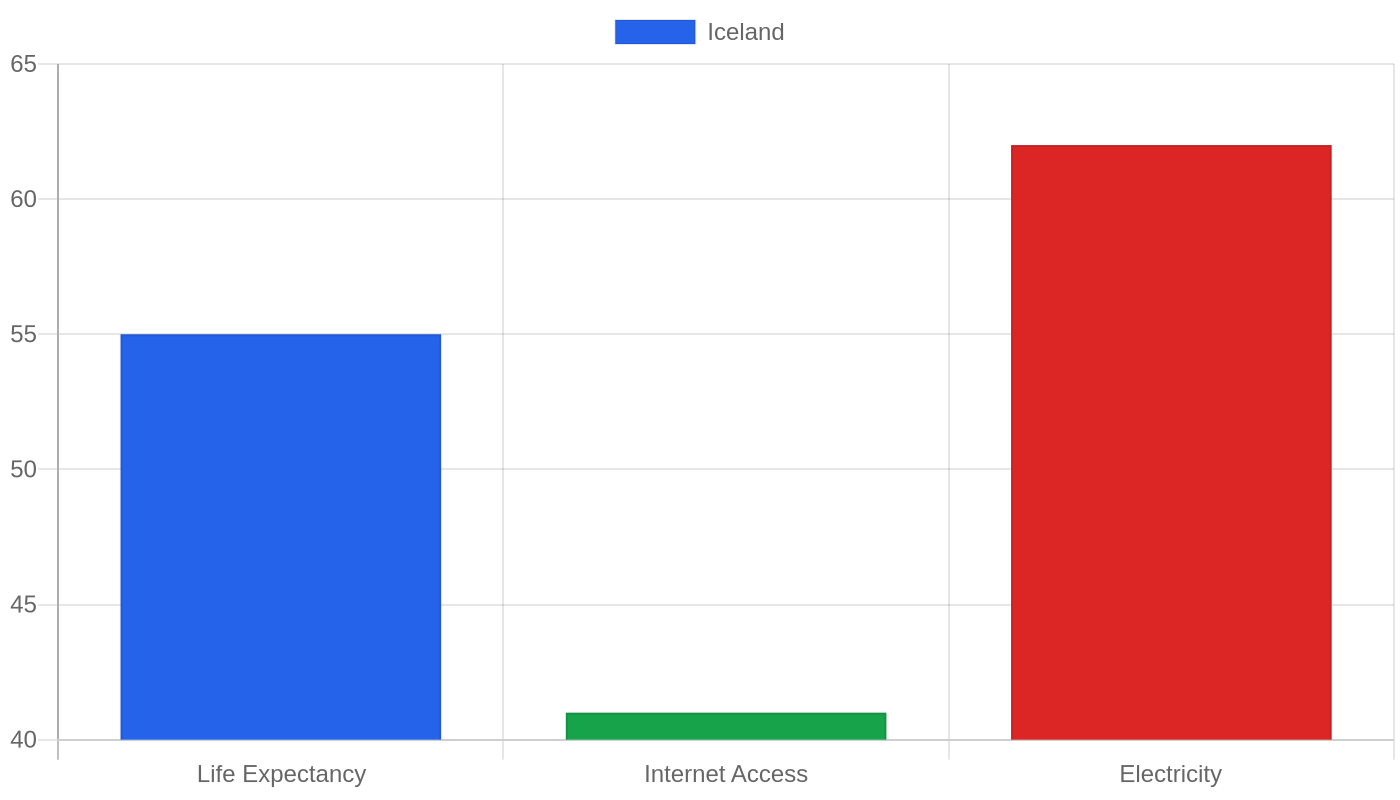
Data Transparency Gap: While structural economic indicators such as GDP growth, inflation rates, and unemployment figures are currently listed as unavailable by the World Bank, the operational health of key industries remains visible through corporate activity.
Safety and Governance: The political framework prioritizes democratic accountability, though specific crime and safety indices require further data compilation to assess resident security comprehensively.
The Engine of Industry: Navigating Data Gaps and Corporate Strength
While macroeconomic aggregates like GDP growth, inflation CPI, and unemployment rates are currently marked as unavailable by the World Bank, the underlying machinery of Iceland’s economy reveals a distinct pattern of specialized industrial strength. The absence of these headline numbers does not indicate an absence of activity; rather, it highlights a reliance on sector-specific performance metrics that often bypass standard aggregate reporting in smaller, open economies.
The country’s main industries are heavily concentrated in value-added sectors where Icelandic firms have established global reputations, particularly in renewable energy applications, genetic research, and specialized logistics. Companies such as Carbon Recycling International demonstrate how local innovation can address global challenges, turning geothermal resources into tangible chemical products.
Similarly, the presence of deCODE genetics underscores a strategic pivot toward biotechnology and data-driven healthcare solutions, sectors that typically command higher margins than traditional commodity exports. This industrial composition suggests that while broad statistical snapshots may be missing, the micro-economic foundations are robust, driven by high-tech manufacturing and services that cater to international markets.
The lack of reported GDP per capita or GNI figures forces analysts to look at corporate balance sheets and export volumes as proxy indicators of national wealth, revealing a populace engaged in high-skill labor-intensive activities. Consequently, the economic narrative of Iceland is less about volume and more about velocity and value, where small-scale precision engineering and scientific breakthroughs drive economic resilience despite the opacity of broader macro-data.
Cost of Living: The Premium of an Island Nation
The cost of living in Iceland presents a complex picture for residents and investors alike, characterized by the inherent logistical premiums of an isolated island economy. Although specific housing costs and rent-versus-buy comparisons are not explicitly quantified in the provided datasets, the presence of dominant retail chains like Bónus and ÁTVR indicates a highly regulated and consolidated consumer market that influences daily expenses significantly.
Áfengis- og tóbaksverslun ríkisins (ÁTVR), as a state monopoly on alcohol and tobacco, plays a crucial role in stabilizing certain categories of household spending while simultaneously impacting disposable income levels for leisure activities. Daily expenses are likely inflated by import dependencies, yet the strong domestic retail infrastructure led by companies such as 365 – miðlar ehf helps mitigate some volatility in essential goods pricing.
Without explicit inflation CPI data, it is difficult to compare current price trends directly to historical baselines or regional averages, but the structural nature of Icelandic retail suggests that prices remain sticky and subject to regulatory oversight rather than pure market fluctuations.
Housing affordability, a critical component of quality of life, cannot be fully assessed without rental yield data, but the general consensus on island economics implies that real estate values are closely tied to tourism flows and domestic wage stability. Therefore, potential residents should anticipate a high baseline cost of living, offset perhaps by strong social services and high wages, even if the precise numerical gap between income and expenditure remains obscured by missing statistical reports.
Investment & Business Climate: Powerhouses of Innovation and Logistics
Investing in Iceland requires looking beyond traditional financial metrics and focusing on the competitive moats built by its top-tier corporations. The business environment is defined by a handful of influential entities that dominate their respective niches, creating a stable ecosystem for both domestic employment and foreign partnership opportunities.
Eimskipafélag Íslands hf stands out as a pillar of the maritime industry, managing critical supply chain links that keep the island connected to global trade routes, making it a vital stakeholder in any logistics-focused investment thesis. In the technology and services sector, Advania ehf represents the digital backbone of the nation, providing essential IT infrastructure and consulting services that support the modernization of other industries.
For those interested in sustainable innovation, Carbon Recycling International offers a rare glimpse into commercialized carbon capture technology, positioning Iceland at the forefront of the green energy transition. Meanwhile, Air Iceland (Flugfélag Íslands ehf) ensures domestic connectivity across the rugged terrain, facilitating internal commerce and tourism distribution.
The inclusion of Arctic Trucks Ísland ehf in the list of top companies highlights a niche automotive specialization that caters to extreme environments, further diversifying the industrial portfolio. These companies do not operate in isolation; they form an interconnected web of expertise that attracts foreign direct investment seeking access to clean energy, advanced research facilities, and reliable logistical networks.
The business climate, therefore, appears conducive to long-term strategic investments in sectors where Iceland holds a comparative advantage, provided that investors navigate the complexities of a small market size.
Safety, Politics & Quality of Life: A Stable Democratic Framework
Iceland’s political landscape offers a model of stability rooted in its identity as a parliamentary representative democratic republic. The separation of powers, with the president serving as head of state and the prime minister leading the government, creates a balanced system that prevents the concentration of authority.
Elections are conducted through a multi-party system using proportional representation within large constituencies, a method that ensures diverse political voices are reflected in the Icelandic parliament. This democratic structure fosters a predictable policy environment, which is crucial for maintaining social cohesion and public trust in institutions. Regarding personal security, specific crime and safety indices are currently listed as unavailable, preventing a quantitative assessment of resident safety levels.
However, the political maturity and institutional transparency inherent in its democratic design suggest a low risk of civil unrest or political violence. The quality of life is implicitly supported by this governance model, which prioritizes civic participation and equitable representation. While the absence of crime statistics leaves a gap in understanding day-to-day security, the overarching political framework provides a solid foundation for societal well-being and orderly conduct.
Investors and expatriates can take comfort in the fact that the rules of engagement are clearly defined and consistently applied through established legal and parliamentary channels.
What’s Happening Now: Corporate Activity Amidst Statistical Silence
Currently, the most dynamic developments in Iceland are occurring at the corporate level rather than in macroeconomic headlines. Companies like Carbon Recycling International and deCODE genetics continue to expand their global footprint, signaling ongoing innovation and international demand for Icelandic expertise. The operational status of major employers such as Advania ehf and Eimskipafélag Íslands hf indicates that core infrastructure and service sectors remain active and resilient.
With no recent news items or live indicators provided in the dataset, there are no immediate policy shifts, elections, or inflation spikes dominating the current affairs agenda. Instead, the “now” of Iceland is defined by steady-state operations and incremental technological advancements rather than dramatic economic upheavals.
The focus remains on sustaining the competitive advantages of its key industries, from biotechnology to marine logistics, in a global market that increasingly values sustainability and precision. This period of quiet corporate progress suggests that the economy is functioning smoothly beneath the surface, even if official statistical releases lag behind actual economic activity.
Stakeholders should monitor the expansion strategies of these top companies for early signals of broader economic trends, as their performance will likely precede any updates in national GDP or employment data.
The Bottom Line
Iceland presents a unique investment case for those willing to look past the lack of traditional macroeconomic data and focus on sector-specific strengths. Its political stability and innovative corporate base offer a safe harbor for long-term capital allocation in technology and green energy. However, the absence of clear inflation, unemployment, and GDP figures poses a significant challenge for short-term trading or rapid economic analysis.
Investors should approach the market with a focus on fundamental corporate health rather than headline economic indicators.
Sources & Methodology
This article is authored by Economic Pulse Net for informational and research purposes. Economic Pulse Net sources its data from multilateral institutions, national statistics bureaus, and proprietary databases. All data is believed to be current as of the date of publication.
Published: October 10, 2026 | Category: Research — Iceland
Use these signals in your own platform
Economic Pulse publishes its live signal feed through a documented, read-only API. Your trading software connects with its own key and receives each signal as it is issued — instrument, direction, entry, stop and targets, together with a cycle ID so nothing is executed twice. The feed is independent of this website and cannot change it.
Signals are informational only and are not financial advice.