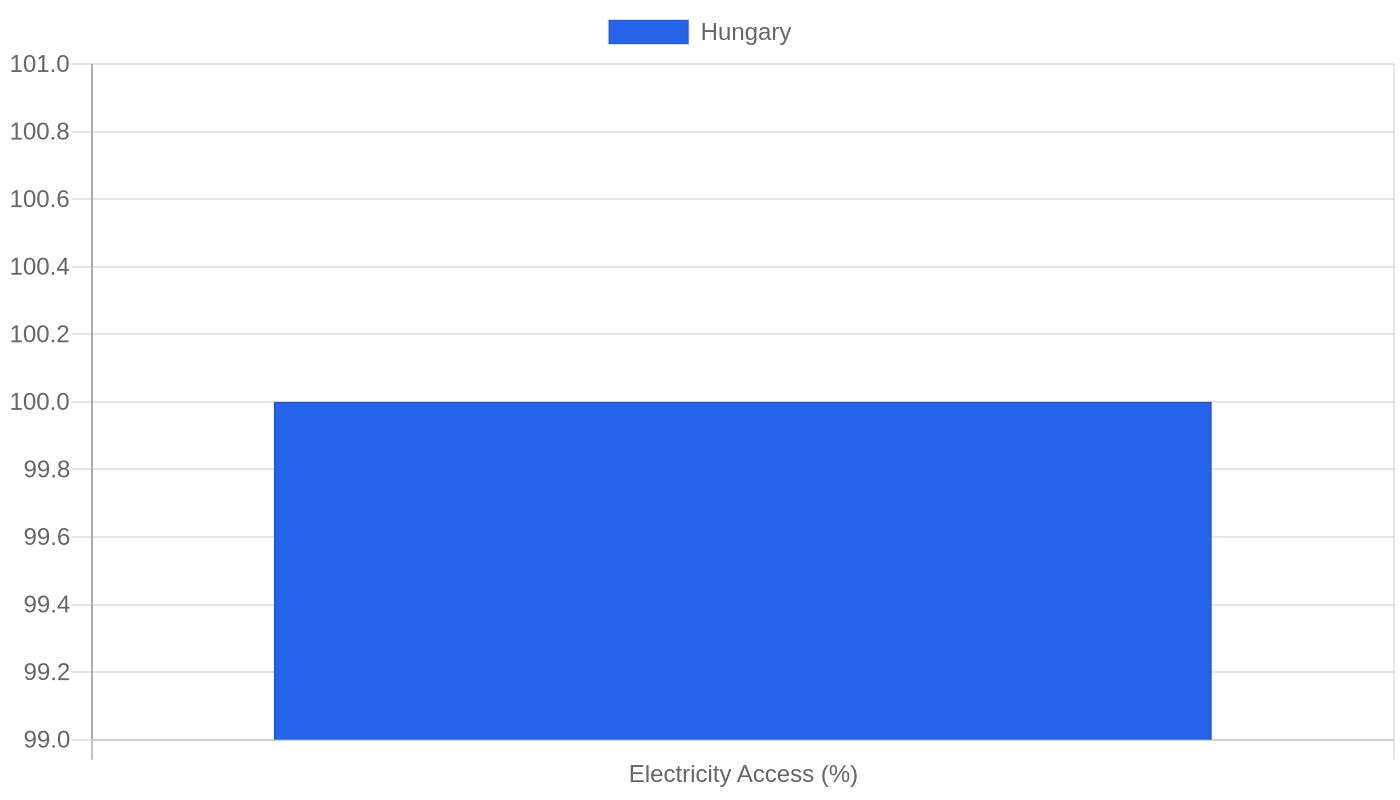
Economic Pulse Net | Sources: World Bank World Development Indicators, Government Sources | 2026
Key Takeaways
– Political Supermajority Shapes Economics: Hungary’s two-thirds parliamentary majority, rooted in the 2012 Fundamental Law, creates a uniquely stable—but controversial—policy environment where economic direction is set with minimal political friction.
– A Services and Manufacturing Hybrid: From telecommunications giants like 4iG to heritage consumer brands like Ajka Crystal and Borsod Brewery, Hungary’s corporate landscape straddles high-tech ambition and traditional industry.
– Consumer-Services Heavy Economy: The presence of major players like CBA and BKV Zrt. highlights a domestic market driven by internal consumption and public services, not just export-oriented manufacturing.
– Constitutional Constraints as Economic Guardrails: The “eternity clauses” protecting rule of law and separation of powers remain legally untouchable, even as the government tests their practical limits.
– A Nation in the EU’s Crosshairs: Hungary’s political trajectory continues to define its economic relationships, with investors watching how constitutional politics translate into fiscal and regulatory reality.
The Fundamental Law of Growth — Reading Between the Data Lines
The World Bank’s latest snapshot of Hungary presents an intriguing puzzle: headline indicators for GDP growth, inflation, and unemployment are currently unquantified in the global database, leaving analysts to piece together the country’s trajectory from structural clues rather than lagging statistics.
What is clear is that Hungary operates as a unitary parliamentary republic whose constitutional framework—the Fundamental Law, heavily reformed in 2012—creates a distinctive political economy that few European peers can match. The requirement of a **two-thirds parliamentary supermajority** for constitutional amendments means that when the ruling coalition moves, it moves decisively, with direct implications for tax policy, investment incentives, and regulatory stability.
The corporate landscape tells a story of surprising diversity beneath the political headlines. 4iG has positioned itself as a telecommunications powerhouse, betting on digital infrastructure as the backbone of future growth. Meanwhile, **BorsodChem** represents the basic materials sector, sensitive to European industrial cycles, and **Budapest Bank** anchors a financial sector navigating the complexities of EU regulatory frameworks and domestic lending preferences.
The presence of **AstridBio** in healthcare signals an ambition to move up the value chain into life sciences, though the sector remains nascent compared to Western European peers. What emerges is an economy attempting to balance its industrial heritage—chemicals, brewing, glassware—against the demands of a digital, services-oriented future.
The World Bank’s silence on aggregate growth figures does not diminish the observable reality: Hungary is a mid-sized European economy with outsized political significance, whose economic choices reverberate well beyond the Carpathian Basin.
Housing, Groceries, and the Cost of Everyday Life
The cost of living in Hungary occupies a curious middle ground within the European context, though precise comparative figures remain elusive in the current data set. What can be observed is the structural composition of the economy: with CBA operating as a dominant consumer services retailer, domestic consumption patterns are shaped by an extensive network of local shops and supermarkets that cater to price-sensitive Hungarian households.
The presence of **Borsod Brewery** and **Ajka Crystal** in the consumer goods space suggests that everyday spending extends beyond necessities into discretionary items—beer, home goods, and traditional crafts—that anchor middle-class consumption habits.
Housing dynamics in Budapest and other major cities have been shaped by the same political-economic forces that define the broader market. The prominence of BKV Zrt. , the Budapest public transport company, indicates that urban living remains heavily reliant on public infrastructure rather than private car ownership, a factor that influences where people choose to live and how they budget their monthly expenses.
For the average Hungarian family, the balance between rent and purchase remains a function of interest rates set within an EU context, though the domestic banking sector, including players like **Budapest Bank**, has developed tailored mortgage products for local conditions. The broader picture is of a society where the cost of living is manageable by Western standards but increasingly strained by the same inflationary pressures affecting the entire European continent.
The Business of Being Hungary — Investment and Corporate Power
For investors surveying Hungary’s corporate terrain, the landscape offers both opportunity and complication. 4iG stands out as the most dynamic player, aggressively expanding its telecommunications footprint in a sector that governments across Europe have identified as strategic.
**ASL Airlines Hungary** and **Budapest Aircraft Service** represent the aviation services niche, connecting the country to broader European travel and logistics networks—a sector that has shown resilience even as global economic headwinds persist. The financial sector, anchored by **Budapest Bank**, operates within the dual constraints of EU banking regulations and a domestic political environment that has occasionally clashed with international financial institutions.
The business climate is fundamentally shaped by the constitutional architecture. The Fundamental Law’s eternity clauses—protecting human dignity, separation of powers, state structure, and rule of law—create legal boundaries that even a supermajority government cannot cross, offering some reassurance to investors concerned about arbitrary state action.
However, the same political concentration that enables rapid decision-making also introduces uncertainty for international partners who must navigate a regulatory environment that can shift with parliamentary winds. For domestic companies like **BorsodChem**, the challenge is maintaining competitiveness in basic materials against cheaper imports, while consumer-facing firms like **CBA** benefit from a government that has shown willingness to protect local retail interests against foreign competition.
Safety, Politics, and the Quality of Life Paradox
The crime and safety indices for Hungary remain unquantified in current data, but the political landscape offers its own indicators of social stability. The Fundamental Law’s structure—with its entrenched constitutional protections—provides a legal framework that has maintained order even as political debates grow heated.
Hungary’s position as a unitary state means that policy implementation is consistent across regions, reducing the fragmentation that can complicate quality of life in federal systems. The presence of major public service employers like **BKV Zrt.** suggests that state provision of essential services remains robust, contributing to a sense of security for residents.
Quality of life in Hungary is inextricably linked to its political identity within Europe. The country’s constitutional journey since 2012 has made it a focal point of EU debates about democratic standards, rule of law, and the limits of national sovereignty within supranational structures.
For ordinary Hungarians, these abstract constitutional questions translate into concrete experiences: the availability of public services, the predictability of the legal environment, and the sense that their government operates within recognized boundaries. The eternity clauses are not merely legal technicalities—they represent a commitment to certain fundamental principles that shape everyday life, from contract enforcement to property rights to the treatment of minorities.
The Supermajority’s Next Move — Current Affairs and Political Economy
The most pressing question for Hungary’s economic future is how the ruling coalition will use its parliamentary dominance in the coming period. The Fundamental Law’s amendment requirements mean that the current government possesses the constitutional capacity to reshape economic institutions with minimal opposition—a power that has been used to influence sectors from banking to media to energy.
The presence of **4iG** as a government-adjacent telecommunications champion suggests a pattern of building national champions in strategic industries, a policy approach that continues to draw scrutiny from EU competition authorities.
The political calendar looms over economic decision-making. With the constitutional framework firmly established and the two-thirds majority intact, the government’s policy space is theoretically vast, bounded only by the eternity clauses and the practical constraints of EU membership. Investors and observers are watching whether the next phase will emphasize economic liberalization to attract foreign capital, or continued state-directed investment in favored sectors.
The evolution of **Budapest Bank** and other financial institutions will be a key indicator—whether they move toward greater integration with European financial markets or serve primarily as instruments of domestic policy. For now, Hungary remains a laboratory for a distinctive model of European governance, one that continues to test the boundaries of what is possible within the EU’s legal and economic framework.
The Bottom Line
Hungary demands attention from anyone interested in the future of European political economy. It represents a working example of how a constitutional supermajority can reshape economic institutions while remaining within formal legal constraints. For investors, the country offers access to a diversified economy with strengths in telecommunications, materials, and consumer services—but requires careful navigation of a political environment that rewards domestic connections.
For policymakers, Hungary is the test case for whether a member state can chart a genuinely alternative path within the EU’s single market. Watch Hungary not for its aggregate numbers, but for what it reveals about the limits and possibilities of national economic sovereignty in an integrated Europe.
Sources & Methodology
This article is authored by Economic Pulse Net for informational and research purposes. Economic Pulse Net sources its data from multilateral institutions, national statistics bureaus, and proprietary databases. All data is believed to be current as of the date of publication.
Published: August 15, 2026 | Category: Research — Hungary
Use these signals in your own platform
Economic Pulse publishes its live signal feed through a documented, read-only API. Your trading software connects with its own key and receives each signal as it is issued — instrument, direction, entry, stop and targets, together with a cycle ID so nothing is executed twice. The feed is independent of this website and cannot change it.
Signals are informational only and are not financial advice.