Economic Pulse Net | Sources: World Bank World Development Indicators, Government Sources | 2026
🇬🇷 Greece 2026 — Resilience and Reform in the Heart of the Mediterranean
Key Takeaways
* Steady Growth Trajectory: Greece is projected to achieve a GDP growth rate of approximately 2.07% in 2025, signaling a consistent recovery path following years of structural adjustment.
Strong Purchasing Power: With a GDP per capita (PPP) of roughly $45,263, the average Greek citizen enjoys a standard of living that significantly outpaces nominal income figures, reflecting robust internal consumption power.
Labor Market Stabilization: The unemployment rate has settled at 8.54%, indicating a gradual but steady normalization of the labor market after decades of volatility.
Political Continuity: Operating under the 1975 parliamentary republic constitution, the nation maintains a stable framework of civil liberties and separation of powers, providing a predictable environment for long-term planning.
Economic Engine: Navigating Post-Crisis Stability
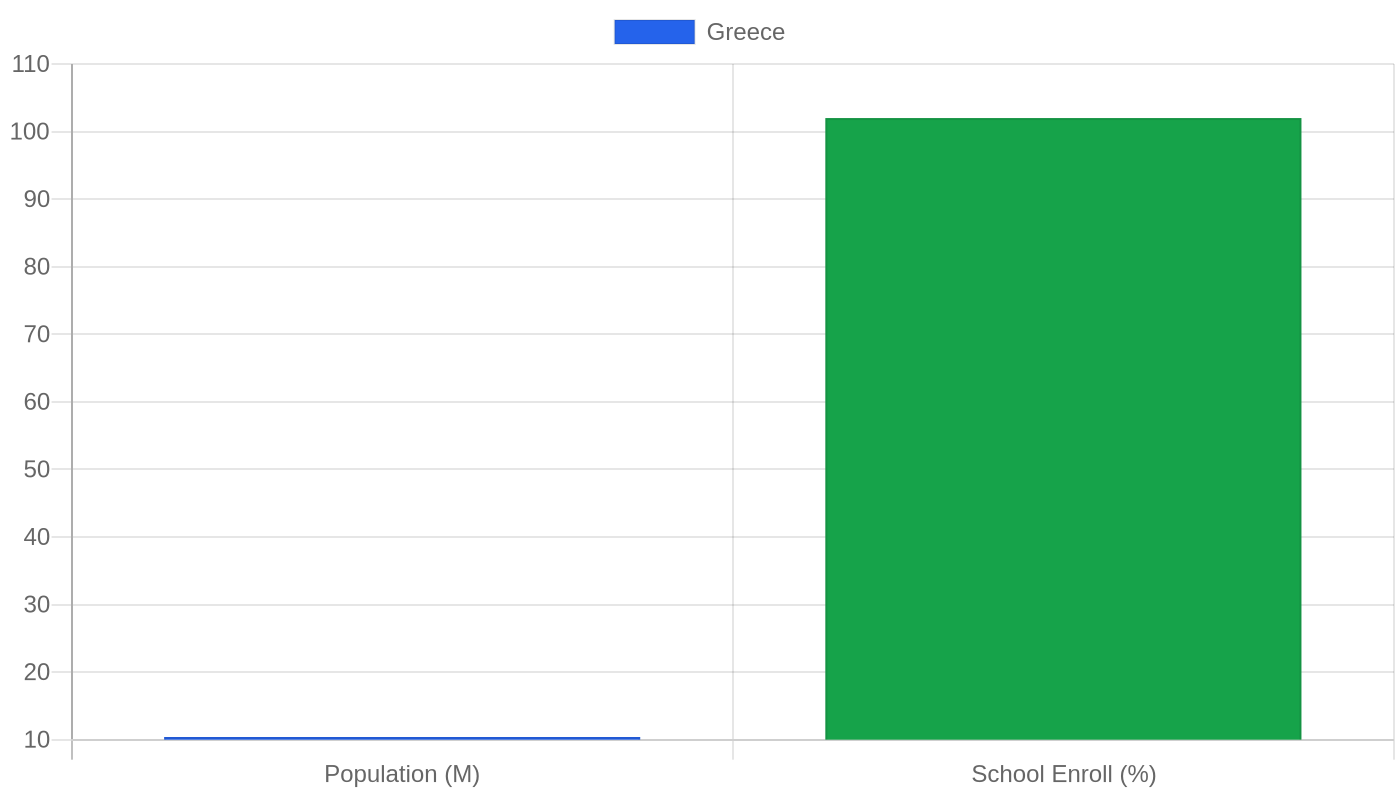
The Greek economy is demonstrating a clear pattern of stabilization, with projections indicating a GDP growth rate of 2.07306882481713% for 2025. This modest but positive expansion suggests that the country has moved beyond the acute phases of crisis management into a period of sustainable development. According to World Bank data, the total GDP stands at approximately $280.6 billion USD, a figure that underscores the scale of economic activity within a population of just over 10.4 million people.
While headline inflation as measured by the CPI sits at 2.48162694360829%, this level is generally considered manageable within the Eurozone context, preserving some purchasing power for households. However, the labor market remains a critical focus; an unemployment rate of 8.54% indicates that while job creation is occurring, significant work remains to fully integrate the workforce.
The disparity between the GNI per capita of $25,360 and the higher PPP-adjusted figure of $45,263.65 highlights the importance of local price levels in determining actual welfare. These numbers matter because they reflect a structural shift toward resilience, where external shocks are absorbed more effectively than in previous decades.
Living Standards: The Reality Behind the Numbers
For residents and potential expatriates, the cost of living in Greece is best understood through the lens of purchasing power parity rather than nominal exchange rates. A GDP per capita (PPP) of $45,263.65 suggests that daily expenses, including housing and food, are relatively affordable compared to other Western European economies with similar nominal incomes.
This high PPP ratio implies that the local currency’s buying power stretches further domestically, allowing citizens to maintain a comfortable lifestyle even if their gross salaries appear modest on international scales. However, with inflation ticking up to nearly 2.5%, consumers are beginning to feel pressure on discretionary spending, particularly in urban centers like Athens and Thessaloniki.
Housing costs, while historically lower than Northern European equivalents, are rising in tandem with tourism-driven demand and foreign investment. The interplay between these factors creates a dynamic where quality of life remains high, but budgeting requires careful attention to emerging price trends in essential goods and services.
Investment Landscape: Corporate Giants and Sector Focus
Greece’s corporate landscape is dominated by established players across consumer services, utilities, and industrials, offering diverse avenues for investment and partnership. Major entities such as ADMIE, the national grid operator, anchor the utilities sector, while Aegean Airlines and Air Mediterranean lead the transportation and consumer services space.
In the retail and consumer goods arena, companies like Alfa-Beta Vassilopoulos and Abea represent the backbone of domestic consumption, catering to a population that values brand loyalty and local availability. Industrial firms such as Aegean Speed Lines and Aegek SA contribute to the broader infrastructure and logistics network, supporting both domestic needs and export capabilities.
Financial services are represented by entities like Aeolian Investment Fund S.A., which plays a crucial role in capital allocation and wealth management. For investors, these top companies signal a mature market where operational efficiency and service quality are paramount. The presence of diversified conglomerates suggests that opportunities exist not only in traditional sectors but also in those undergoing digital transformation and modernization.
Political Framework and Social Climate
The political stability of Greece is rooted in its constitutional framework, which was enacted in 1975 following the fall of the military dictatorship. This document establishes a parliamentary republic with a clear separation of powers among the executive, legislative, and judicial branches, ensuring checks and balances that protect civil liberties.
Further reinforced by amendments in 2001, the constitution provides extensive guarantees for social rights, creating a legal environment that prioritizes individual freedoms and democratic participation. Although specific crime and safety indices are currently listed as N/A, the broader political narrative emphasizes institutional continuity and rule of law. This stability is crucial for maintaining investor confidence and fostering a sense of security among residents.
The absence of recent authoritarian threats or major constitutional crises allows the government to focus on economic reforms and social welfare initiatives. Consequently, the political landscape serves as a stabilizing force, enabling long-term strategic planning without the fear of abrupt policy reversals.
Current Affairs: Momentum and Future Directions
Looking ahead, the focus for Greece is on sustaining growth momentum while addressing lingering structural challenges. The projected 2.07% GDP growth for 2025 reflects ongoing efforts to attract foreign direct investment and boost exports, particularly in tourism and technology sectors. Policymakers are likely concentrating on labor market reforms to further reduce the 8.54% unemployment rate, aiming to create higher-quality jobs that match the skills of the workforce.
Inflation management remains a priority, with central bank policies calibrated to keep the CPI near the 2.5% mark without stifling economic activity. Recent developments suggest a continued emphasis on digital transformation and green energy projects, leveraging EU funding mechanisms to modernize infrastructure. As the country integrates deeper into global supply chains, businesses are adapting to new regulatory environments and consumer expectations.
The interplay between fiscal discipline and social protection will define the next phase of Greece’s economic journey, balancing austerity lessons with inclusive growth goals.
The Bottom Line
Greece presents a compelling case for observers interested in emerging markets with strong institutional foundations and resilient consumer bases. Investors should watch this country closely due to its improving macroeconomic indicators and the strategic position of its leading corporations in key service sectors. The combination of political stability and rising purchasing power makes it an attractive destination for long-term capital deployment.
For professionals and families alike, the balance of affordability and quality of life offers a unique value proposition in the Mediterranean region.
Sources & Methodology
This article is authored by Economic Pulse Net for informational and research purposes. Economic Pulse Net sources its data from multilateral institutions, national statistics bureaus, and proprietary databases. All data is believed to be current as of the date of publication.
Published: October 15, 2026 | Category: Research — Greece
Use these signals in your own platform
Economic Pulse publishes its live signal feed through a documented, read-only API. Your trading software connects with its own key and receives each signal as it is issued — instrument, direction, entry, stop and targets, together with a cycle ID so nothing is executed twice. The feed is independent of this website and cannot change it.
Signals are informational only and are not financial advice.